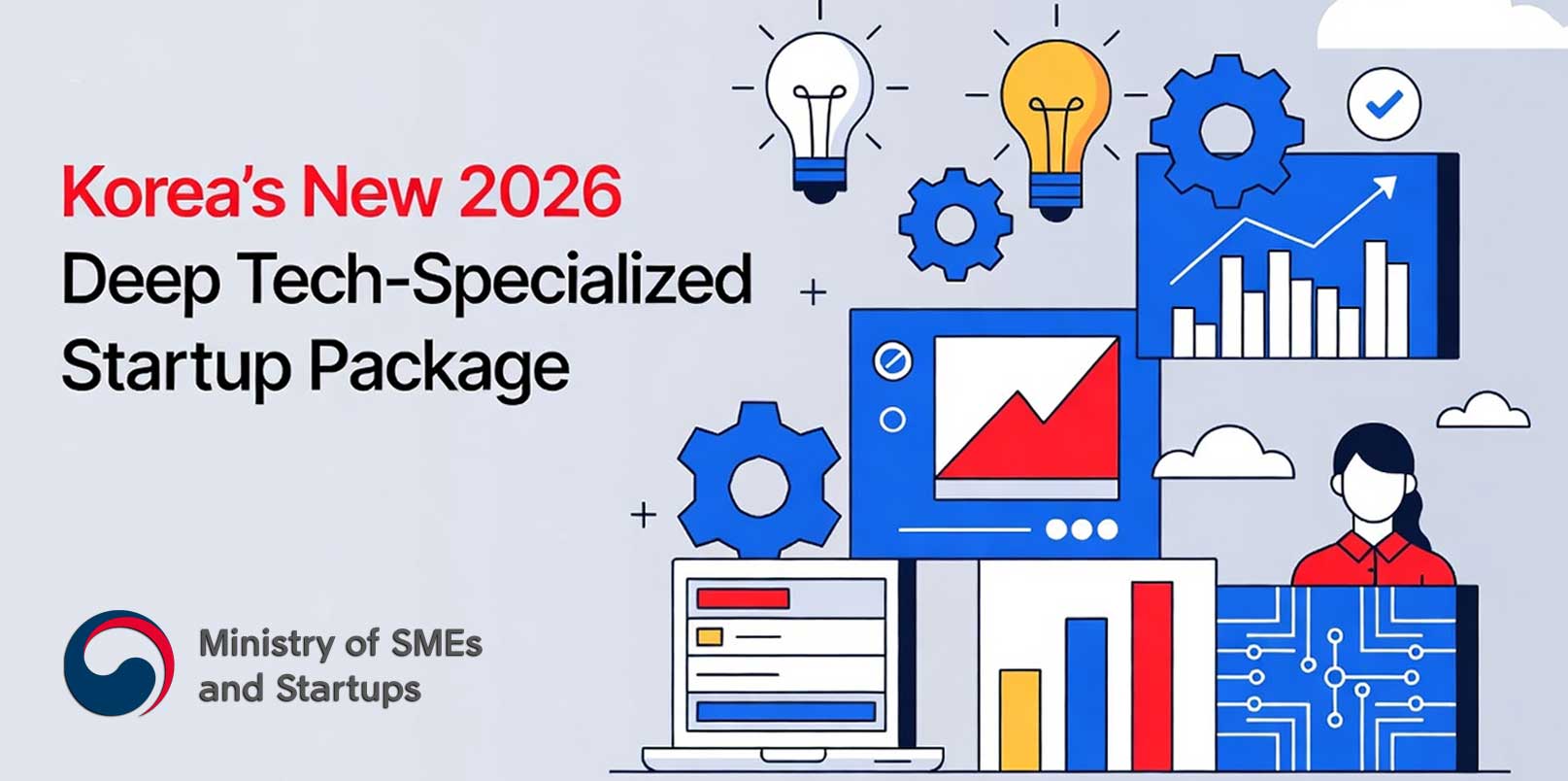
Korea is reshaping its startup finance system into a long-term innovation infrastructure. The Ministry of SMEs and Startups (MSS) has officially launched the 2026 Startup Package Program, beginning with the Deep Tech-Specialized track, signaling a decisive move toward nurturing AI, robotics, and bio-health ventures that demand extended research, validation, and commercialization time.
Through this restructuring, Korea is not simply funding startups—it is building the architecture of its next-generation innovation economy, blending financial support with ecosystem-level transformation that connects capital, technology, and regional balance.
Deep Tech-Specialized Startup Package Opens First Recruitment for 2026
The Ministry began accepting applications on January 6, with submissions open until January 27 at 4:00 PM KST via K-Startup (www.k-startup.go.kr).
The first phase targets 175 deep tech startups, including 100 early-stage companies and 75 scale-up (leap stage) companies, in five strategic technology fields: big data and AI, bio-health, future mobility, eco-friendly energy, and robotics.
Each selected startup will receive commercialization funding and tailored programs based on stage:
- Early Startups (within 3 years): up to KRW 150 million (~ USD 115,000).
- Scale-Up Startups (3–10 years): up to KRW 300 million (~ USD 230,000).
Alongside financial support, MSS and its designated implementing agencies will offer mentoring, investment linkage, technology transfer assistance, and global expansion programs designed specifically for high-complexity sectors.
Background: A Three-Tiered System Becomes Policy Infrastructure
The Startup Package Program is one of Korea’s most comprehensive government-backed initiatives for entrepreneurial growth. It supports companies through three distinct maturity phases:
- Pre-Startup Package (for those in planning stage, preparing to establish a business),
- Early Startup Package (startups established within three years), and
- Startup Leap Package (between three and seven years, extended to ten years for new industries).
Beginning in 2026, the MSS restructured the system into three specialized types:
- Deep Tech-Specialized, focusing on high-technology ventures;
- General, for startups across industries; and
- Investment-Linked, for startups with verified fundraising records.
The Deep Tech-Specialized Package launches first, with the General Package expected in late January and the Investment-Linked version in May.
This segmentation reflects a broader policy intent: to align Korea’s startup support framework with global innovation standards by matching financial aid to the technology readiness level (TRL) and investment maturity of each venture.
Stakeholder Perspective: A Policy Built on Realistic Growth Horizons
The MSS highlighted that deep tech ventures, unlike traditional IT startups, require long-term, patient capital. In its statement, the ministry emphasized that the Deep Tech-Specialized Package was introduced through the 2025 supplementary budget to “thicken the foundation” of Korea’s high-technology startup ecosystem.
An official from the ministry noted,
“Deep tech startups need sustained support to refine technology and achieve commercialization. This stage-specific and region-sensitive program is designed to improve their success rate and accelerate Korea’s transformation into a high-value innovation economy.”
Regional Balance: Lower Burdens, Higher Access for Non-Metropolitan Startups
For the first time, the 2026 Startup Package incorporates a regional preference policy aimed at reducing the economic gap between the Seoul metropolitan area and the rest of the country.
Non-metropolitan startups will benefit from differentiated private contribution ratios, depending on regional classification:
- Special Support Areas: 10% private share (government covers 90%),
- Preferential Support Areas: 20% private share,
- General Areas: 25% private share.
Special Support Areas include 40 rural counties that overlap between population-declining regions and underdeveloped localities in national balance indices. This adjustment is designed to reduce financial strain on early-stage founders outside major cities, fostering a broader geography of innovation.
A Deep Tech Policy Designed for Maturity
The launch of Korea’s 2026 Startup Package reflects a structural shift in national innovation policy—from short-term funding programs to long-horizon ecosystem engineering.
By integrating AI, robotics, bio-health, energy transition, and future mobility under one strategic umbrella, the government is positioning Korea’s startup policy as a platform for industrial intelligence and sustainability. The inclusion of differentiated regional funding ratios and investment-linked pathways also indicates growing alignment with global innovation models seen in Japan, Singapore, and the EU—where policy finance functions as infrastructure, not subsidy.
This signals a more stable and scalable pathway for founders seeking long-term growth, while investors and policymakers gain a clearer view of Korea’s ambition to establish itself as a cross-border innovation hub—linking deep tech development with commercialization-ready capital and regionally distributed industrial clusters.
The initiative also aligns with South Korea’s broader vision to spark a third venture boom and position itself among the world’s top four global venture powerhouses, while reinforcing its ongoing regional development strategy through integrated startup finance and innovation policy.
MSS 2026 Startup Package: Korea’s Policy Transformation
Korea’s 2026 Startup Package marks more than a fiscal cycle; it represents a policy transformation toward an ecosystem that values endurance, sophistication, and inclusion.
By treating startup finance as infrastructure rather than intervention, the Ministry of SMEs and Startups is shaping a model where capital, knowledge, and geography coalesce into a sustainable foundation for high-technology entrepreneurship.
As the Deep Tech-Specialized track begins recruitment, this framework could redefine how Korea’s startup ecosystem attracts both domestic innovators and global partners seeking stability, precision, and depth in Asia’s fast-evolving innovation landscape.
– Stay Ahead in Korea’s Startup Scene –
Get real-time insights, funding updates, and policy shifts shaping Korea’s innovation ecosystem.
➡️ Follow KoreaTechDesk on LinkedIn, X (Twitter), Threads, Bluesky, Telegram, Facebook, and WhatsApp Channel.