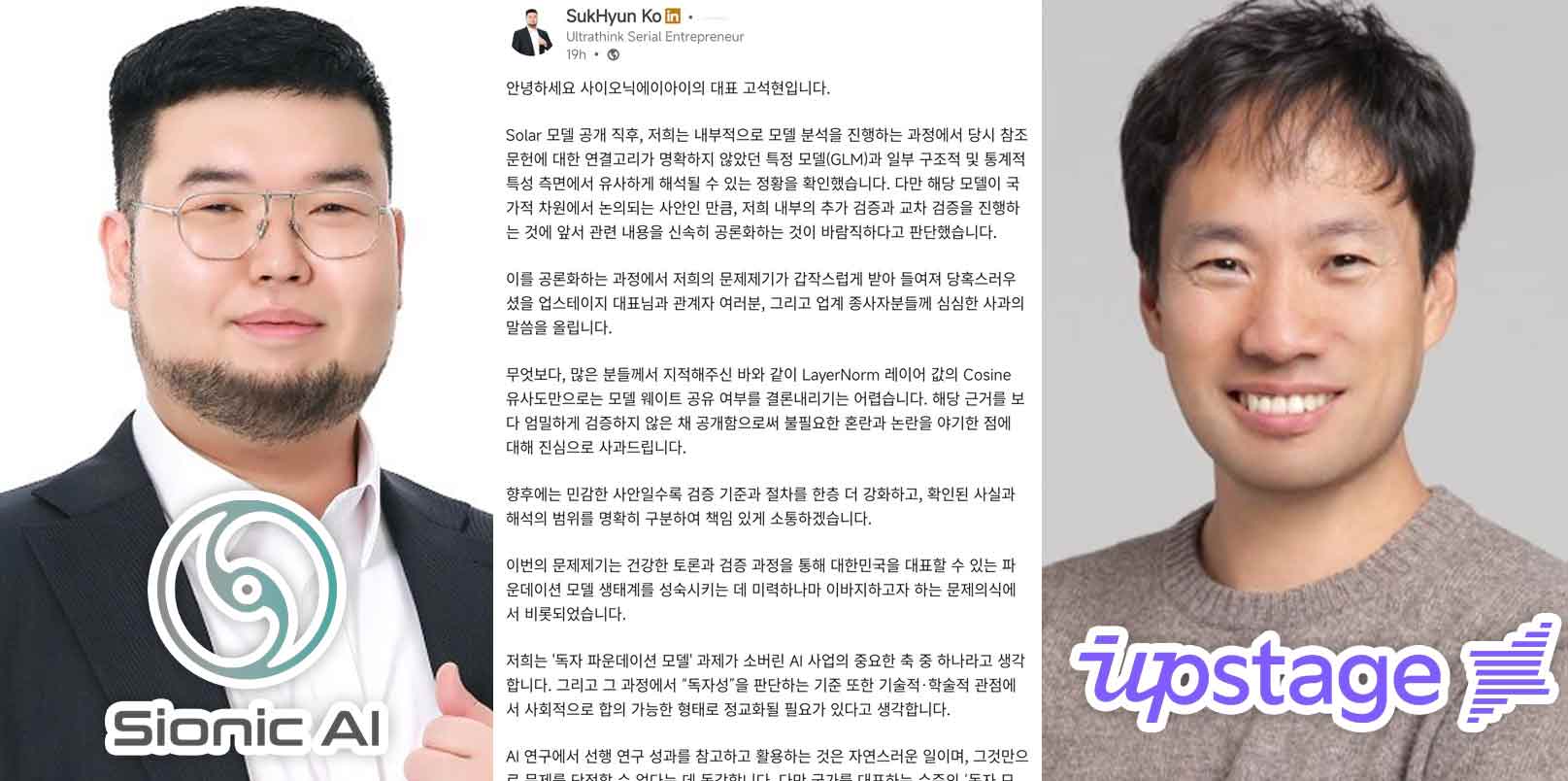
The plagiarism allegations that once put South Korea’s sovereign AI ambitions under scrutiny have now closed with a public apology. The retraction by Ko Suk-hyun, CEO of Sionic AI, to Upstage, represents more than the end of a controversy—it signifies a maturing phase for Korea’s AI ecosystem, where transparency and integrity are no longer optional, but essential pillars of credibility.
Sionic AI CEO Issues Formal Apology for Unverified Allegations Against Upstage
Ko Suk-hyun, who had earlier claimed that Upstage’s Solar Open 100B foundation model showed a 96.8% similarity with China’s ZhipuAI GLM-4.5-Air, officially apologized on January 3 through a social media statement. He admitted that the accusation was made “without sufficient verification,” and that the use of LayerNorm cosine similarity alone was not enough to conclude that any model weights had been copied.
Ko wrote,
“As many have pointed out, it is difficult to determine model weight reuse solely based on LayerNorm cosine similarity. I deeply apologize to CEO Kim Sung-hoon, the Upstage team, and industry colleagues who may have been unsettled by the abrupt allegation.”
He acknowledged that his intent was to “encourage public verification” of models tied to national projects but conceded that the execution lacked the academic rigor such claims require.
Upstage’s Transparency Defense and the Turning Point
The apology followed a public verification session held by Upstage on January 2 in Gangnam, Seoul. CEO Kim Sung-hoon presented internal training logs, checkpoints, and experimental records to prove that Solar Open 100B had been developed from scratch, without using any external pre-trained weights.
Kim explained that similarities observed in LayerNorm values were a statistical phenomenon common among large language models sharing Transformer or Mixture-of-Experts architectures. He also disclosed that only 0.0004% of the model’s parameters showed resemblance to other models, underscoring that 99.9996% of Solar Open 100B was unique.
Upstage’s defense—dubbed by Korean media as the “parenting diary” proof—showcased months of training data that traced the model’s learning progression, reinforcing its originality claim under the government’s Sovereign AI Foundation Model Project.
Sionic AI’s Reflection: “The Ecosystem Must Mature Through Debate”
In his follow-up statement, Ko clarified that his initial motivation stemmed from a desire to strengthen Korea’s AI ethics and transparency standards. He wrote,
“Because the model was part of a national discussion, I believed public scrutiny was necessary. I hoped this would spark healthy debate and verification that could help mature Korea’s foundation model ecosystem.”
Ko, however, used the moment to urge stronger governance in research publishing and open-source transparency. Referring to Upstage’s belated inclusion of ZhipuAI in its license documentation, the CEO noted:
“Clear attribution and verifiable references are essential principles in academic and research ethics, especially for projects representing a nation’s capabilities.”
He concluded by expressing hope that this controversy would lead to “constructive, responsible dialogue” on defining what constitutes an independent AI model and how open collaboration can coexist with sovereign innovation.
Upstage AI Controversy: A Defining Test for Korea’s AI Governance Maturity
The resolution of this dispute marks a watershed moment for Korea’s AI ecosystem. What began as a technical disagreement over model similarity has evolved into a larger discussion on AI governance, transparency, and accountability.
Korea’s push for sovereign AI—anchored in the Ministry of Science and ICT’s foundation model initiative—requires startups and research institutions to maintain scientific integrity equal to that of their global counterparts. Experts note that how the country manages controversies like this will determine the credibility of its sovereign AI strategy abroad.
The episode also highlights how Korean startups are learning to navigate public scrutiny with professionalism. Instead of escalating into legal conflict, both parties—Upstage and Sionic AI—demonstrated restraint, paving the way for a culture of open verification over accusation.
The Rise of Ethical AI as Korea’s Competitive Edge
The Upstage – Sionic AI contoversy underscores that the strength of Korea’s AI future will depend not only on algorithms, but on ethical resilience. Sovereign innovation must be paired with transparent governance to earn global trust.
As Korea’s AI ecosystem accelerates toward commercialization and international competition, this moment serves as a reminder that technological independence without integrity is hollow. The maturity shown in resolving this dispute may ultimately prove more valuable to Korea’s long-term credibility than any single model or milestone.
🤝 Looking to connect with verified Korean companies building globally?
Explore curated company profiles and request direct introductions through beSUCCESS Connect.
– Stay Ahead in Korea’s Startup Scene –
Get real-time insights, funding updates, and policy shifts shaping Korea’s innovation ecosystem.
➡️ Follow KoreaTechDesk on LinkedIn, X (Twitter), Threads, Bluesky, Telegram, Facebook, and WhatsApp Channel.