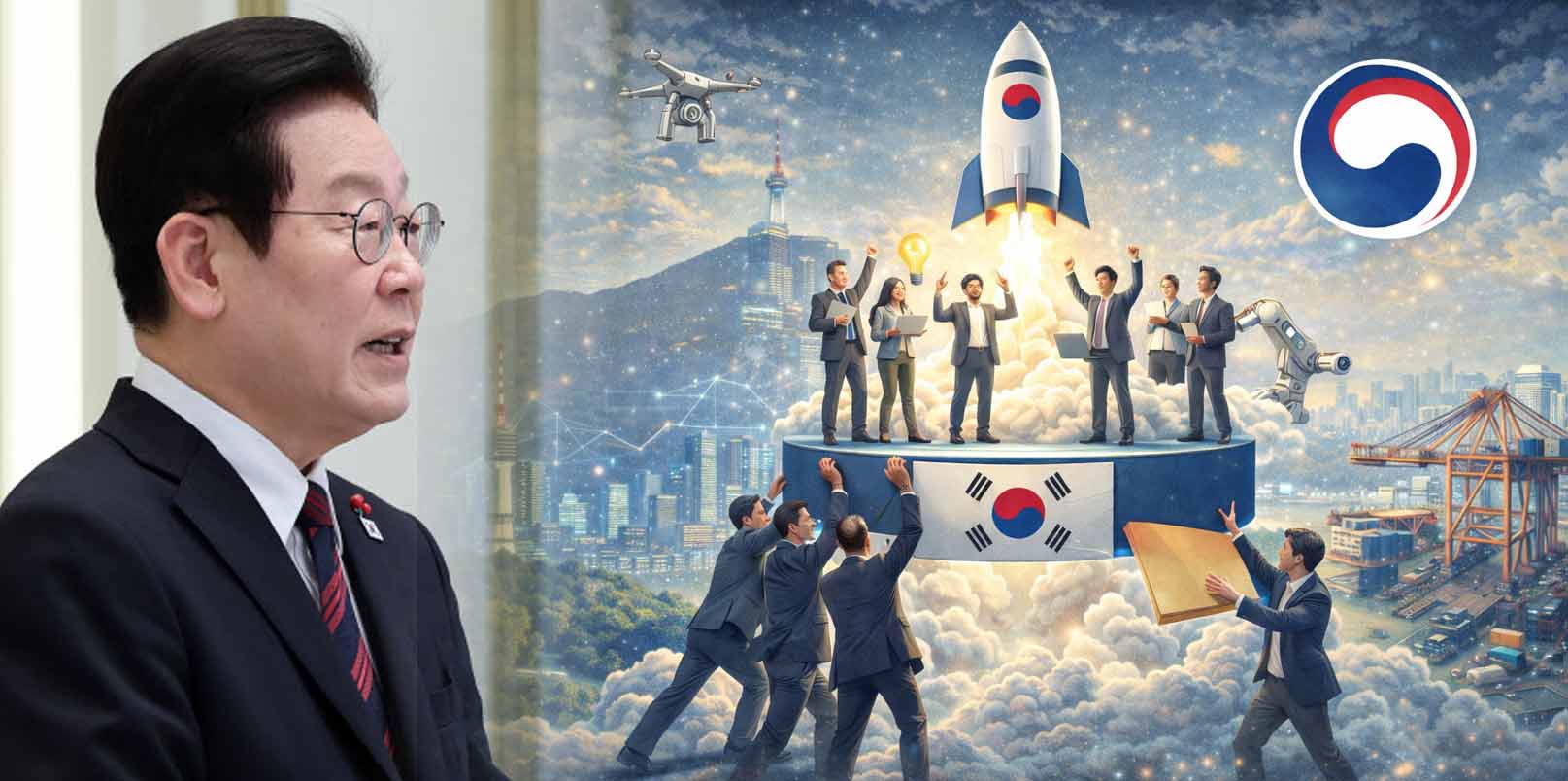
Another announcement in Korea’s 2026 policy agenda signals beyond just an economic reset but also marks a cultural redefinition of ambition. By placing startups and founders at the center of national growth, Seoul is moving to replace inherited hierarchies with creative ownership. The shift toward startup-centered economy challenges decades of conglomerate dominance and positions entrepreneurship as the new engine driving Korea’s next wave of technological and global expansion.
Korea’s Economic Vision Enters a New Era of Entrepreneurship
In his 2026 New Year’s address, President Lee Jae-myung declared that Korea will shift its national growth strategy toward a “startup-centered society.” The announcement signals a structural transformation of the country’s innovation policy: from a model long dominated by large conglomerates to one led by founders, venture capital, and open innovation.
The message has drawn strong approval across Korea’s venture and startup communities, which view the move as a bold and timely commitment to rebalancing economic opportunity and driving sustainable growth through entrepreneurship.
Venture and Startup Leaders Applaud the President’s Declaration
Following the address, the Korea Startup Forum (KOSPO) issued an official statement welcoming the initiative, calling it “a decisive and visionary step for Korea’s economic future.”
The forum praised the President’s plan to replace “growth concentrated in a few major conglomerates” with a model of “growth shared by all.”
KOSPO said the administration’s recognition of startups as the core agents of innovation and its pledge to build an environment where founders can take bold risks without fear would provide vital momentum for the country’s innovation economy.
The Korea Venture Capital Association (KVCA) also voiced support, describing the policy as evidence of the government’s strong will to “transform Korea into one of the world’s top four venture powerhouses.”
KVCA Chairman Kim Hak-gyun said the New Year’s address reaffirmed the state’s commitment to building an ecosystem where entrepreneurs and investors can collaborate under clear, predictable conditions for innovation.
National Growth Fund at the Center of Korea’s 2026 Innovation Drive
Much of the enthusiasm surrounding the announcement centers on the National Growth Fund, a large-scale public financing vehicle launched to catalyze Korea’s next innovation cycle. The KRW 150 trillion fund is designed to inject liquidity into the KOSDAQ and venture investment markets, while attracting private capital into early- and mid-stage startups.
Industry leaders described the fund as the “priming water” for Korea’s innovation economy, expected to establish a virtuous cycle of investment, growth, and reinvestment that distributes outcomes more equitably across society.
Both KOSPO and KVCA stressed that the fund’s long-term success will depend on practical implementation—calling for regulatory innovation and real-world policy execution that reflect the realities of startup financing and scaling.
Beyond ‘Startup-Centered Society’ Policy: A Call for Cultural and Structural Transformation
President Lee’s remarks emphasized that Korea must evolve “from an employment-centered to a startup-centered society,” promising to build a nation where failure becomes an asset and “any idea can grow into a startup.”
The message resonated strongly across the startup ecosystem. Leaders described it as both an economic and cultural turning point, reflecting a vision of entrepreneurship not as risk, but as resilience.
The President’s five strategic pillars for Korea’s next phase—regional-led growth, shared prosperity, safety-based sustainability, culture-driven appeal, and peace-backed stability—frame entrepreneurship as the core mechanism that binds them together.
Why the Shift Matters for Korea’s Global Startup Ambition
This declaration is more than an economic policy as it aligns with the Korea’s ambition to become one of the world’s top global venture powerhouse. For years, the country’s innovation economy has been shaped by strong manufacturing, ICT, and chaebol-centered frameworks. The new focus on founders, early-stage capital, and open entrepreneurship marks a strategic alignment with global innovation trends seen in Singapore, Japan, and the United States.
By fostering startup creation and mobilizing both public and private investment, Korea aims to expand its deeptech, AI, and energy transition sectors—domains seen as critical for regional competitiveness.
Now with the official announcement of Korea’s venture powerhouse masterplan and the President’s pledge to place startups and innovation at the center of the country’s economy, the success of this pledge and policy could determine how effectively the nation diversifies beyond export-heavy industries and builds globally scalable technology firms.
Turning ‘Startup-Centered Society’ Vision into Execution
The President’s call for a “startup-centered society” will be measured not by its rhetoric but by how swiftly Korea translates this vision into regulatory, financial, and cultural infrastructure that enables sustainable entrepreneurship.
As Korea enters 2026, its startup ecosystem stands at a defining crossroads. The alignment between government policy and private initiative offers unprecedented potential—if execution matches ambition. For investors and founders watching across Asia, this may well be the year when Korea’s innovation economy begins its most significant transformation yet.
– Stay Ahead in Korea’s Startup Scene –
Get real-time insights, funding updates, and policy shifts shaping Korea’s innovation ecosystem.
➡️ Follow KoreaTechDesk on LinkedIn, X (Twitter), Threads, Bluesky, Telegram, Facebook, and WhatsApp Channel.
🤝 Looking to connect with verified Korean companies building globally?
Explore curated company profiles and request direct introductions through beSUCCESS Connect.