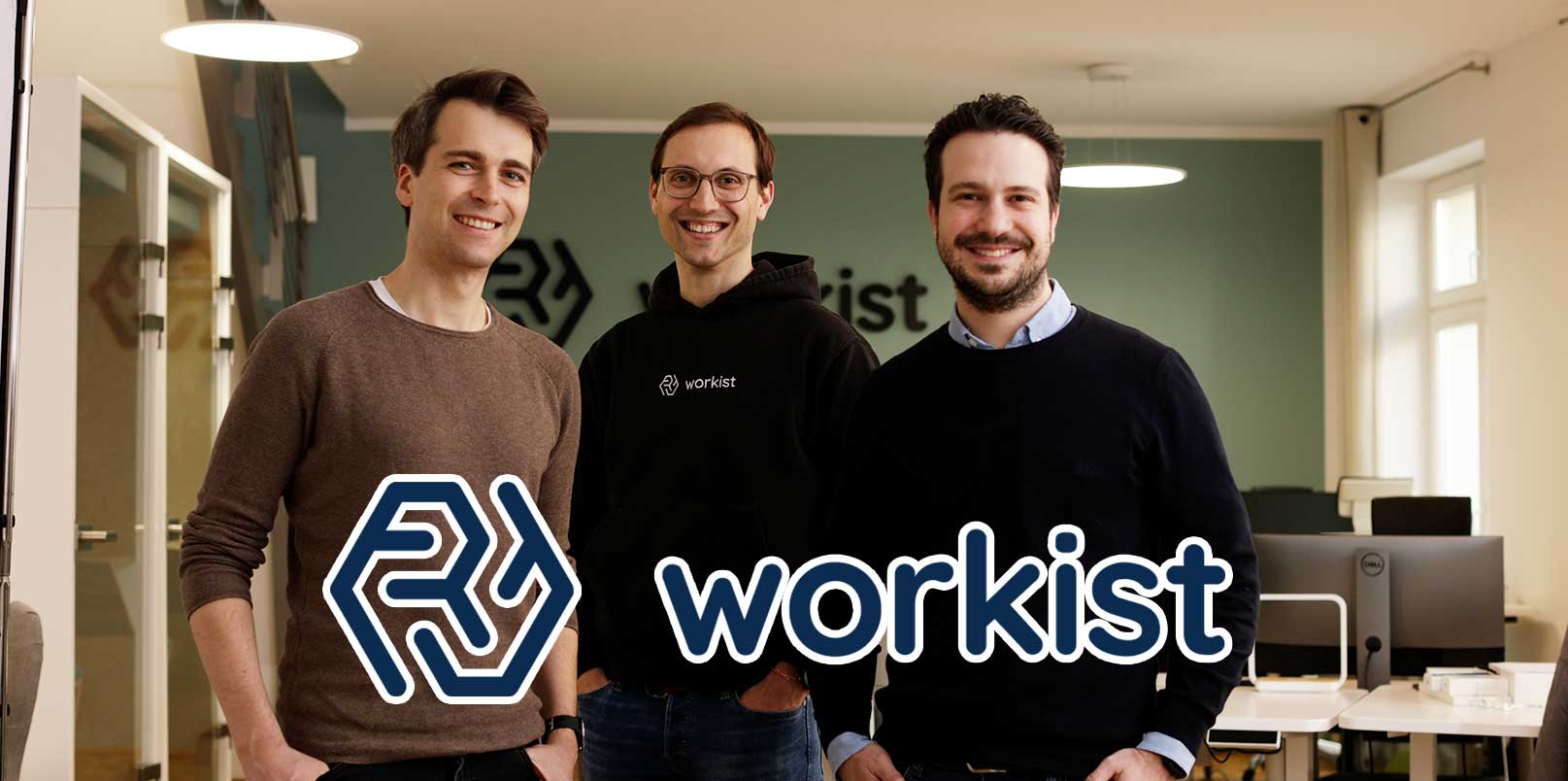
Factories may hum with automation, but the back offices behind them still rely on human keystrokes. Order entries, invoice checks, and email-based workflows quietly slow even the most advanced manufacturers. Workist, a Berlin-based AI automation company founded by Tim Wegner and Alexander Müller (Co-CEOs) with Dr. Fabian Brosig (CTO), is changing that reality.
By combining deep expertise in consulting, machine learning, and database engineering, the team is bridging advanced AI with real-world enterprise needs — redefining what efficiency means in the modern industrial era.
In this exclusive interview, the founders explain how Workist is closing the world’s productivity gap — and why Korea may become its next major growth frontier as the company progressed as one of the Top 40 Startups of K-Startup Grand Challenge 2025.
“After KSGC, we gained valuable exposure to Korean manufacturers and advisors, helping us validate local requirements—and now partners increasingly tell us, ‘Oh, Workist, I’ve heard of your automation solution,’ and we are proud of that.”
Workist: Automating the Work That Automation Forgot
Q1. What motivated you to start this company, and what core problem were you trying to solve?
The idea for Workist grew out of countless conversations with manufacturers and wholesalers. Whenever we asked about their biggest operational challenge, the answer was almost always the same:
“Production is automated, but order entry and other manual administrative work still consume too much of our team’s time.”
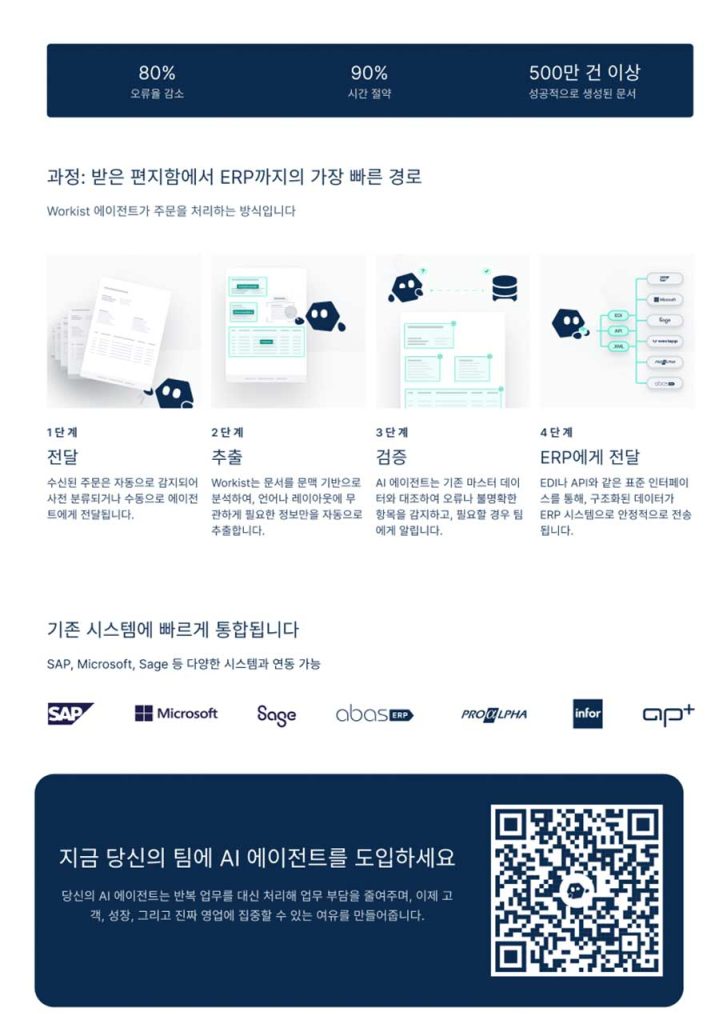
Across industries, skilled sales and procurement professionals spend hours each day transferring data from emails, PDFs, and spreadsheets into outdated ERP systems.
Although essential for revenue flow, this work is manual, slow, and prone to errors. We realized this was more than just a productivity issue: it was also a structural barrier to growth, resilience, and competitiveness.
Today, we’re at an inflection point where AI can reliably automate routine administrative work, just as earlier technologies transformed physical labor. When order entry and other repetitive tasks are handled by AI agents, people regain the capacity to focus on what truly drives value: building relationships, generating new business, and making informed decisions. Companies can scale despite workforce constraints, improve both team and customer experiences, and enable meaningful digital upskilling.
Therefore, Workist was founded to make this shift practical and accessible. We have a simple but powerful mission: to free teams from repetitive work so they can concentrate on tasks that create lasting impact.
Why Korea Could Become the Model for Human-AI Collaboration for Workist
Q2. What opportunity or unmet need did you identify in the Korean market, and what early signals convinced you that your solution could gain real traction here?
Korea stands out as one of the world’s most innovation-driven economies, home to an advanced manufacturing sector that is now confronting familiar structural challenges—shrinking workforce numbers, rising labor costs, and escalating global competition.
In early discussions with Korean manufacturers and distributors, one message came through clearly: administrative workload is growing faster than the availability of skilled staff. Teams face mounting manual volumes, increasingly complex product catalogs that drive higher error rates, and global software tools that fail to accommodate Korean workflows or file formats such as HWP.
A strong early signal came from our global rollouts across 36 countries, where Korean teams emerged as some of the most enthusiastic adopters. Several participants shared that they felt “finally included” in a software deployment that truly addressed their specific needs—a response we had not seen as strongly anywhere else.
These insights confirmed both the urgency of the problem and Korea’s readiness for a reliable, fully integrated back-office automation solution like Workist.
Localizing Intelligence: What Global SaaS Often Gets Wrong
Q3. During KSGC, were there any mentors, partners, or specific insights that significantly influenced your product or strategy?
One of the most valuable insights we gained during KSGC came from early discussions with Korean advisors, system integrators, and potential partners. They helped us understand why many global SaaS solutions struggle—or fail—to establish a foothold in Korea. The challenge is rarely about demand; it is more about localization.
Many global tools overlook Korea’s specific document formats, workflows, and integration requirements. This realization was pivotal. It confirmed that demand for back-office automation in Korea is strong, but adoption depends on building solutions that respect how Korean teams actually operate—not just translating an interface.
In response, we enhanced our Korean UI elements, added native support for formats like HWP, and refined our integration strategy to align seamlessly with local ERP systems. As one mentor summarized it perfectly, “Companies here are ready for automation, but only if the solution genuinely works for Korea.”
This perspective guided our strategy toward local partnerships, deeper product adaptation, and building long-term trust from the very start.
From Trust to Traction: The KSGC Effect
Q4. After joining KSGC, what has been the most meaningful change for your company and what evidence supports this growth?
The most meaningful change for Workist after joining the K-Startup Grand Challenge program has been the acceleration of our Asia market readiness, both strategically and product-wise. The program gave us valuable exposure to Korean manufacturers, distributors, and advisors, helping refine our understanding of local requirements and validate key market assumptions.
A major insight that emerged early on was the critical importance of true localization. Based on this, we refined several product components, including our Korean UI, native support for regional formats such as HWP, and font compatibility to ensure a seamless experience for Korean users and ERP environments.
KSGC also helped us build early momentum in another crucial aspect: credibility. Being selected for the program serves as a clear trust signal when approaching Korean companies. Multiple stakeholders mentioned that KSGC participation demonstrates commitment and reliability. And it’s opening doors to conversations with manufacturers, IT service providers, and potential integration partners.
In parallel, Workist’s global growth and recognition continued to accelerate. Today, we serve more than 170 customers worldwide, connecting over 100,000 companies through our platform and processing more than 15 trillion KRW in GMV annually.
Increasingly, we hear, “Oh, Workist—I’ve heard of your automation solution,” at the start of new conversations, which makes us incredibly proud.
These developments, combined with insights from KSGC, have reinforced our conviction that Korea represents a highly receptive and strategically important market for Workist’s continued expansion.
The Future of Work Isn’t About Replacing People—It’s About Reclaiming Time
Q5. Looking ahead, what is the most important vision or long-term goal your company aims to achieve, and what steps are you taking to move toward it?
Workist’s long-term vision is to reshape the future of work by making global trade more frictionless by enabling truly touchless order cycles. We envision a world where administrative tasks no longer slow teams down—where AI agents handle complex data processing with reliability, and people can focus on judgment, creativity, and meaningful human interaction.
To realize this vision, we are building Workist as a global AI backbone for back-office automation. Our platform already processes documents in over 40 languages, and we see this as only the beginning. Our goal is to support any document, in any format, across any market, enabling companies to operate globally without being constrained by manual workflows, region-specific formats or language barriers.
Our strategy centers on three priorities:
- End-to-end process automation.Expanding beyond data extraction and validation to enable fully seamless order cycles, including outbound email handling and intelligent order insights.
- Enterprise-grade reliability.Enhancing accuracy, security, and integration depth—backed by SOC 2 Type 2 certification and partnerships with major ERP providers.
- Global expansion through local ecosystems.Working closely with trusted partners in Korea, Japan, and the United States to ensure deep localization and sustainable adoption.
Ultimately, our ambition is to remove administrative friction worldwide, empowering companies to scale, innovate, and compete at their full potential.
In the broader story of industrial transformation, Workist isn’t just automating data entry — it’s rewriting how knowledge work functions in an AI-driven world. And in Korea, where innovation meets precision, that vision is finding fertile ground.
About This Series
This article is part of the “K-Startup Grand Challenge 2025 Interview Series,” featuring 40 global startups from Phase 2 of Korea’s leading accelerator program. The series highlights how international founders are scaling innovation through Korea’s startup ecosystem.
Read more stories from the K-Startup Grand Challenge 2025 Interview Series on KoreaTechDesk.
– Stay Ahead in Korea’s Startup Scene –
Get real-time insights, funding updates, and policy shifts shaping Korea’s innovation ecosystem.
➡️ Follow KoreaTechDesk on LinkedIn, X (Twitter), Threads, Bluesky, Telegram, Facebook, and WhatsApp Channel.
🤝 Looking to connect with verified Korean companies building globally?
Explore curated company profiles and request direct introductions through beSUCCESS Connect.