Korea’s innovation economy is reaching a moment that demands recalibration. Global protectionism is reshaping trade routes, AI is redefining how value is created, and pension fund capital is poised to alter venture finance itself. For Korean startups and SMEs, 2026 will test not just resilience but adaptability—how well they align technology, policy, and purpose to sustain growth in a shifting global order.
Korean SMEs Enter Structural Transition as KOSI Identifies 2026’s Ten Key Issues
At the close of 2025, Korea’s small and medium enterprise (SME) and startup ecosystem stands at a defining inflection point. The Korea Small Business Institute, also known as Korea Institute for SMEs and Startups (KOSI), has outlined Top 10 Issues for SMEs and Small Business Owners in 2026, highlighting the urgent need for export diversification, AI-driven industrial transformation, and institutionalized pension fund venture investment to secure long-term competitiveness.
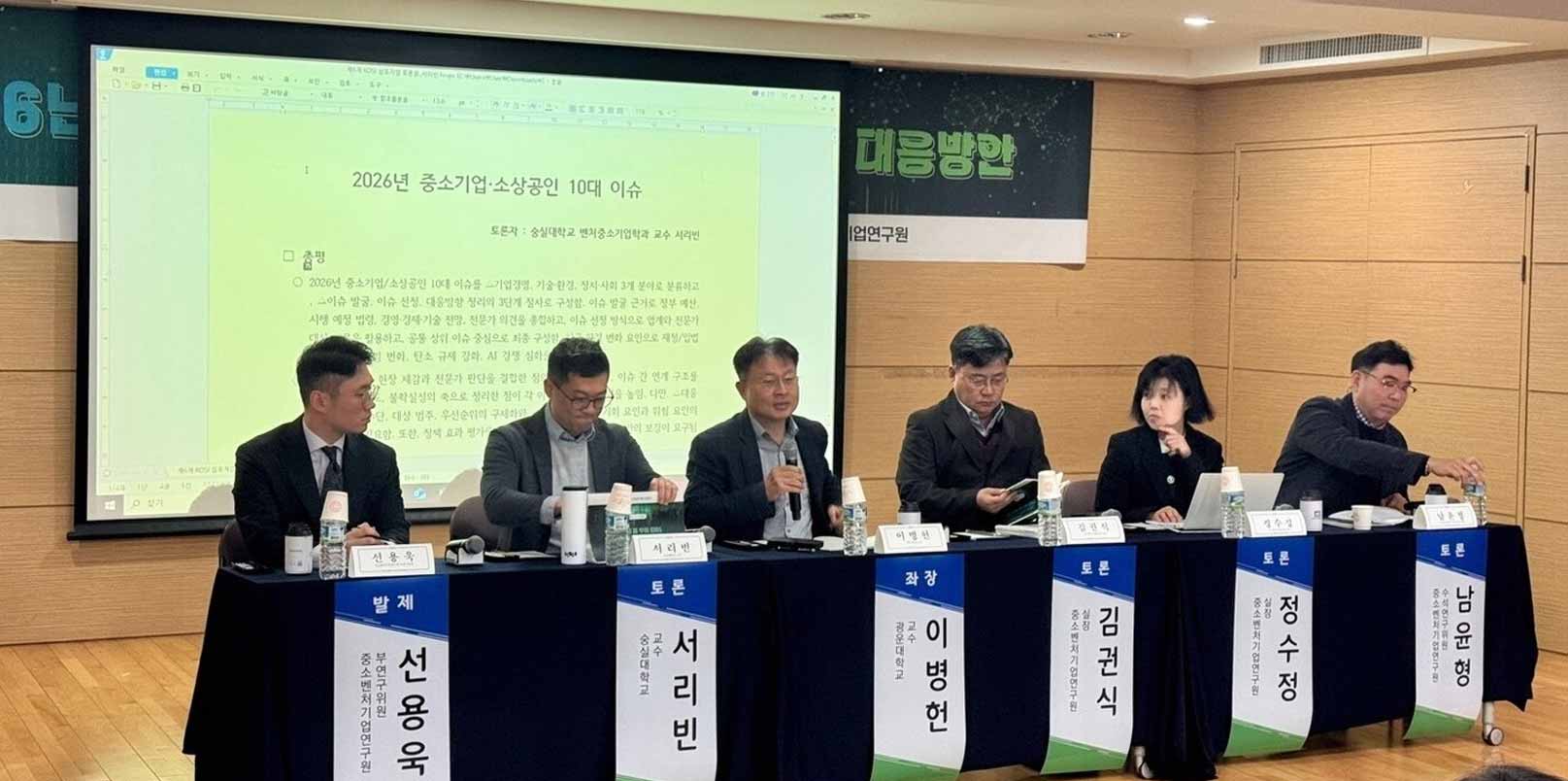
Derived through a survey of small business owners, experts, as well as startups and SMEs, the findings were announced at the 6th KOSI Symposium held in Seoul on December 29, where policymakers, academics, and industry experts agreed that Korean SMEs are entering a structural transition phase amid global protectionism, domestic regulatory expansion, and accelerating digital disruption.
2026 SME Agenda: Export Diversification, AI, and Institutional Investment
The symposium’s analysis identified ten major issues against Korea’s small business, startups and SMEs across three domains — corporate management, technology and environment, and political and social structure.
In corporate management, KOSI emphasized:
- Diversification of export structures as U.S.–China trade and global protectionism intensifies;
- Institutionalization of pension fund venture investments, channeling new long-term capital into innovation sectors;
- Expansion of global sales bases for small businesses to reduce domestic dependency;
- Structural reforms in business operations to enhance resilience and efficiency.
Under technology and environment, the focus shifted to:
- Bridging digital adoption gaps among companies;
- Strengthening climate response and green transition capacity.
Meanwhile, political and social priorities included:
- Expanding Labor Standards Act coverage to microbusinesses;
- Implementing a gradual statutory retirement extension;
- Addressing AI-driven changes in employment and workplace structures;
- Ensuring fair competition in digital platform ecosystems.
Expert Insights: Balancing Reform with Risk
KOSI’s Senior Fellow Seon Yong-wook stated that the geopolitical environment demands immediate strategic adjustment,
“With the U.S. and China reinforcing domestic-first policies, 2026 is a critical moment for SMEs to diversify export portfolios. Tailored policy support, such as institutionalized pension fund venture investment and overseas market expansion for small businesses, will be essential.”
Professor Seo Ri-bin of Soongsil University highlighted both the opportunities and risks of mobilizing pension funds into venture capital,
“The expectation for growth capital expansion is significant, but potential conflicts between fiduciary duty and policy goals remain. A phased cap structure, indirect investment focus, and standardized performance data will be key safeguards.”
Director Kim Kwon-sik of KOSI’s Startup and Venture Innovation Office stressed that SMEs’ competitiveness depends on AI adoption and on-site digital transformation:
“We must move beyond uniform software support. The next phase requires robotics, automation, and AI talent development tailored to industrial demand.”
Director Jung Soo-jung, from the Small Business and Coexistence Division, called for a global mindset in small business strategy:
“Traditional markets and commercial districts can evolve into ‘mini duty-free zones’ if tourism, taxation, and transport policies are integrated. Practical mechanisms are urgently needed to protect small businesses as platform fairness legislation progresses.”
Policy Context: A Structural Turning Point for Korea’s Innovation Economy
KOSI President Cho Joo-hyun summarized that Korea’s SME ecosystem is now facing systemic, not cyclical change, noting:
“High interest rates, inflation, and demographic shifts have permanently altered Korea’s business environment. We must move beyond short-term policy responses and establish forward-looking frameworks that anticipate structural risks.”
He emphasized that export diversification, AI-driven transformation, and institutional capital formation are the foundation of Korea’s next growth phase — one that connects small enterprises and startups to a more balanced and innovation-oriented economy.
Korea’s Policy Shift in Motion for Small Business, Startups and SMEs
The ten-issue framework proposed by KOSI signals a new stage in Korea’s industrial and startup policy evolution. If implemented effectively, the integration of pension fund capital into venture markets could introduce tens of trillions of won annually into innovation investment. Meanwhile, digital transformation and AI upskilling could reduce the productivity gap between small and large firms — a persistent weakness in Korea’s industrial structure.
However, experts cautioned that the success of these initiatives depends on regulatory coherence and sustained collaboration between government, academia, and industry. Korea’s SME policy is no longer about short-term stabilization; it is about building global competitiveness through structural modernization.
Navigating 2026 Startups and SMEs: Turning Policy Insight into Global Competitiveness
KOSI’s findings make clear that 2026 is not simply another fiscal year, but a strategic transition period for Korea’s innovation economy. The next twelve months will determine how well Korean SMEs adapt to global market fragmentation, technological acceleration, and labor transformation.
If Korea succeeds in aligning capital flow, technology adoption, and export structure, its startup and SME ecosystem could shift from reactive adaptation to proactive global leadership — a model that balances national innovation policy with global economic reality.
🤝 Looking to connect with verified Korean companies building globally?
Explore curated company profiles and request direct introductions through beSUCCESS Connect.
– Stay Ahead in Korea’s Startup Scene –
Get real-time insights, funding updates, and policy shifts shaping Korea’s innovation ecosystem.
➡️ Follow KoreaTechDesk on LinkedIn, X (Twitter), Threads, Bluesky, Telegram, Facebook, and WhatsApp Channel.