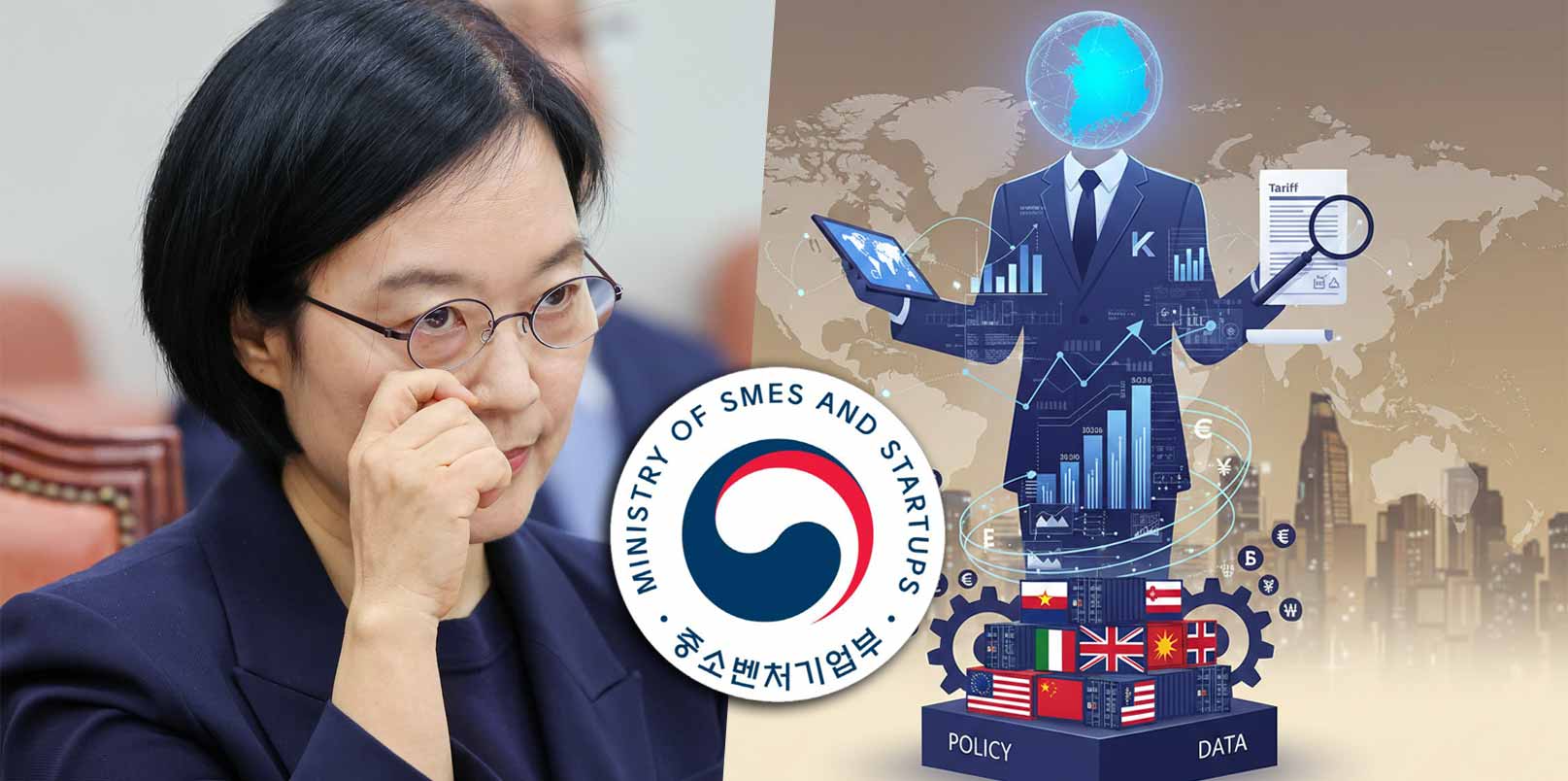
Amid rising global trade uncertainties, Korea is tightening its export foundation for small and medium-sized enterprises (SMEs). The Ministry of SMEs and Startups (MSS) has introduced new personnel and a data-driven “Export Specialist” role to navigate escalating tariff disputes and currency volatility — a move signaling the government’s growing emphasis on structured, evidence-based export policy.
MSS Expands Export Team to Address Trade Pressures
The Ministry of SMEs and Startups (MSS) is reinforcing its export division by adding two new officers and a professional “Export Specialist” position within its Global Growth Policy Bureau.
According to the government’s announcement on December 22, the expansion aims to strengthen export assistance, improve tariff response, and support data management as part of Korea’s broader export competitiveness strategy.
The newly added officers — one at Grade 5 and one at Grade 6 — will focus on export support programs, customs coordination, and policy execution. The team will oversee areas including global market entry, logistics, online exports, and strategic sectors such as K-beauty, which remains a key consumer export pillar.
Officials explained that as export policies and tariff-related countermeasures increase in frequency, the volume of work has surpassed current manpower capacity.
An official from the Global Growth Policy Bureau stated:
“This year alone, we had to handle multiple tariff issues and export countermeasures, along with their follow-up actions. Combined with tasks like online export expansion, the workload exceeded what our current manpower could manage. Strengthening the team is a minimal but necessary measure to ensure stability and continuity in export operations.”
Strengthening Data-Driven Export Policy with Dedicated Specialist
In a structural first, the MSS is introducing a full-time Export Specialist within its headquarters in Sejong. The role, classified as a professional officer-level public service position, will focus on export data management, trade statistics compilation, and performance analysis — all critical inputs for SME export policymaking and strategy development.
Recruitment is currently under way, with appointment scheduled for early 2026.
The ministry stated that the addition reflects growing demand for specialized analytical capabilities to track export trends systematically and align statistical evidence with ongoing policy measures.
An official from the Global Growth Policy Bureau noted that the decision follows months of intensive tariff negotiations and export plan implementations, which revealed the need for stronger data governance to support follow-up actions and future planning.
Global Protectionism Raises Stakes for Korean Export Policy
The ministry’s timing is significant. Korean exporters are currently navigating a complex web of global trade barriers — from the European Union’s Carbon Border Adjustment Mechanism (CBAM) and recent U.S. tariffs to Vietnam’s anti-dumping duties imposed in response to global protectionist shifts.
For a country with a limited domestic consumer base, global markets remain the only viable growth channel for its startups and SMEs. Yet the current wave of tariffs and retaliatory measures exposes Korea’s structural vulnerability: its export-driven economy is too externally dependent to withstand prolonged protectionist pressure without policy adaptation.
The new Export Specialist role alone will not resolve these challenges. However, it represents an institutional acknowledgment that data precision, policy agility, and trade intelligence are now essential tools in countering protectionism. After years of criticism that Korea’s SME policy framework lagged behind fast-changing global trade conditions, this move signals a step toward proactive, rather than reactive, export governance.
Part of Korea’s Broader 2026 Export Strategy
The reorganization aligns with MSS’s broader 2026 agenda presented during its presidential policy briefing to President Lee Jae-myung.
Key initiatives include:
- Expanding consumer-goods exports, especially in K-beauty and lifestyle sectors,
- Launching a K-Export Pioneering Mission to explore new overseas markets,
- Enacting the SME Export and Overseas Expansion Promotion Act, and
- Identifying high-potential online export items for next-generation global commerce.
These policies highlight the government’s intent to balance traditional manufacturing exports with digital and consumer-centric trade growth, backed by real-time data and performance analytics.
Record-High SME Export Growth Reinforces Timing
According to the MSS Q3 2025 SME Export Trends report, SME exports reached US $30.5 billion in the third quarter — an 11.6 percent increase year-on-year, marking the highest third-quarter performance on record.
Between January and September, cumulative exports hit USD 87.1 billion, up 5.8 percent from 2024, while the number of exporting SMEs rose to 89,418, a 3 percent increase.
These results underscore why the ministry is prioritizing export governance capacity. Sustained export growth now depends not only on market performance but also on the government’s ability to manage data, anticipate trade barriers, and align SME strategies with shifting global supply chains.
Building a Smarter Export Infrastructure with New Export Specialist
For Korea’s startup and SME ecosystem, the establishment of the Export Specialist marks a step toward institutionalized export intelligence — a move that transforms fragmented trade responses into coordinated, data-led policy action.
The initiative strengthens Korea’s position as a mid-sized export power driven by digitalization, product diversification, and regional trade agility.
It also suggests a potential model for other emerging economies: pairing trade policy with real-time analytics to help SMEs withstand external shocks such as tariff disputes and exchange-rate volatility.
Toward Smarter Growth for Startups and SMEs Navigating Cross-Border Expansion
As global trade becomes increasingly data-dependent, Korea’s investment in export expertise signals a strategic pivot toward smarter, evidence-driven growth. For startups and SMEs navigating cross-border expansion, this shift means stronger institutional backing, more reliable export data, and clearer policy pathways.
This export specialist appointment is a crucial step to show that South Korea is not only protecting its exporters from immediate shocks but also engineering a long-term, intelligence-based export ecosystem to sustain competitiveness in 2026 and beyond.
– Stay Ahead in Korea’s Startup Scene –
Get real-time insights, funding updates, and policy shifts shaping Korea’s innovation ecosystem.
➡️ Follow KoreaTechDesk on LinkedIn, X (Twitter), Threads, Bluesky, Telegram, Facebook, and WhatsApp Channel.
🤝 Looking to connect with verified Korean companies building globally?
Explore curated company profiles and request direct introductions through beSUCCESS Connect.