In today’s hyperconnected world, logistics still suffers from an age-old problem: businesses can track shipments, but not the individual items inside them. Indonesian startup TaggIoT, founded by Hendriansyah, a BeVisioneers Fellow and University of Leeds graduate with years of experience in global supply-chain operations, wants to end that visibility gap.
In this exclusive KoreaTechDesk interview, Hendriansyah explains how TaggIoT’s ultra-thin IoT tags are redefining what “traceability” means—transforming item-level data into actionable sustainability intelligence—and how the company’s growth in KSGC 2025 is accelerating its vision to make every shipment measurable, accountable, and environmentally responsible.
“KSGC created a turning point for TaggIoT for product maturity, strategic partnerships, and the ability to convert interest into structured pilot opportunities in Korea.”
TaggIoT: Turning Frustration into Innovation
Q1. What motivated you to start this company, and what core problem were you trying to solve?
Most supply chains still lack item-level visibility. The result? Wasted capacity, higher emissions, unnecessary costs.
TaggIoT began from my own frustration working in international logistics. Even large companies had no real-time knowledge of how full their vehicles were, where assets had been misplaced, or whether temperature-sensitive goods remained within safe ranges. I watched this gap cause delayed shipments, lost items, and inefficient fleet use. The problems only escalated as supply chains grew more complex.
What motivated me to start TaggIoT was recognizing that these issues weren’t about lack of effort or expertise. Companies lacked affordable, scalable technology. Traditional RFID and IoT devices were too expensive, too bulky, or required complex infrastructure. Businesses needed a simpler, lighter, more scalable way to track each item across its entire journey.
So, we built exactly that: an ultra-thin IoT smart tag and analytics platform that gives businesses real-time traceability, improved load efficiency, and verifiable CO2 reductions without disrupting existing operations.
Korea’s Next Step Toward Smart, Sustainable Logistics with TaggIoT
Q2. What opportunity or unmet need did you identify in the Korean market, and what early signals convinced you that your solution could gain real traction here?
Korea’s logistics and manufacturing sectors are modern and highly efficient, yet many companies still struggle with granular traceability, especially at the item or component level.
As we had early conversations with local operators, we saw the unmet need: businesses were seeking a scalable, low-cost way to track high-value components—particularly in automotive parts and cold-chain logistics—without installing heavy infrastructure.
During these early discussions, many expressed that current systems provide visibility only at container or pallet level, not the individual parts level. And it limits optimization and increases loss risk.
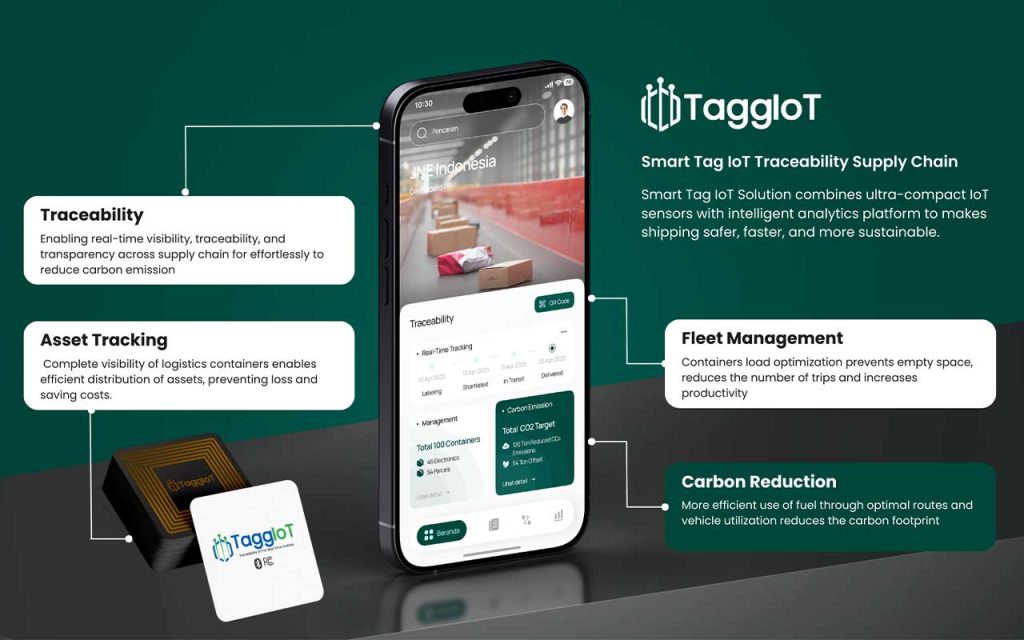
Another early indicator was the strong response to our hybrid BLE–RFID smart tag, which solved two immediate pain points: compatibility with existing systems and the ability to track assets indoors and in transit. During pilot evaluations, Korean partners highlighted the value of receiving real-time alerts on temperature deviations and load efficiency.
These interactions gave us clear confirmation that the solution fits real operational needs and has strong potential to scale in Korea.
KSGC 2025 and the Mentorship That Changed the Company’s Course
Q3. During KSGC, were there any mentors, partners, or specific insights that significantly influenced your product or strategy?
One of the most influential parts of KSGC was our mentorship with industry experts from NIPA (National IT Industry Promotion Agency), particularly their guidance on Korea’s evolving logistics and smart-factory ecosystem.
A key insight they shared fundamentally shaped our strategy: Korean logistics companies prioritize solutions that deliver measurable CO2 reductions and verifiable ESG outcomes, not just operational efficiency.
This shifted our product focus during the program. We strengthened our CO2 calculation engine, refined our load-optimization analytics, and aligned our dashboard with Korean ESG reporting standards. What originally started as a visibility tool has now matured into a platform that helps companies measure, report, and reduce emissions in real time.
Additionally, introductions through KSGC allowed us to speak directly with local logistics firms, which accelerated our understanding of user workflows and compliance requirements. This helped us adapt our tag specifications, gateway placement strategy, and integrations to match Korean warehouses and transportation environments. The combination of mentorship and market feedback significantly sharpened our market entry approach.
TaggIoT at KSGC 2025: From Concept to Commercial Traction
Q4. After joining KSGC, what has been the most meaningful change for your company and what evidence supports this growth?
K-Startup Grand Challenge program created a turning point for TaggIoT, especially in terms of product maturity, strategic partnerships, and measurable commercial traction. The biggest change has been our ability to convert interest into structured pilot opportunities in Korea.
Before the program, our deployments were mostly concentrated in Indonesia. But after joining KSGC, we were able to initiate discussions with multiple Korean logistics and automotive parts companies, resulting in five active pilot negotiations and an expanded pipeline that is more than triple its previous size.
In addition, our product development also advanced quickly thanks to KGSC. Guidance from mentors and site visits helped us improve our hybrid BLE–RFID smart tag and refine it for Korea’s high-density logistics environments. We are able to improve its read-range performance, enhance temperature accuracy, and upgrade our ESG reporting dashboard.
These advancements directly contributed to the interest we received from Korean partners.
Lastly, KGSC also helped increase our global readiness and credibility. After joining KSGC, TaggIoT reached an annual revenue run rate of USD 926K, deployed 77,000+ smart tags, and strengthened our retention with 10+ loyal clients.
Building the World’s Most Connected Supply Chain
Q5. Looking ahead, what is the most important vision or long-term goal your company aims to achieve, and what steps are you taking to move toward it?
Our long-term vision is to build the world’s most connected manufacturing and logistics ecosystem, where every item—no matter how small—is traceable, measurable, and optimizable in real time.
We believe the future of supply chains relies on item-level intelligence that enables companies to eliminate waste, reduce carbon emissions, and operate with complete transparency. To move toward this vision, we are focusing on three strategic steps.
First, we are scaling our smart tag production and lowering unit cost, enabling mass adoption for high-volume industries such as automotive components, electronics, and consumer goods.
Second, we are expanding our AI analytics platform to provide deeper insights into load efficiency, carbon impact, and anomaly detection. This allows companies not just to track items, but to make smarter decisions driven by real-time data.
Third, as Korea is becoming our strategic base for Northeast Asia, collaborating with advanced logistics operators and manufacturers gives us a valuable environment that can accelerate technology validation and cross-border expansion.
By combining ultra-thin IoT tags, ambient-powered sensors, and a strong ecosystem of partners, we aim to create a future where supply chains operate with zero blind spots and significantly lower environmental impact.
Ultimately, we are moving toward a future where real-time traceability evolves into deeper intelligence that supports stronger sustainability outcomes.
From invisible cargo spaces to visible impact, TaggIoT is transforming how global supply chains think about efficiency, accountability, and sustainability.
Its journey through KSGC 2025 proves that technology built for simplicity can solve the world’s most complex logistics challenges—making every shipment smarter, every operation greener, and every supply chain transparent from source to shelf.
About This Series
This article is part of the “K-Startup Grand Challenge 2025 Interview Series,” featuring 40 global startups from Phase 2 of Korea’s leading accelerator program. The series highlights how international founders are scaling innovation through Korea’s startup ecosystem.
Read more stories from the K-Startup Grand Challenge 2025 Interview Series on KoreaTechDesk.
🤝 Looking to connect with verified Korean companies building globally?
Explore curated company profiles and request direct introductions through beSUCCESS Connect.
– Stay Ahead in Korea’s Startup Scene –
Get real-time insights, funding updates, and policy shifts shaping Korea’s innovation ecosystem.
➡️ Follow KoreaTechDesk on LinkedIn, X (Twitter), Threads, Bluesky, Telegram, Facebook, and WhatsApp Channel.