South Korea’s race to establish sovereign AI infrastructure is revealing how deep-tech startups now serve as both technological pioneers and strategic connectors within the country’s evolving innovation ecosystem. Among them, Rebellions stands out — not just for proving the stability of its homegrown AI chip in medical applications, but for building bridges between national R&D programs and enterprise collaboration within Korea’s evolving AI ecosystem.
Rebellions Validates Domestic NPU Stability in Medical AI Applications
In November 2025, Rebellions, a Seoul-based AI semiconductor startup, announced successful verification of its neural processing unit (NPU) within the AI Semiconductor Farm Construction and Demonstration Program.
The project, overseen by the Ministry of Science and ICT and supported by the National IT Industry Promotion Agency (NIPA), aims to strengthen Korea’s domestic AI hardware capabilities through cloud-based NPU infrastructure.
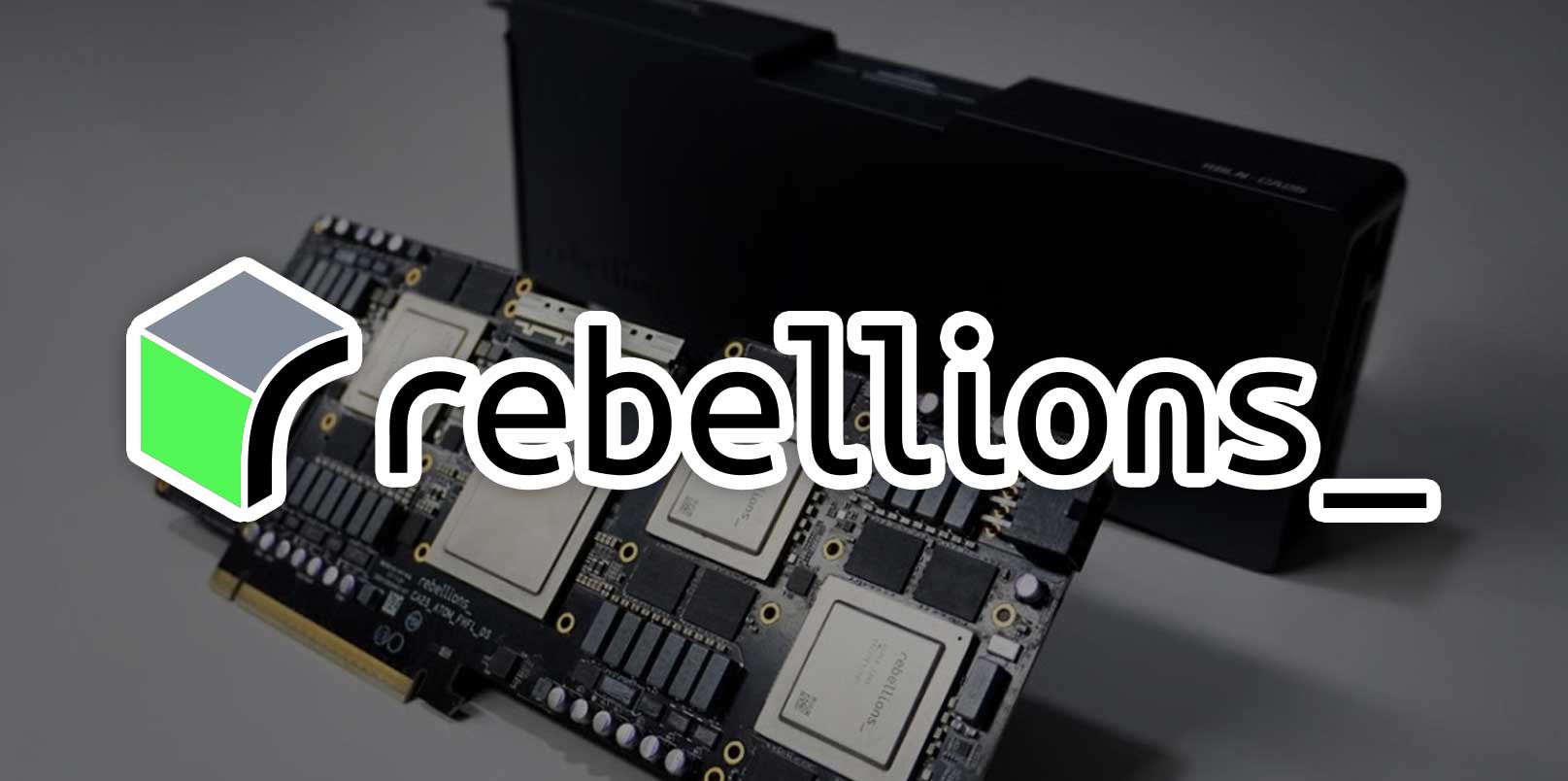
Over a three-year collaboration, Rebellions supplied its proprietary ATOM chip to KT Cloud, building a 3.45-petaflop computing infrastructure designed to serve as a major testbed for domestic AI semiconductor validation.
The company then partnered with Mondrian AI, optimizing the inference performance of the FastSurfer medical imaging model and Meta’s Llama 3.1 LLM, achieving notable improvements in speed and power efficiency.
This validation marks the first domestic demonstration of medical imaging AI inference on a Korean-built NPU — a milestone that showcases the maturity of Korea’s AI chip sector and its readiness for commercial deployment in high-precision applications such as healthcare.
Korea’s Expanding AI Infrastructure Policy
The project aligns closely with South Korea’s national strategy to secure AI sovereignty, which emphasizes R&D-led digital transformation across key sectors. The AI Semiconductor Farm program represents a policy-level response to global semiconductor dependencies and the need to embed AI computing capacity within national infrastructure.
By combining public-sector funding with private-sector execution, Korea is reinforcing a model that integrates state-backed R&D, domestic hardware innovation, and applied AI validation. Rebellions’ role as both a hardware provider and optimization partner reflects how startups now act as functional enablers of government-led digital initiatives rather than passive beneficiaries.
The company’s technical achievement — especially within the medical AI domain — also mirrors the government’s broader ambition to merge AI hardware development with high-value application ecosystems, a trend that may define the next phase of Korea’s industrial AI roadmap.
In addition to its public-sector demonstration with KT Cloud and Mondrian AI, Rebellions had earlier partnered with medical AI company Lunit to explore next-generation diagnostic solutions. The collaboration reflected an emerging alignment between Korea’s semiconductor innovators and specialized AI companies, aiming to bridge hardware performance with applied intelligence in regulated domains such as healthcare.
Rebellions: Collaboration Beyond Hardware
Beyond its technical breakthroughs, Rebellions has been actively deepening its industry engagement strategy. At D.CAMP’s “Startup OI #CVC” event in Seoul, CEO Park Sung-hyun discussed how early strategic investment from KT helped the company scale its operations and strengthen its global positioning.
Park emphasized that open innovation must evolve from transactional partnerships into ecosystem-level collaboration, noting that Korea’s relatively limited M&A activity has often restricted the effectiveness of strategic investment. His remarks suggest that the country’s deep-tech sector will require not only capital but also more dynamic acquisition and integration pathways to sustain innovation cycles.
This view is increasingly shared among investors and corporate venture leaders who see CVC partnerships as essential to accelerating startup scalability and commercialization, particularly in capital-intensive fields like semiconductors and AI computing.
Deep-Tech Validation as Policy Leverage
Rebellions’ progress underscores a structural shift in Korea’s deep-tech investment priorities. In recent years, national budgets and SME policies have increasingly favored R&D expansion, seeking to turn advanced materials, AI semiconductors, and computing architectures into economic growth engines.
The company’s NPU validation not only strengthens investor confidence in domestic chip capabilities but also reinforces Korea’s narrative as an emerging AI infrastructure powerhouse. It also illustrates how local startups can play a pivotal role in executing state-led AI initiatives while maintaining commercial relevance across global technology supply chains.
The collaboration model between Rebellions, KT Cloud, Mondrian AI, and public-sector agencies offers a glimpse into how Korea’s public-private partnerships might evolve — less as policy experiments and more as operational blueprints for industrial AI adoption.
The Convergence of R&D and Real Deployment
Korea’s AI semiconductor ecosystem is entering a phase where validation and application must converge. For startups like Rebellions, success will hinge on expanding beyond research demonstration toward market deployment, while for policymakers, the challenge lies in translating infrastructure projects into sustainable commercial networks.
If sustained, this alignment between domestic chip innovation, public-sector support, and cross-industry collaboration could position South Korea as one of the few countries with a vertically integrated AI value chain — from semiconductor architecture to applied intelligence.
– Stay Ahead in Korea’s Startup Scene –
Get real-time insights, funding updates, and policy shifts shaping Korea’s innovation ecosystem.
➡️ Follow KoreaTechDesk on LinkedIn, X (Twitter), Threads, Bluesky, Telegram, Facebook, and WhatsApp Channel.
🤝 Looking to connect with verified Korean companies building globally?
Explore curated company profiles and request direct introductions through beSUCCESS Connect.