Korea’s public research system is entering a new phase, and this time, it’s defined by coordination and connected innovation. With two key ministries joining forces for the first time, the government is signaling a shift toward an integrated national R&D framework. For startups and tech investors, this move could reshape how Korea allocates capital, builds regional ecosystems, and scales industrial AI into global competitiveness.
MSS – MOTIE Unveil 2026 Integrated R&D Implementation Plan
The Korean government has announced a unified R&D strategy connecting industrial innovation, artificial intelligence, and regional development under one coordinated system.
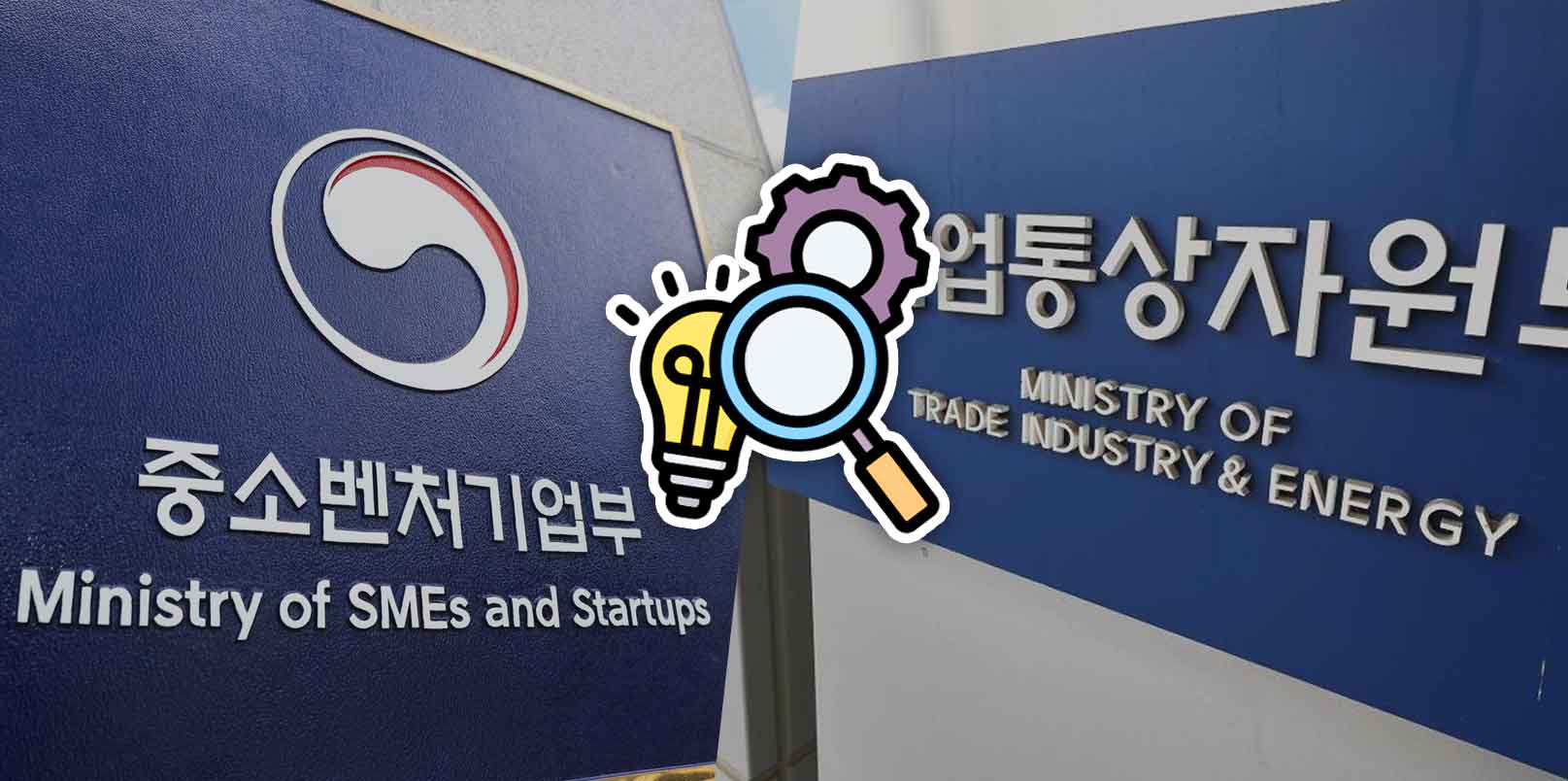
For the first time, the Ministry of SMEs and Startups (MSS) and the Ministry of Trade, Industry and Energy (MOTIE) will jointly publish the 2026 Integrated R&D Implementation Plan, consolidating all corporate support programs, funding schedules, and application procedures.
The initiative aims to streamline access to national R&D resources by allowing companies to view all programs in one place—through either ministry or any affiliated R&D institution such as TIPA, KIAT, or KEIT. The new framework represents a major policy shift designed to reduce administrative burden and align national research investments with Korea’s long-term technology competitiveness goals.
Unified R&D Access and Record-High Budget Commitment
Under the plan, the two ministries will provide a combined KRW 7.7 trillion (approximately USD 5.6 billion) in 2026 to strengthen Korea’s innovation capacity.
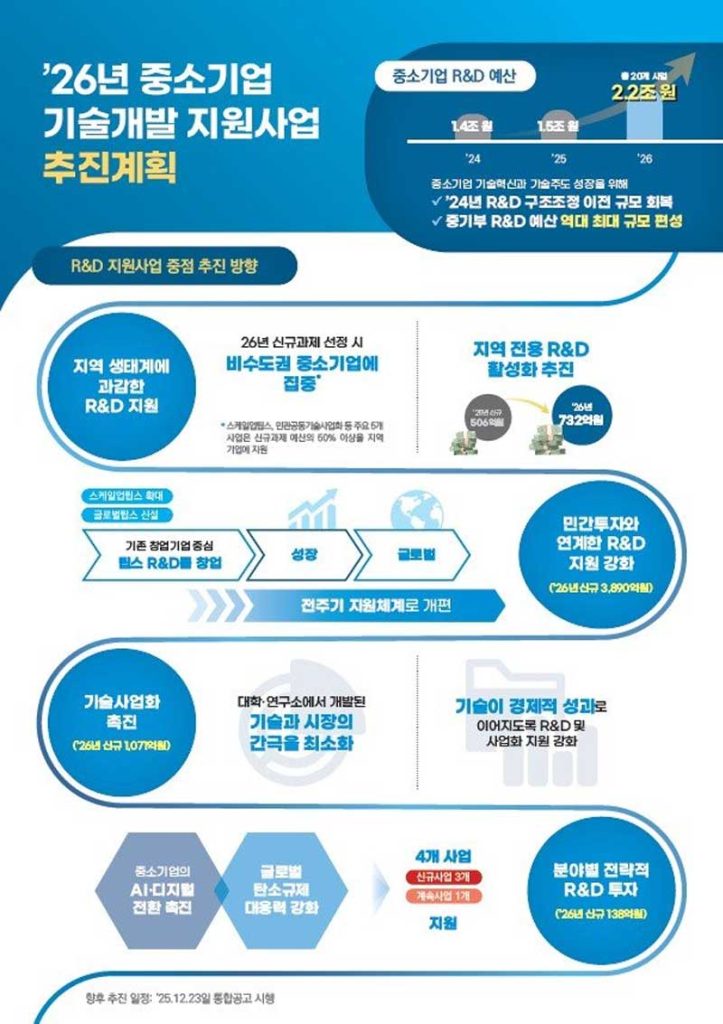
MSS will allocate KRW 2.2 trillion, marking a 45% increase over 2025.
- KRW 749.7 billion will support new R&D projects, more than double the previous year’s level.
- Priority areas include regional innovation ecosystems, TIPS-style startup R&D (KRW 389 billion), and the newly established Korean-style STTR program for technology transfer (KRW 107.1 billion).
- Additional investment of KRW 13.8 billion will target AI adoption, digital transformation, and global carbon-neutral readiness among SMEs.
More than 50% of new project funding will go to companies outside the Seoul metropolitan area. Every MSS R&D program will include bonus scoring for non-capital region applicants to support balanced regional development.
Meanwhile, MOTIE will invest a record KRW 5.5 trillion, an 18% year-on-year increase, focusing on industrial AI and advanced sectors critical to Korea’s next growth phase.
- KRW 1.8325 trillion will go toward semiconductors, secondary batteries, biotechnology, mobility, robotics, and shipbuilding.
- KRW 1.0455 trillion will accelerate industrial AI adoption, including the M.AX initiative, autonomous AI factories (KRW 220 billion), and manufacturing AI model development (KRW 27 billion).
- KRW 299 billion will fund green process innovations such as hydrogen-based steelmaking.
- KRW 1.4914 trillion will support materials, parts, and equipment (SoC) supply-chain stabilization, while KRW 704 billion will strengthen talent development, regional strategies, and global collaboration.
Creating a Seamless R&D Environment
The ministries emphasized that the integrated framework will enable businesses to focus on innovation rather than paperwork.
Hwang Young-ho, Director of Technology Innovation Policy at MSS, stated:
“By allowing companies to access all R&D support information in one place through the new joint announcement system, we’re reducing administrative complexity and building an environment where research can thrive.”
Choi Yeon-woo, Director of Industrial Technology Convergence Policy at MOTIE, added:
“Bringing both ministries’ R&D initiatives under a unified system makes it easier for companies to search, compare, and plan. Together, we’ll deliver comprehensive support across the full cycle—from technology development to commercialization.”
This marks the first coordinated release between the two ministries, a step designed to increase policy coherence and visibility for entrepreneurs navigating Korea’s R&D landscape.
MSS – MOTIE: Building Connected Framework for Innovation
The integrated R&D plan redefines how Korea manages public research investments—linking AI, industry, and regional ecosystems into one strategic growth framework. It reflects a broader policy evolution toward connected innovation, where digital transformation, industrial competitiveness, and startup scalability operate under a single national agenda.
By combining resources and aligning evaluation systems, the initiative reduces redundancy between agencies and helps startups identify relevant support channels more efficiently. It also ensures AI-driven and industrial R&D projects feed directly into regional innovation hubs, creating localized yet globally competitive clusters.
For international investors and technology partners, this unified structure offers clearer entry points into Korea’s R&D ecosystem, particularly in deep-tech and industrial AI collaborations. The plan signals that the Korean government aims to create not just more projects, but a more integrated and outcomes-oriented innovation engine.
Toward an Inclusive, Future-Ready R&D Ecosystem
Korea’s new R&D integration framework is more than administrative reform—it’s a blueprint for policy connectivity in the digital and industrial era. By combining the strengths of two ministries and creating a unified access system for companies, the nation is positioning its innovation infrastructure for the next decade of competition.
The outcome will determine how effectively Korea can balance central coordination with regional autonomy, and how small and large enterprises alike can leverage AI and industrial R&D to build global competitiveness. The 2026 plan, if executed effectively, could become
🤝 Looking to connect with verified Korean companies building globally?
Explore curated company profiles and request direct introductions through beSUCCESS Connect.
– Stay Ahead in Korea’s Startup Scene –
Get real-time insights, funding updates, and policy shifts shaping Korea’s innovation ecosystem.
➡️ Follow KoreaTechDesk on LinkedIn, X (Twitter), Threads, Bluesky, Telegram, Facebook, and WhatsApp Channel.