South Korea’s ambition to build sovereign artificial intelligence infrastructure is moving into early operational testing. AI infrastructure startup VESSL AI and AI semiconductor developer Rebellions have agreed to build cloud infrastructure based on domestically developed neural processing units.
The collaboration targets robotics and industrial computing environments while exploring deployments in Korea’s public sector and overseas markets. The effort signals how Korean startups are attempting to combine hardware and AI platforms into a domestic infrastructure stack capable of supporting emerging physical AI workloads.
VESSL AI and Rebellions Launch Collaboration on Domestic NPU Cloud
AI infrastructure startup VESSL AI announced that it has signed a memorandum of understanding with AI semiconductor company Rebellions to cooperate on building cloud infrastructure based on domestic neural processing units.
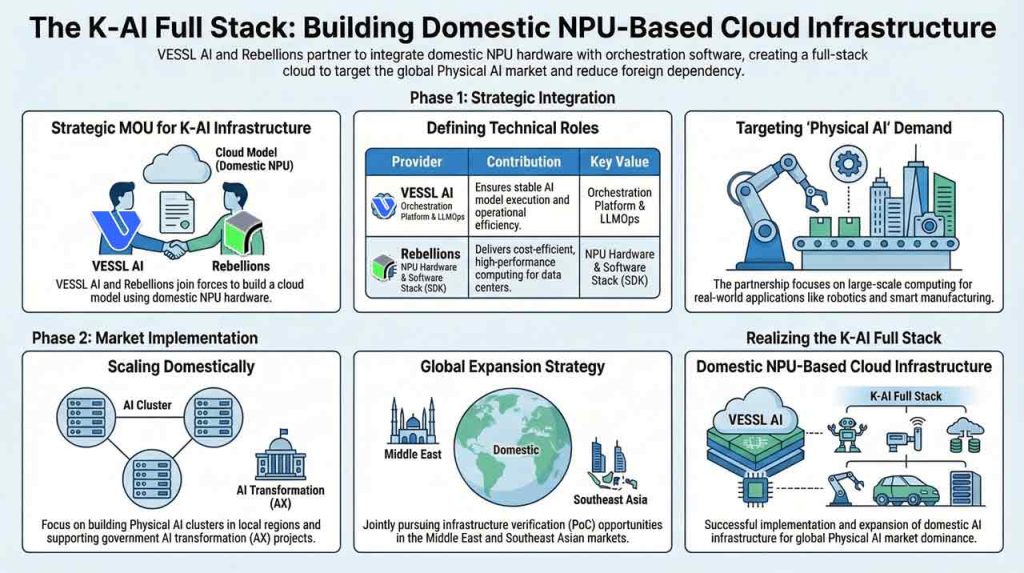
The agreement aims to combine Rebellions’ NPU hardware with VESSL AI’s software platform to develop a competitive AI infrastructure model built on Korean technology.
According to the companies, the partnership will focus on three main areas:
- Joint planning and development of packaged solutions that combine domestic NPUs with VESSL software
- Technical integration reviews and performance validation through proof-of-concept testing
- Identification of joint business opportunities in Korea and international markets
The collaboration reflects a broader effort among Korean startups to assemble a “K-AI full stack” that integrates semiconductor hardware, AI infrastructure software, and model deployment environments.
Targeting Physical AI Workloads in Robotics and Smart Manufacturing
The partnership centers on infrastructure designed for physical AI, which refers to AI systems operating in real-world environments such as robotics and industrial automation.
Sectors including robotics and smart manufacturing as key demand drivers. These environments often require large-scale computation to process data generated by machines, sensors, and automated production systems.
VESSL AI will provide an orchestration platform designed to allow AI models to run reliably on infrastructure powered by domestic NPUs. The company also plans to deploy an operational framework based on LLMOps, which enables large language models to be managed and deployed in industrial settings.
Rebellions will supply NPU hardware optimized for data center and cloud environments along with its software development kit.
The companies also plan to jointly design infrastructure architecture optimized for NPU workloads while validating stability in multi-user environments.
Public Sector AI Projects Become Early Deployment Channel for VESSL AI and Rebellions Collab
The domestic deployment strategy highlights the role of government-led AI projects as an early testing ground.
The companies plan to pursue opportunities linked to physical AI cluster initiatives promoted in regional hubs such as Jeonbuk Province. These projects aim to build localized AI infrastructure supporting robotics and advanced manufacturing.
Another opportunity lies in AI transformation initiatives, often referred to as AX, which are being pursued by Korean local governments.
Through these projects, the companies aim to demonstrate that domestic AI infrastructure can be adopted in public sector systems that currently rely heavily on foreign technology.
Industry observers often note that public sector infrastructure projects in Korea frequently serve as initial markets for emerging technology platforms before wider commercial adoption.
Overseas Expansion Targets Middle East and Southeast Asia
The partnership also includes plans to explore international deployment opportunities. The companies identified the Middle East and Southeast Asia as potential target markets for demonstrations of NPU-based infrastructure, especially with Rebellions successfully establishing a Saudi subsidiary last year.
The strategy centers on securing proof-of-concept deployments that demonstrate how Korean AI infrastructure can operate in industrial environments outside the domestic market.
Korean AI infrastructure startups are increasingly looking beyond traditional cloud markets when testing new hardware platforms. Emerging industrial economies in the Middle East and Southeast Asia often present opportunities to deploy new computing architectures in greenfield environments where large-scale AI infrastructure is still being built.
Reports also mentioned that companies aim to showcase cost-efficient AI infrastructure through what they describe as a K-AI full stack combining hardware and software platforms.
Therefore, securing operational case studies in overseas industrial environments could help Korean AI infrastructure startups validate their technology beyond domestic pilot programs.
Korea’s Emerging Push for Domestic AI Infrastructure
Statements from both companies highlight a broader strategic motivation.
Executives from VESSL AI and Rebellions framed the partnership as part of an effort to demonstrate the competitiveness of domestic AI infrastructure built on Korean technology.
Vessl AI CEO Ahn Jae-man said:
“This agreement is meaningful because it establishes a foundation for securing real operational examples of AI infrastructure in regional clusters and global markets, beyond simple technology exchange. Through this collaboration, we will expand the application scope of infrastructure based on domestic NPUs and strengthen our capability to respond to the physical AI market.”
Rebellions CEO Park Sung-hyun said:
“In the AI infrastructure market, where cost efficiency (CAPEX and OPEX) is critical, this collaboration will become a unique example of building a large-scale cloud based on NPUs. Through this attempt to complete a K-AI full stack using domestic technology, from NPU hardware to cloud infrastructure, we will demonstrate the practical competitiveness of sovereign AI.”
The initiative reflects growing discussion within Korea’s technology ecosystem about reducing dependence on foreign infrastructure while developing domestic AI capabilities.
In practical terms, the partnership attempts to integrate three layers of infrastructure:
- AI semiconductor hardware
- Infrastructure orchestration software
- Operational systems capable of supporting large AI models in industrial environments
Such integration remains an early-stage experiment, as the companies still need to validate the infrastructure through real deployments and proof-of-concept projects.
Early Infrastructure Experiments Still Require Real Deployment Evidence
Despite the strategic ambition, the collaboration remains at the stage of technical validation and early infrastructure development.
The agreement outlines plans for integration testing, proof-of-concept demonstrations, and infrastructure architecture design. So real adoption will depend on whether the system can demonstrate stability and performance in large-scale deployments, including public sector environments and overseas industrial sites.
This challenge is common across the global AI semiconductor ecosystem. Many chip startups must prove that their hardware can function effectively within full infrastructure stacks that include orchestration platforms, cloud environments, and operational software.
The partnership between VESSL AI and Rebellions therefore represents an early attempt to test how Korean AI hardware and infrastructure platforms might operate together in real computing environments.
Why VESSL AI x Rebellions Partnership Matters for Global Startup Ecosystem Observers
The development offers several signals for global startup ecosystem participants following Korea’s AI sector.
First, Korean startups are increasingly exploring AI infrastructure development, not only AI models or applications.
Second, industrial AI environments such as robotics and smart manufacturing are emerging as potential early deployment markets for alternative AI hardware architectures.
Third, overseas markets in the Middle East and Southeast Asia are becoming testing grounds for infrastructure platforms seeking to demonstrate cost-performance advantages.
For international founders, investors, and policymakers watching Korea’s deep technology ecosystem, the partnership illustrates how domestic AI infrastructure initiatives are moving from concept to initial deployment experiments.
Practical Test of Korea’s Sovereign AI Infrastructure
The VESSL AI–Rebellions collaboration highlights how Korea’s efforts to build sovereign AI infrastructure are beginning to move beyond strategy discussions into practical testing environments.
By combining domestic AI chips, infrastructure orchestration platforms, and government-linked pilot projects, the companies aim to demonstrate that Korean technology can support emerging AI workloads in robotics and industrial computing.
The real measure of success will depend on whether these early infrastructure experiments can evolve into stable, scalable deployments in both domestic and international markets.
Key Takeaways on Korea’s Domestic NPU Cloud Infrastructure Strategy by VESSL AI and Rebellions
- VESSL AI and Rebellions signed an MOU to collaborate on cloud infrastructure built on domestic neural processing units.
- The partnership combines Rebellions’ AI semiconductor hardware with VESSL AI’s orchestration platform and LLMOps environment.
- The infrastructure targets physical AI workloads, including robotics and smart manufacturing that require large-scale computation.
- Public sector AI projects and regional physical AI clusters in Korea may serve as early deployment environments.
- The companies are exploring international proof-of-concept deployments in the Middle East and Southeast Asia.
- The collaboration reflects broader discussions within Korea’s technology ecosystem about building domestic AI infrastructure capabilities and reducing reliance on foreign systems.
🤝 Looking to connect with verified Korean companies building globally?
Explore curated company profiles and request direct introductions through beSUCCESS Connect.
– Stay Ahead in Korea’s Startup Scene –
Get real-time insights, funding updates, and policy shifts shaping Korea’s innovation ecosystem.
➡️ Follow KoreaTechDesk on LinkedIn, X (Twitter), Threads, Bluesky, Telegram, Facebook, and WhatsApp Channel.