South Korea’s autonomous driving startup sector is entering a new phase as companies attempt to move beyond domestic testing toward international deployment. Autonomous driving developer Autonomous A2Z has raised KRW 40.5 billion (USD 30 million) in a pre-IPO funding round while expanding pilot projects across Asia and the Middle East. The development highlights Korea’s broader effort to position homegrown autonomous mobility technologies in emerging global markets.
Autonomous A2Z Secures Pre-IPO Funding and Prepares for KOSDAQ Listing
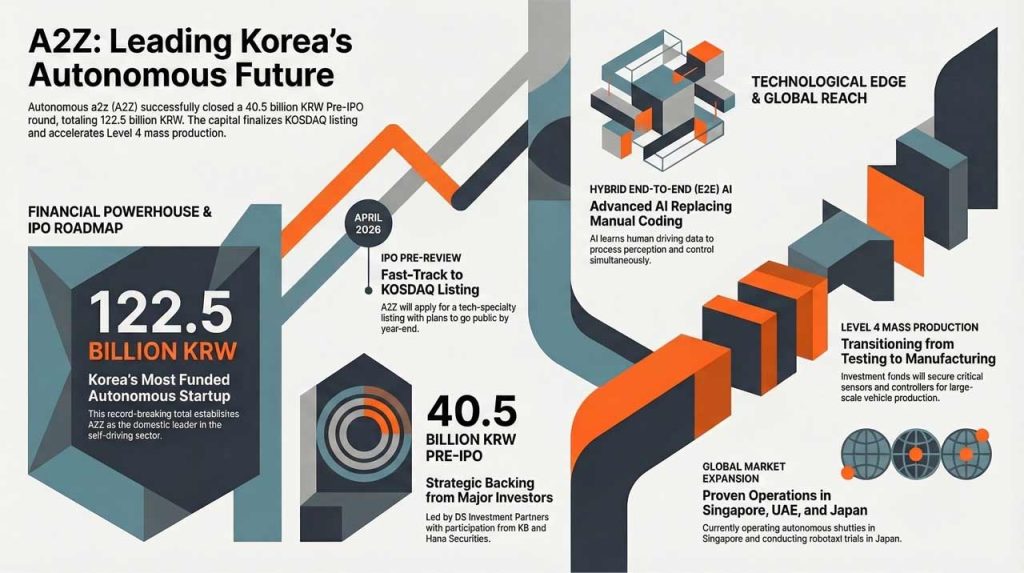
Autonomous A2Z announced on March 12 that it completed a KRW 40.5 billion pre-IPO investment round. The funding raises the company’s cumulative investment to approximately KRW 122.5 billion, which the company says represents the largest funding total among autonomous driving startups in South Korea.
The round was led by existing investor DS Investment Partners as anchor investor. Other participants included Envestor, KB Investment, KB Securities, and Hana Securities. Daesung Venture Investment, Suin Investment Capital, and E& Venture Partners joined as new investors.
The company plans to submit a preliminary review application to the Korea Exchange in April under the technology-special listing track. Hana Securities and KB Securities, selected in 2023, will serve as joint IPO underwriters.
Autonomous A2Z said the funding will support development of its hybrid end-to-end autonomous driving technology, expansion of global operations, recruitment of technical staff, and procurement of key vehicle components such as sensors and controllers needed for large-scale autonomous driving demonstration programs promoted by South Korea’s Ministry of Land, Infrastructure and Transport.
Global Pilot Programs Expand Across Asia and the Middle East
The company’s strategy centers on international demonstration projects that test autonomous mobility services in real transportation environments.
In Singapore, Autonomous A2Z operates an autonomous shuttle bus in cooperation with Southeast Asian mobility platform Grab. The project includes deployment of the company’s LiDAR Infrastructure System integrated with local traffic infrastructure.
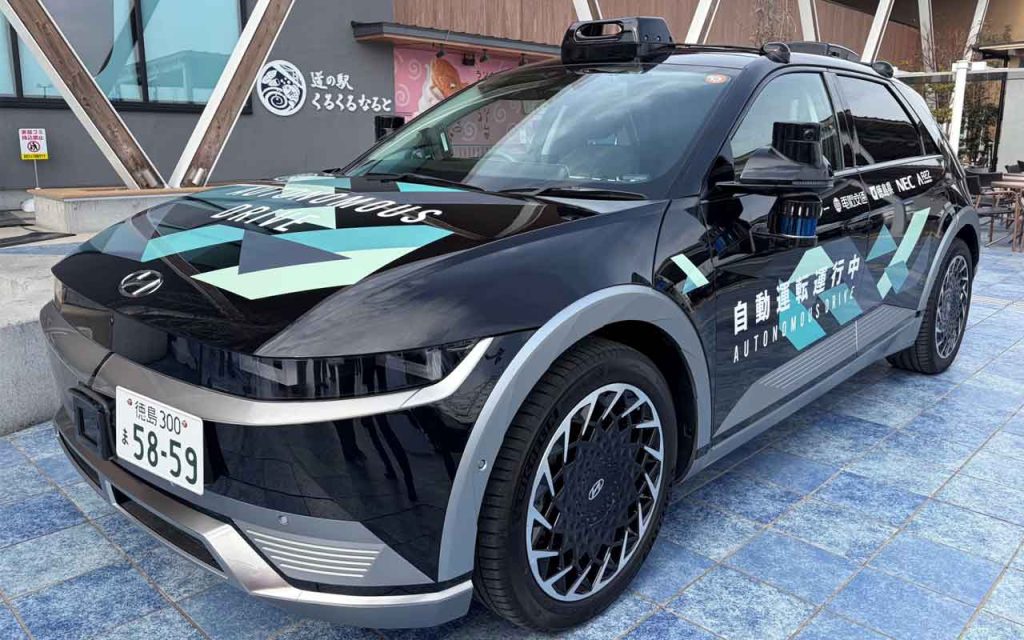
Japan represents another test market. Autonomous A2Z launched a Level-4 autonomous taxi demonstration in Naruto City, Tokushima Prefecture in February. The project is conducted with NEC and Denno Kotsu, with Japanese trading company Kanematsu acting as a local partner. Vehicles equipped with the company’s autonomous system operate along fixed routes connecting 27 pickup locations, including Tokushima Awaodori Airport. A safety driver remains onboard during the trial.
The company is also expanding its activity in the Middle East. Autonomous A2Z recently obtained government approval to export its autonomous driving technology, which is classified as a national core technology in Korea. The approval allows deployment of the company’s Level-4 autonomous vehicle “ROii” in the United Arab Emirates. The firm is pursuing local contracts and aims to secure approximately USD 7.6 million in UAE projects this year.

Stakeholders Highlight Commercialization and Technology Ambitions
Autonomous A2Z CEO Han Ji-hyung said the investment is intended to strengthen the company’s ability to execute ongoing international projects, saying:
“This pre-IPO round was a strategic decision to secure the execution capability needed for key projects with governments and companies at home and abroad.”
He added that the company aims to expand Korean autonomous driving technology globally through mass production of Level-4 vehicles and the development of a global data ecosystem.
Kim Hee-joong of DS Investment Partners said the company’s combination of automotive engineering and artificial intelligence capabilities has been recognized by both investors and government stakeholders:
“Autonomous A2Z integrates vehicle technology with AI and has already gained recognition for its technology from global investors and public institutions.”
Korea’s Autonomous Mobility Strategy Is Emerging Through Startups
The company’s expansion reflects a broader shift in Korea’s autonomous mobility strategy.
Autonomous driving technology is treated as a national strategic technology and subject to export controls. The recent export approval granted to Autonomous A2Z marked the first authorization of its kind in the sector.
Government policy also aims to accelerate Level-4 autonomous driving commercialization by 2027 under Korea’s national mobility roadmap.
International partnerships are also expanding. During the Korea–Singapore AI Connect Summit held earlier this year, several cooperation agreements related to autonomous driving were signed involving Autonomous A2Z and Singapore organizations.
These developments suggest that Korea’s mobility strategy increasingly involves startups as global deployment vehicles rather than relying solely on large automakers.
Demonstration Success Does Not Yet Guarantee Commercial Revenue
Despite technological progress and global pilots, analysts note that commercialization remains uncertain across the autonomous driving sector.
Autonomous A2Z reported approximately KRW 16 billion in revenue for 2025, representing a year-over-year increase from roughly KRW 10.7 billion the previous year. However, industry analysis indicates that much of this revenue is linked to government R&D projects and demonstration programs rather than large-scale commercial operations.
The broader autonomous driving industry faces similar challenges. Even globally established companies continue to experiment with robotaxi services while working toward sustainable business models.
This dynamic has led some observers to caution that technology rankings or pilot deployments do not automatically translate into profitable autonomous mobility services.
Why Emerging Markets Are Becoming Key Testing Grounds
Autonomous mobility startups are increasingly exploring markets in Asia and the Middle East.
Smart city programs in countries such as the United Arab Emirates and Saudi Arabia create demand for next-generation mobility systems. Dubai has announced a goal of converting 25 percent of public transportation to autonomous vehicles by 2030.
Industry observers note that these regions are also less dominated by large U.S. and Chinese technology companies compared with their domestic markets.
Some Korean founders view these regions as strategic entry points where autonomous mobility systems can be tested and deployed before global technology giants expand into the same markets.
The Next Test for Korea’s Robotaxi Ambitions
Autonomous A2Z’s funding round and planned IPO reflect growing capital demands in the autonomous mobility sector.
Developing Level-4 autonomous systems requires sustained investment in software, vehicle integration, testing infrastructure, and regulatory validation. For startups operating in this space, public markets often represent one of the few financing paths capable of supporting long development cycles.
The company’s global pilots therefore serve two purposes. They test the technical readiness of Korean autonomous driving systems while also building operational experience that could support commercialization.
Whether these pilots evolve into sustainable robotaxi businesses remains an open question.
For Korea’s startup ecosystem, the next phase will not be defined solely by technological breakthroughs. It will depend on whether companies can convert global demonstrations into durable mobility services.
Key Takeaways on Autonomous A2Z Pre-IPO Funding 2026
- Autonomous driving startup Autonomous A2Z raised KRW 40.5 billion (USD 30M) in pre-IPO funding, bringing cumulative funding to about KRW 122.5 billion.
- The company plans to apply for a technology-special listing on the KOSDAQ market in April, with Hana Securities and KB Securities as underwriters.
- Autonomous A2Z operates international pilot projects in Singapore, Japan, and the United Arab Emirates to test Level-4 autonomous mobility services.
- Korea recently granted the company export approval for autonomous driving technology, classified as a national core technology.
- Analysts note that much of the company’s revenue currently comes from demonstration projects and R&D programs, reflecting wider commercialization challenges in the global autonomous driving sector.
- The company’s expansion highlights how Korean startups are being used as vehicles for global autonomous mobility deployment in emerging markets such as Southeast Asia and the Middle East.
🤝 Looking to connect with verified Korean companies building globally?
Explore curated company profiles and request direct introductions through beSUCCESS Connect.
– Stay Ahead in Korea’s Startup Scene –
Get real-time insights, funding updates, and policy shifts shaping Korea’s innovation ecosystem.
➡️ Follow KoreaTechDesk on LinkedIn, X (Twitter), Threads, Bluesky, Telegram, Facebook, and WhatsApp Channel.