Korea’s push to become a global AI powerhouse is entering a more operational phase. Beyond funding programs and strategy papers, the government is now addressing a friction point founders consistently raise: tax uncertainty during early growth. A new inter-agency agreement signals a shift in its AI startup playbook. It determines how the AI startups are treated, prioritizing speed, liquidity, and execution over administrative scrutiny at a stage when failure risk is highest.
Korea Aligns Startup and Tax Authorities Around AI Growth
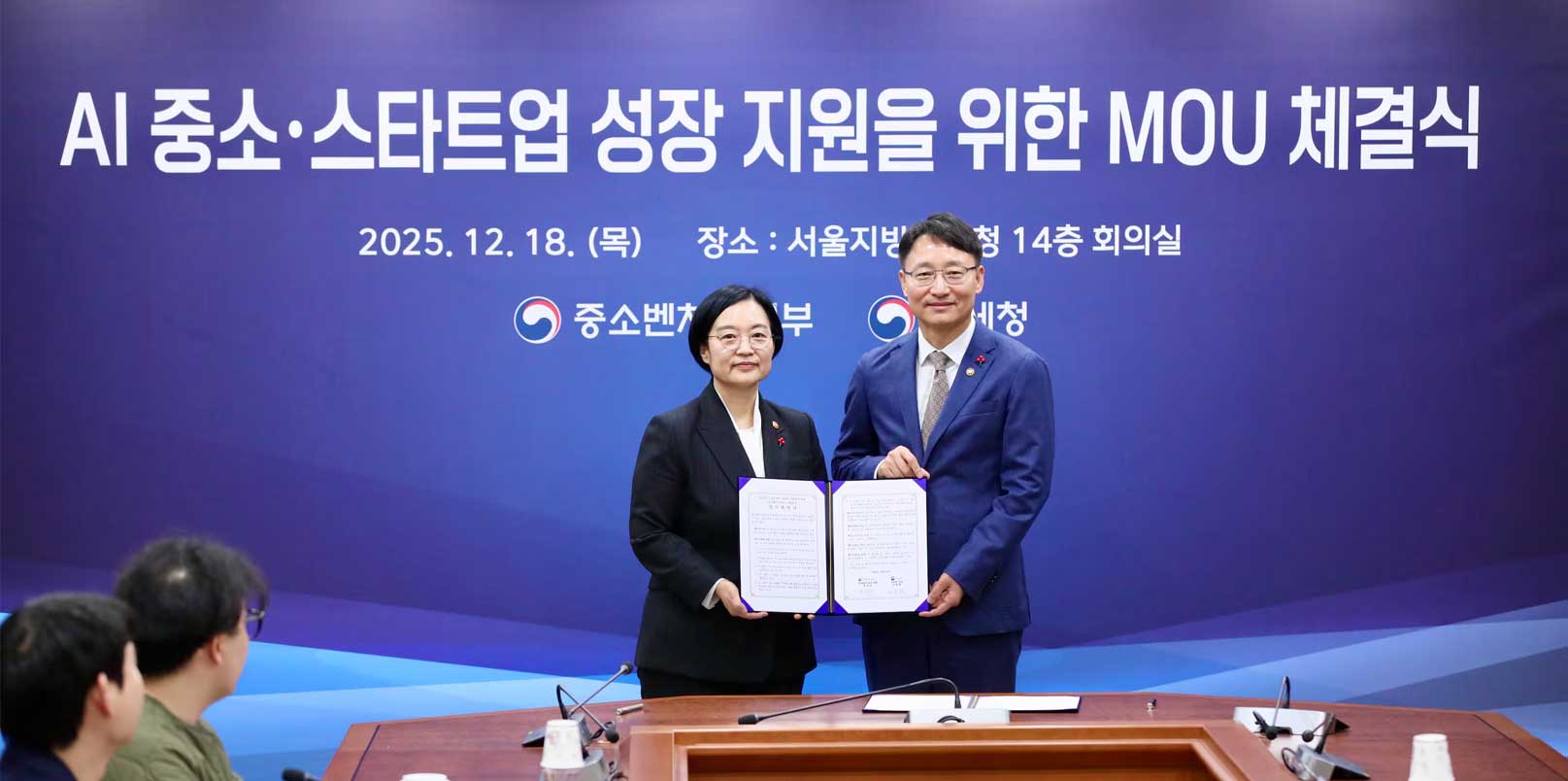
On December 18, the Ministry of SMEs and Startups and the National Tax Service signed a memorandum of understanding to support the growth of AI-focused small and medium-sized enterprises and startups.
The agreement was signed at the Seoul Regional Tax Office in Jongno, with participation from Minister Han Seong-sook and National Tax Service Commissioner Lim Kwang-hyun. Senior officials from the presidential office responsible for AI strategy also attended, underscoring the policy-level importance of the move.
What Changes for AI Startups on the Ground
Under the agreement, the Ministry of SMEs and Startups will formally designate AI startups eligible for policy support and share that list with the tax authority. The National Tax Service will then apply targeted tax administration measures to those companies.
These measures include minimizing tax audits, providing advance reviews for R&D tax credits, allowing extensions on tax payment deadlines to ease cash flow pressure, and offering consultations on complex tax issues.
The goal is to reduce administrative disruption during critical development and commercialization phases.
Why Tax Policy Is Now Part of Korea’s AI Strategy
AI startups face structural challenges that differ from traditional SMEs. High upfront R&D costs, long development cycles, and heavy reliance on GPUs and data infrastructure often delay revenue generation.
By coordinating startup policy with tax administration, the government is attempting to remove non-technical barriers that slow execution. Rather than introducing new subsidies, the focus is on predictability and liquidity, allowing founders to concentrate on model development, product validation, and early market entry.
Stakeholder Signals From Government Leadership
Minister Han Seong-sook stated that the agreement lays the groundwork for core AI startups to grow rapidly, emphasizing plans to expand cooperation across sectors,
“Through this memorandum of understanding between the two agencies, we have laid the foundation for key AI small and medium-sized enterprises that will be responsible for the future of Korea’s AI industry to grow rapidly.
Going forward, we will expand cooperation across individual policy areas and do our utmost to establish a full-cycle support framework that enables AI SMEs and startups to grow into global companies.”
National Tax Service Commissioner Lim Kwang-hyun stressed that the agreement must deliver tangible benefits rather than remain symbolic,
“It is critically important that small and venture companies and startups, which form the backbone of our economy, achieve innovation and growth based on AI technology.
This agreement must not remain a simple declaration. We will continue to cooperate closely with the Ministry of SMEs and Startups so that AI companies can experience tangible, practical support in the field.”
Senior presidential advisor Ha Jung-woo described AI startups as a key driver of Korea’s ambition to become one of the world’s top AI nations,
“Small and medium-sized enterprises and startups are the core driving force behind Korea’s goal of becoming one of the world’s top three AI powers and the main actors shaping our future.
I hope this cooperation will break down barriers between government agencies and create changes that AI startups can actually feel, and the government will provide full support to make that happen.”
A Targeted, Sector-First Policy Signal Starting with AI Startup Sector
What’s most notable in this agreement is the fact that the MSS – NTS collaboration does not apply to all startups in general. The measures are explicitly limited to AI SMEs and startups, reflecting a sector-priority approach rather than a blanket SME policy.
Hence, through the latest MSS – NTS collaboration, founders and investors may glimpse signals in how Korea is beginning to differentiate policy support by strategic technology domain.
AI is being treated as a national capability area, similar to semiconductors in earlier industrial phases. If successful, this model could later be extended to other deep-tech sectors. But for now, AI is clearly the first test case as the country moves to pursue its ambition to become one of the top three AI powerhouses.
Internationally, the move aligns Korea more closely with ecosystems such as Singapore, where regulatory predictability and tax clarity are used as competitiveness tools rather than compliance instruments.
New AI Startup Playbook: Less Paperwork, More Runway
Korea’s new AI startup playbook does not promise instant success or remove market risk. What it offers instead is time and focus.
By easing tax scrutiny, accelerating R&D tax processes, and improving cash flow flexibility, the government is effectively buying AI startups more runway, signaling founders to focus on building, testing, and scaling with fewer administrative interruptions.
And ultimately at the policy level, the agreement illustrates how Korea is turning AI ambition into operational action that global partners can observe and evaluate.
– Stay Ahead in Korea’s Startup Scene –
Get real-time insights, funding updates, and policy shifts shaping Korea’s innovation ecosystem.
➡️ Follow KoreaTechDesk on LinkedIn, X (Twitter), Threads, Bluesky, Telegram, Facebook, and WhatsApp Channel.
🤝 Looking to connect with verified Korean companies building globally?
Explore curated company profiles and request direct introductions through beSUCCESS Connect.