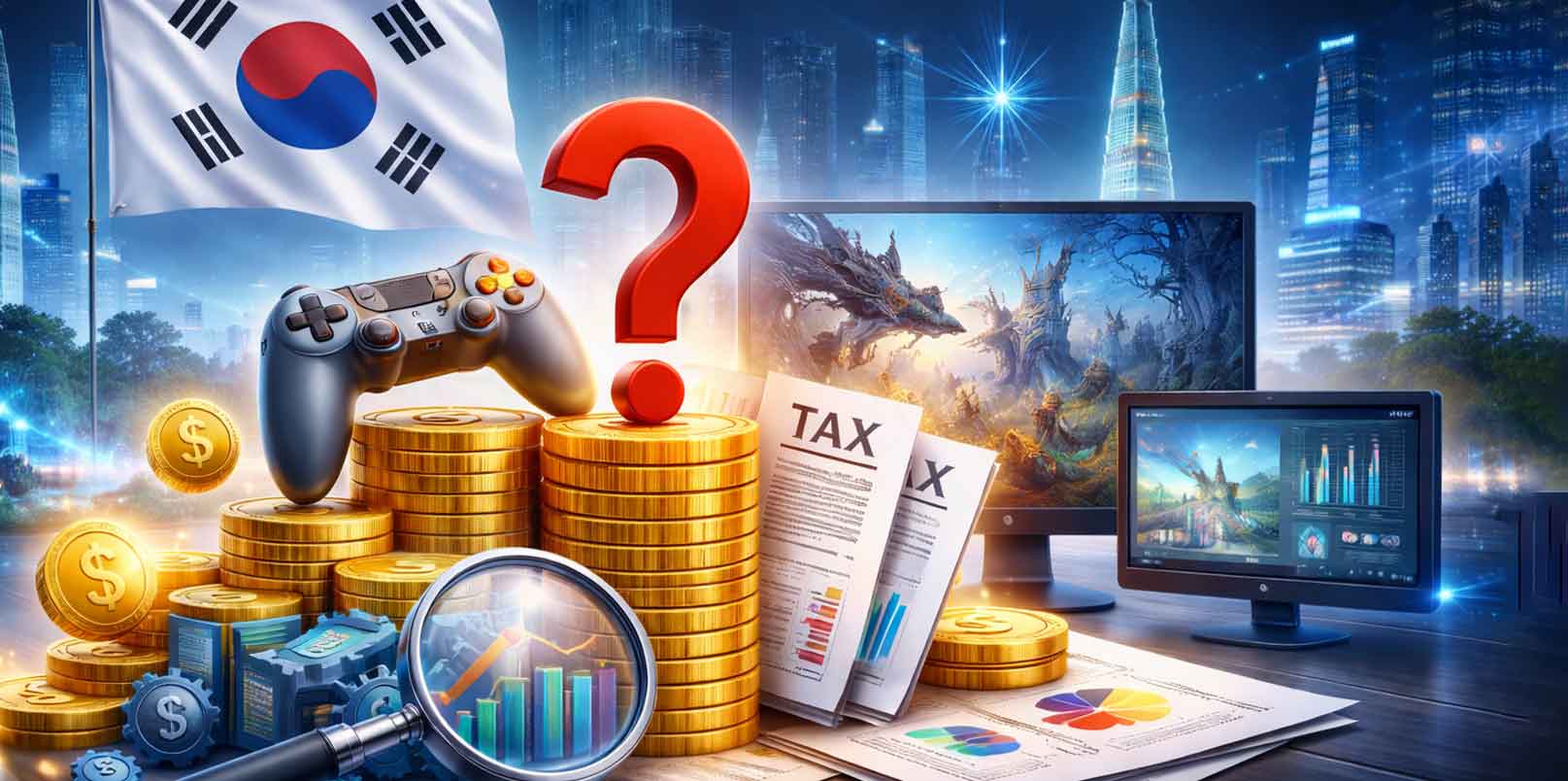
South Korea’s game industry has opened a new policy debate in Seoul that carries implications far beyond taxation. At a National Assembly forum on March 10, developers, policymakers, and industry groups examined whether the country’s current tax framework reflects the economic reality of game creation.
The issue emerged as development costs rise and smaller studios struggle to access existing research and development incentives. For many participants, the conversation moved quickly past competitiveness and toward a deeper concern: the survival of early-stage game developers in Korea’s startup ecosystem.
Korea’s Game Industry Calls for Production Cost Tax Credits
A policy forum titled “Enhancing Global Competitiveness of the Game Industry Through Tax Support” brought together lawmakers, industry representatives, and policy researchers at the National Assembly Members’ Office Building.
The event was hosted by People Power Party lawmaker Park Sung-hoon and organized by the Korea Game Industry Association (K-GAMES).
During the session, Song Jin, director of the Content Industry Policy Research Center at the Korea Creative Content Agency (KOCCA), presented data showing the scale of the sector within Korea’s cultural exports.
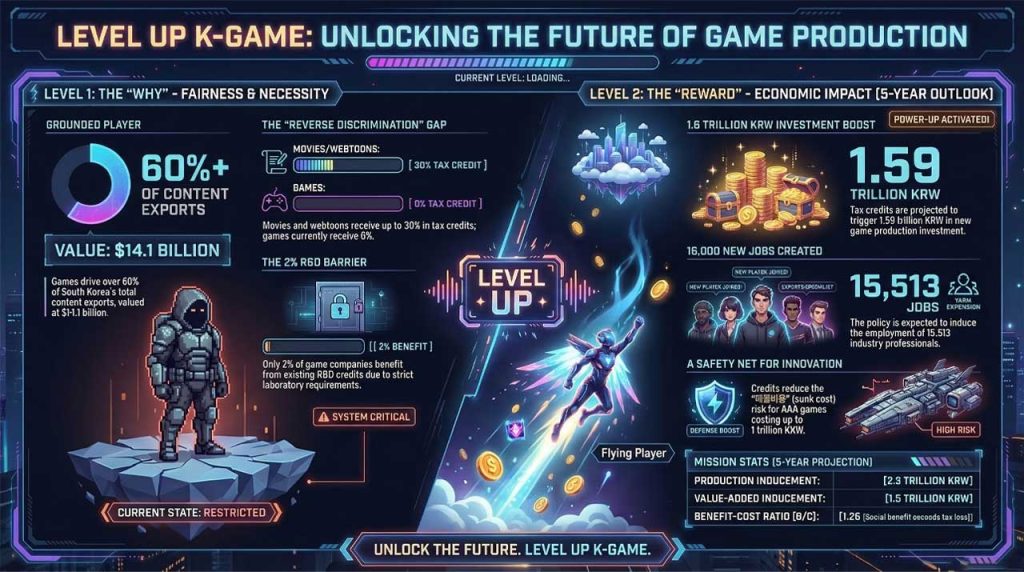
According to KOCCA’s analysis, Korea’s game industry generated KRW 23.8 trillion in revenue in 2024 and accounted for 60.4% of the country’s total K-content exports, which reached USD 14.1 billion.
Despite this role in the export economy, games remain outside Korea’s production cost tax credit framework. The current policy applies such credits only to film and video content and webtoon production under the Restriction of Special Taxation Act.
Participants at the forum argued that this gap has created a policy imbalance inside the country’s broader content ecosystem.
Why Developers Say the Current Tax System Misses Industry Reality
Industry representatives emphasized that the economic structure of game development differs significantly from traditional manufacturing or technology sectors.
According to the research presented at the forum, labor costs represent 62% of game production budgets, rising to 66.7% when outsourced work is included.
Existing tax incentives mainly rely on R&D tax credits, which require companies to maintain dedicated research departments focused on scientific or technological advancement.
Developers said that requirement does not match the project-based nature of game creation.
Hence, the challenge is particularly acute for smaller studios. Data presented at the event showed that 86.4% of Korean game companies employ between one and nine people, making the establishment of separate research divisions difficult.
As a result, many developers say they remain effectively outside the current tax support structure.
Officials from the Ministry of Culture, Sports and Tourism cited similar concerns during the forum. According to ministry data, fewer than 20 companies among roughly 1,300 game publishers in Korea currently receive R&D tax credits.
Rising Development Costs Are Increasing the Pressure on Studios
Participants also described how development economics in the global game market have shifted in recent years.
Culture Minister Choi Hwi-young noted that producing a large-scale game increasingly requires significant capital. According to remarks shared during the forum, AAA game projects can require investments ranging from several hundred billion won to more than KRW 1 trillion.
Development cycles can last three to four years, and success in the market remains uncertain.
Unlike manufacturing industries, game development produces limited physical assets during production. If a project fails, most of the investment becomes sunk cost.
Industry executives said that reality creates financial risk that current policy tools may not fully address.
Hwang Wook, chief financial officer of game publisher Neowiz, told participants that game studios now compete with a wider range of digital entertainment services.
Streaming platforms, short-form video, and other media formats all compete for the same user attention.
In that environment, he argued that policy support designed around traditional R&D frameworks does not necessarily reflect the competitive conditions faced by game developers.
Small Developers Say the Debate Is About Survival
The policy discussion has drawn particular attention to the pressures faced by early-stage studios.
Won Jae-ho, chief executive of game developer AnchorNode, described the risk structure facing small developers.
When development stops midway, the company often has little to show for years of investment. Unlike industrial sectors, there are no factories or inventory left behind.
Time, salaries, and development resources can disappear without generating recoverable value.
Developers at the forum suggested that production cost tax credits could function as a limited risk-sharing mechanism. Such policies could allow companies to recover part of their investment when projects fail, while still encouraging experimentation with new intellectual property.
Industry participants also linked the issue to employment stability. Game development teams often expand and contract based on project cycles, making the industry sensitive to financial shocks.
Government Signals Interest but Maintains a Cautious Position
While the forum showed growing political interest in the topic, fiscal authorities have taken a more cautious approach.
Officials from the Ministry of Economy and Finance emphasized that the gaming sector already benefits from several support mechanisms, including R&D tax credits, integrated investment tax credits, and tax reductions for startup small and medium-sized enterprises.
Government representatives also raised concerns about overlapping tax incentives if both R&D expenses and production costs were eligible for separate credits.
According to Cho Moon-gyun, director of the ministry’s tax incentive system division, any policy change must evaluate several factors, including economic impact, employment effects, and fiscal sustainability.
Officials indicated that further discussions between the government, the National Assembly, and industry groups would likely continue.
The Economic Case Presented by Policy Researchers
Research presented during the forum attempted to estimate the economic effects of introducing production cost tax credits.
KOCCA’s analysis suggested that the policy could generate measurable economic activity over five years.
According to the projections:
- Additional production investment could reach KRW 1.6 trillion
- Value-added economic impact could total around KRW 1.5 trillion
- Production-inducing effects could reach about KRW 2.3 trillion
- Employment growth could exceed 15,000 jobs
The research calculated a cost-benefit ratio of 1.26, suggesting that the overall economic benefits could exceed the expected reduction in tax revenue.
Song Jin said the policy could provide companies with a baseline level of financial stability while encouraging reinvestment in new projects.
Global Policy Context: Game Tax Incentives Are Common Elsewhere
Participants at the forum also pointed to policy frameworks in other major game development markets.
Countries including the United Kingdom, Canada, the United States, and Japan operate tax incentive programs targeting digital media or game production. These policies typically combine research support with production-related tax incentives designed to offset development risk.
Industry representatives said such frameworks allow studios in those markets to continue developing new projects even after commercial failures.
And so, this Seoul discussion suggests that Korea is beginning to examine whether the country needs similar policy tools to sustain its own game development ecosystem.
Why This Debate Matters for Korea’s Startup-Level Game Ecosystem
Additionally, the tax debate also reflects a structural divide inside Korea’s gaming industry.
Large publishers with established revenue streams can distribute risk across multiple projects and global releases.
On the other hand, smaller studios operate with far narrower margins. For early-stage developers, the outcome of a single title can determine whether a company continues operating.
Participants at the forum said that policy frameworks designed for manufacturing or large-scale R&D may not fully capture the economics of creative industries that are commonly built around project cycles.
The discussion therefore raises broader questions about how Korea’s innovation policy treats content startups compared with technology or manufacturing sectors.
Shaping The Resilience of Korea’s Game Development System
South Korea’s game industry remains one of the country’s most visible cultural export sectors. Yet the policy framework surrounding it is still in the evolving process. The debate over production cost tax credits illustrates how governments are beginning to reconsider how creative industries fit within national innovation strategies.
For Korea’s startup-level game developers, the outcome of that conversation could shape the conditions under which new studios attempt their next project. And that is why the final decision will likely depend on further discussions between policymakers, fiscal authorities, and industry participants.
But what is already clear is that the question now extends beyond tax policy. It touches the long-term resilience of Korea’s game development ecosystem.
Key Takeaways on Korea’s Game Production Tax Debate
- Games account for more than 60% of South Korea’s content exports, yet they currently receive no production cost tax credits.
- Most Korean game developers are micro-studios with fewer than 10 employees, limiting their access to R&D-based tax incentives.
- Development costs are rising, with AAA projects sometimes exceeding KRW 1 trillion, increasing financial risk for studios.
- Government officials acknowledge the debate but remain cautious due to concerns about overlapping tax incentives and fiscal impact.
- The policy discussion highlights a broader question about how Korea supports creative startups within its innovation ecosystem.
– Stay Ahead in Korea’s Startup Scene –
Get real-time insights, funding updates, and policy shifts shaping Korea’s innovation ecosystem.
➡️ Follow KoreaTechDesk on LinkedIn, X (Twitter), Threads, Bluesky, Telegram, Facebook, and WhatsApp Channel.
🤝 Looking to connect with verified Korean companies building globally?
Explore curated company profiles and request direct introductions through beSUCCESS Connect.