
A signed contract may secure market access in the Middle East, but it does not automatically secure commitment from distributors, retailers, or local partners. Many Korean companies entering Gulf markets still approach expansion as a transaction-driven process centered around agreements, shipments, and launch activity. Yet across the region’s business ecosystems, commercial relationships often continue being evaluated long after the paperwork is completed, shaping everything from distributor support and retail cooperation to long-term growth opportunities.
Gulf Business Networks Continue Operating Through Long-Cycle Partnership Structures
Commercial ecosystems across the Gulf remain heavily influenced by concentrated distributor networks, long-term partnership continuity, and family-led business groups that often prioritize reliability and sustained engagement alongside pricing or product competitiveness.
Saudi Arabia’s Regional Headquarters Program has already attracted more than 700 international companies, while the UAE continues strengthening its position as a regional coordination and commercial hub connecting global suppliers, distributors, and retail operators across the Gulf.
That environment increasingly affects how Korean startups, SMEs, and consumer brands are evaluated after entering the market, especially as regional operations become more interconnected across logistics, retail, healthcare, manufacturing, and consumer sectors.

Drawing from decades of experience managing regional commercial partnerships and distribution operations across the Middle East, founder and CEO of KOMEA Group, Taegyun (James) Lim, believes many Korean companies continue underestimating how relationship continuity influences long-term business performance across Gulf markets.
During an exclusive interview on Korean startups challenges in the Middle East, Lim told KoreaTechDesk that many foreign companies mistakenly assume business relationships stabilize once contracts are signed.
“In the Middle East, relationships are not simply a soft element of business.
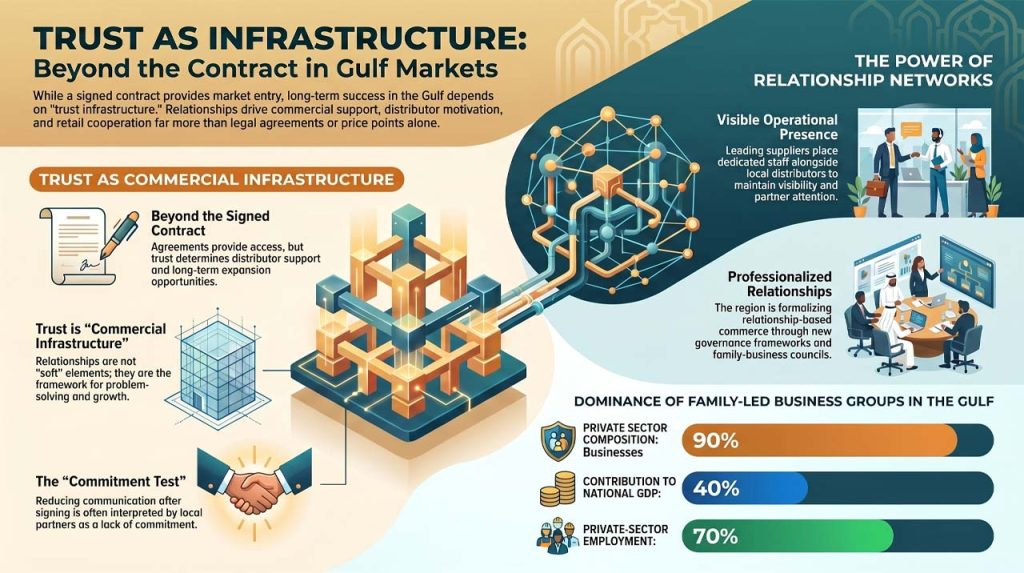
They are part of the commercial infrastructure,”
Contracts May Open Access, but Trust Often Determines Commercial Support
As Korean companies expand into Gulf markets, many still approach contracts as the primary indicator of business security. However, Middle Eastern commercial ecosystems often operate through longer-term relationship systems that continue evolving after agreements are signed.
The U.S. International Trade Administration (ITA) notes that business culture in the UAE places strong importance on personal relationships, integrity, and sustained engagement. The ITA also advises international companies to maintain frequent contact, local presence, and regular market visits because long-term relationships often influence commercial access and business continuity.
Lim said many Korean companies unintentionally weaken local partnerships after formal agreements are completed.
“One common mistake Korean companies make is reducing communication after signing a contract,”
he explained.
“From the local partner’s perspective, this can be interpreted as a lack of commitment.”
That issue can quietly affect distributor motivation, retailer cooperation, problem-solving speed, and future expansion opportunities long after initial agreements are signed.
Gulf Business Ecosystems Often Reward Consistency More Than Short-Term Activity
Relationship continuity has also become increasingly important because many Gulf economies remain heavily influenced by family-owned commercial groups and long-cycle partnership networks.
According to KPMG, family-owned businesses account for approximately 90% of the UAE’s private sector and contribute nearly 40% of national GDP. The sector also employs more than 70% of the UAE’s private-sector workforce.
At the same time, Forbes Middle East’s 2025 ranking of the Top 100 Arab Family Businesses showed Saudi Arabia and the UAE dominating the regional list through major commercial groups operating across retail, logistics, healthcare, manufacturing, real estate, and consumer distribution.
That structure creates an operating environment where reputation, responsiveness, and long-term reliability often carry commercial weight beyond the legal contract itself.
“Distributors and retailers do not make decisions based only on price and margin,”
Lim said.
“They evaluate whether a brand is reliable, responsive, committed to the market, and willing to invest for the long term.”
According to Lim, companies that consistently maintain communication, provide support, respond quickly to operational issues, and remain visibly engaged often secure stronger long-term collaboration opportunities.
“When trust is built, brands can secure better shelf positioning, additional store expansion, stronger marketing collaboration, and more flexible commercial discussions.”
Saudi Arabia’s Commercial Environment Increasingly Rewards Visible Commitment
Saudi Arabia’s rapidly expanding economy has further intensified the importance of sustained business engagement.
The ITA states that many foreign suppliers operating in Saudi Arabia place dedicated staff alongside local distributors to support training, marketing, and technical operations. Even companies without local teams are encouraged to maintain regular visits in order to preserve commercial visibility and partner attention inside highly relationship-sensitive business environments.
At the same time, Saudi Arabia’s distribution ecosystem remains closely interconnected. The ITA warns that replacing agents or distributors without careful handling can create reputational risks because of the kingdom’s tightly connected business networks.
That reality increasingly matters as Korean companies pursue larger opportunities tied to Saudi Vision 2030, industrial diversification, healthcare expansion, logistics infrastructure, smart-city development, and consumer market growth.
“In this region, regular communication, market visits, quick response to issues, and consistent support are essential,”
Lim explained.
“Trust is often stronger than the contract itself in determining long-term business success.”
The Gulf Is Professionalizing Relationship-Based Commerce, Not Replacing It
The region’s relationship-driven business structure is also becoming more institutionalized rather than disappearing.
In 2025, Dubai Chambers and Dubai’s Department of Economy and Tourism launched a dedicated family-business guidebook covering governance, succession planning, strategic continuity, conflict management, and long-term sustainability. Abu Dhabi’s Family Business Council also expanded cooperation initiatives supporting governance frameworks and next-generation leadership development across Gulf family enterprises.
Those developments suggest Gulf economies are not moving away from relationship-oriented commerce. Instead, they are building more formal governance structures around long-term business continuity.
That shift may become increasingly important for Korean companies that still approach Gulf expansion primarily through transactional sales targets or short-term distributor arrangements.
The Middle East Is Becoming a Long-Term Commitment Test for Korean Companies
The Gulf’s rapid economic expansion continues creating meaningful opportunities for Korean startups, SMEs, technology firms, and consumer brands. Yet the region is also quietly testing how well companies sustain commercial relationships after the first agreement, shipment, or launch cycle is completed.
For many Korean companies, the next stage of Middle East expansion may depend less on entering the market quickly and more on remaining operationally present long enough to build durable business credibility inside regional commercial ecosystems.
Lim believes that distinction increasingly separates short-term activity from sustainable growth.
“I often describe the Middle East not as a market that grows quickly from day one, but as a market that grows quickly after trust is built.”
Key Takeaways
- Middle Eastern commercial ecosystems increasingly reward long-term relationship continuity, not only signed contracts or short-term sales activity.
- Personal relationships, responsiveness, and sustained engagement often influence distributor support, retailer cooperation, and expansion opportunities across GCC markets.
- Family-owned business groups continue shaping major sectors across the Gulf, including retail, logistics, healthcare, manufacturing, and consumer distribution.
- Saudi Arabia and the UAE remain highly relationship-sensitive business environments, where regular communication and visible commitment can affect long-term commercial credibility.
- Many Korean companies weaken partnerships after signing agreements by reducing communication, market visits, or operational involvement.
- Trust functions as commercial infrastructure in many Middle Eastern markets, affecting negotiations, collaboration flexibility, and long-term business continuity.
- The Gulf is professionalizing relationship-based commerce through governance and continuity frameworks, not abandoning it.
- Korean companies seeking sustainable GCC growth increasingly need long-term partnership discipline rather than fast expansion alone.
– Stay Ahead in Korea’s Startup Scene –
Get real-time insights, funding updates, and policy shifts shaping Korea’s innovation ecosystem.
➡️ Follow KoreaTechDesk on LinkedIn, X (Twitter), Threads, Bluesky, Telegram, Facebook, and WhatsApp Channel.
🤝 Looking to connect with verified Korean companies building globally?
Explore curated company profiles and request direct introductions through beSUCCESS Connect.