

Building good quality products has never been a challenge for Korean startups. What happens after these good products leave Korean soil is where the challenge most likely begins. Across Southeast Asia, founders most often encounter a surprising reality: users may admire the technology and understand its value. But they still choose not to adopt it. Hence, as Korean companies expand deeper into ASEAN, the next competitive challenge may not be innovation itself, but understanding how local customers actually buy, learn, trust, and use the products.
Korean Brands Have Momentum in Southeast Asia, But Adoption Requires More
South Korea enters Southeast Asia with advantages that many foreign startups would welcome. Korean entertainment, beauty products, consumer brands, and digital culture have built strong familiarity across the region.
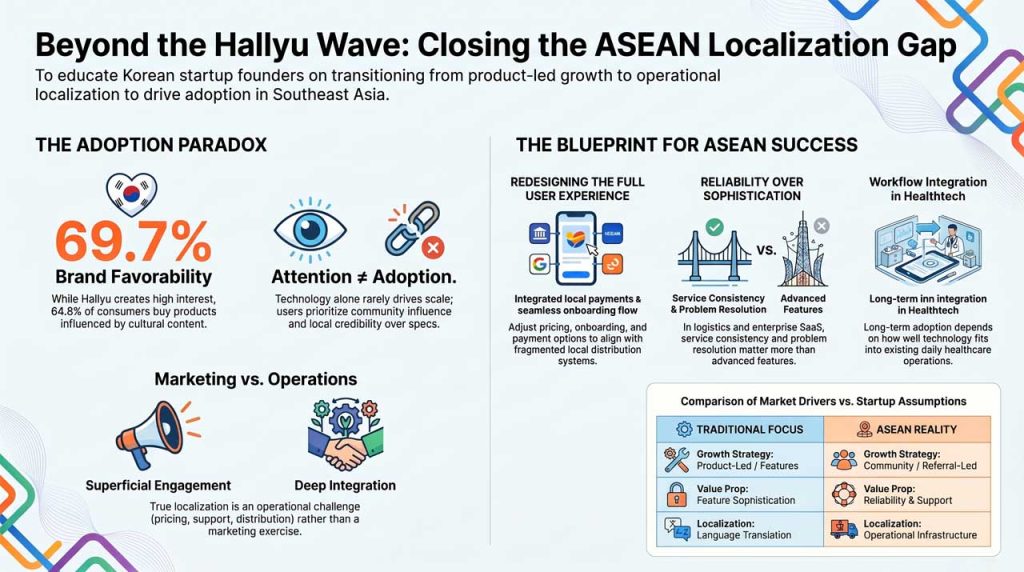
According to the 2026 Global Hallyu Trends report released by Korea’s Ministry of Culture, Sports and Tourism and the Korean Foundation for International Cultural Exchange (KOFICE), Korean cultural content favorability reached 69.7 percent across surveyed markets. The report also found that 64.8 percent of respondents had purchased Korean products or services influenced by Korean cultural content.
That familiarity can help Korean startups attract attention. Yet attention and adoption are not the same thing.
Henry Maw, Founder and Chairman of X Venture Holdings, who has worked across venture investment, startup development, healthcare operations, and frontier Southeast Asian markets, believes many foreign startups still underestimate this distinction.
“Korean startups are globally respected for product quality, engineering discipline, and speed of execution,”
Maw told KoreaTechDesk as discussion on Korean startup expansion to SEA continues.
“However, in emerging Southeast Asia, technology alone is rarely enough to drive adoption at scale.”

Digital Adoption Is Rising, But Buying Behavior Remains Local
Southeast Asia’s digital economy continues expanding rapidly. The 2025 e-Conomy SEA report by Google, Temasek, and Bain & Company projects regional gross merchandise value will exceed USD 300 billion this year, supported by growing e-commerce activity, digital payments, and online services.
But digital maturity does not automatically create uniform customer behavior.
The same report highlights the growing influence of video commerce, which now represents approximately one-quarter of regional e-commerce activity. Consumers increasingly discover and evaluate products through creators, social media communities, and trusted recommendations rather than traditional digital advertising channels alone.
This creates a challenge for foreign startups accustomed to product-led growth strategies.
“Users often adopt products through community influence, referrals, or offline credibility rather than purely digital marketing efficiency,”
Maw explained.
As a result, a product that performs well in one market may encounter entirely different adoption dynamics elsewhere, even when the underlying technology remains unchanged.

Localization Means Redesigning More Than the User Interface
Localization is often associated with language translation, regional marketing campaigns, or minor product customization.
In practice, successful ASEAN expansion usually requires a deeper adjustment.
According to Maw, products gain relevance when they fit local operating realities rather than simply delivering strong technical performance.
“Products become relevant when they align with local operating realities, affordability levels, fragmented distribution systems, customer trust behavior, and service consistency expectations.”
For many startups, that means rethinking pricing structures, onboarding processes, payment options, customer support models, and channel strategies.
Research from the Korea Institute for International Economic Policy (KIEP) suggests that ASEAN economies continue developing digital infrastructure, payment ecosystems, and digital business capabilities at different speeds. While internet access has expanded significantly, differences remain in business digitalization levels, operational readiness, and user behavior.
This gives startups more signals that localization increasingly becomes an operational challenge rather than a marketing exercise.

Healthtech and Medtech Adoption Depends on Workflow Fit
Moreover, the challenge becomes particularly visible in healthcare.
Korean healthtech and medtech companies are attracting growing attention across Southeast Asia due to their technical capabilities and innovation strengths. Yet adoption often depends on factors that extend beyond technology.
The ASEAN-Japan Centre’s assessment of digital health adoption across ASEAN found that healthcare systems continue facing challenges related to interoperability, workforce readiness, digital trust, and integration into existing healthcare environments.
Maw believes many startups underestimate how important those practical considerations can become.
“For example, in healthcare or medtech, advanced technology may generate interest initially, but long-term adoption often depends more on pricing accessibility, after-sales support, training capability, and integration into existing healthcare workflows.”
A solution may be technologically superior yet still struggle if healthcare providers cannot integrate it efficiently into daily operations.

Reliability Often Matters More Than Feature Sophistication
The same pattern appears in enterprise software, logistics, and operational technology.
While startups frequently compete by introducing new features, customers often prioritize reliability, responsiveness, and problem resolution.
“In logistics or enterprise solutions, reliability can matter more than feature sophistication,”
Maw said.
This observation aligns with broader customer experience research. Qualtrics’ global consumer experience studies have consistently shown that service delivery, communication quality, and issue resolution influence customer satisfaction as strongly as product performance itself.
Hence, for businesses operating in complex environments, trustworthy service frequently creates more value than incremental product enhancements.
That reality becomes increasingly important as Korean startups expand into sectors such as logistics technology, enterprise SaaS, AI infrastructure, digital health, and operational platforms across Southeast Asia.
The Real Test Begins After Product-Market Fit
Many founders approach international expansion by asking whether local customers need their product.
But an equally important question is whether local customers can adopt it realistically.
Distribution channels, onboarding requirements, training needs, service expectations, payment preferences, and workflow compatibility often determine adoption outcomes long after initial interest has been established.
Maw argues that companies achieving long-term success in ASEAN tend to focus on solving practical operational problems instead of assuming that strong technology will naturally drive market acceptance.
“Sustainable success in emerging Southeast Asia comes from solving real operational problems consistently over time, not simply exporting technology.”
The Next Layer of ASEAN Expansion
In the end, as Korean startups continue expanding across Southeast Asia, product quality will remain an important competitive advantage.
Yet the companies that build lasting positions may increasingly be the ones that understand something deeper: customers do not adopt technology because it is impressive. They adopt technology because it fits naturally into how they already live, work, buy, and solve problems.
And in ASEAN’s increasingly competitive markets, localization is no longer about changing the language on a product. It is about ensuring the product belongs inside the realities of the market it hopes to serve.
Key Takeaway
- Korean startups enter ASEAN with strong product and engineering advantages, supported by growing familiarity with Korean brands and culture.
- Technology alone does not guarantee adoption, according to X Venture Holdings Founder and Chairman Henry Maw.
- Digital consumers across Southeast Asia often rely on community influence, referrals, creators, and local credibility when evaluating products and services.
- Localization increasingly involves pricing, onboarding, payment systems, support models, and distribution strategy, not just language adaptation.
- Healthtech and medtech adoption depends heavily on workflow integration, training, affordability, and operational fit, not only innovation.
- Enterprise and logistics customers frequently prioritize reliability and service consistency over feature sophistication.
- Successful ASEAN expansion requires solving local operational challenges consistently, making localization a core business capability rather than a marketing function.
– Stay Ahead in Korea’s Startup Scene –
Get real-time insights, funding updates, and policy shifts shaping Korea’s innovation ecosystem.
➡️ Follow KoreaTechDesk on LinkedIn, X (Twitter), Threads, Bluesky, Telegram, Facebook, and WhatsApp Channel.
🤝 Looking to connect with verified Korean companies building globally?
Explore curated company profiles and request direct introductions through beSUCCESS Connect.