
A founder walks into a fundraising meeting expecting questions about vision, market size, and product strategy. Instead, the conversation turns to customer acquisition costs, payback periods, and assumptions buried inside financial models. The shift can be jarring. Yet as venture funding recovers in Korea and other markets, many investors appear to be making decisions earlier than founders realize. So now, the first test for Korean startups is often not the idea itself. It is whether the founder truly understands the business behind it.
Korea’s Venture Recovery Is Real, but Investor Expectations Are Changing
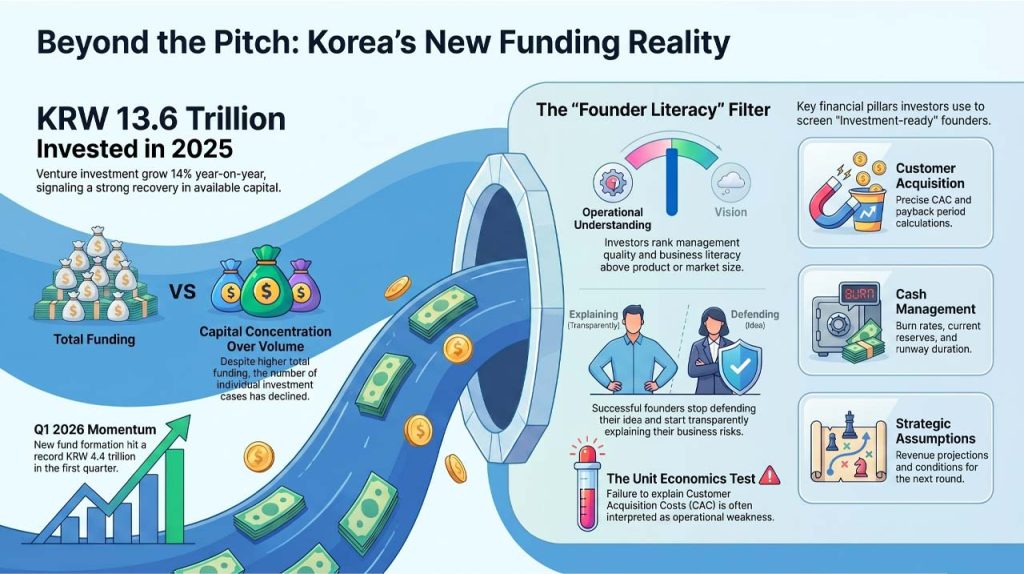
South Korea’s venture market has regained momentum after a difficult funding cycle. According to the Ministry of SMEs and Startups (MSS), venture investment reached KRW 13.6 trillion in 2025, up 14 percent year-on-year. New venture fund formation climbed to KRW 14.3 trillion, while the number of investment cases reached a record high.
This recovery has continued into 2026. MSS reported that first-quarter venture investment reached KRW 3.3 trillion, with new fund formation hitting a record KRW 4.4 trillion for a first quarter.
Those figures suggest capital remains available. Yet they do not tell the full story.
Data compiled by TheVC shows that while overall investment value remained relatively resilient in 2025, the number of investments declined sharply. Early-stage investment activity also weakened, while average deal sizes increased. The pattern suggests that investors are concentrating capital more selectively and spending more time evaluating which companies are prepared for institutional funding.

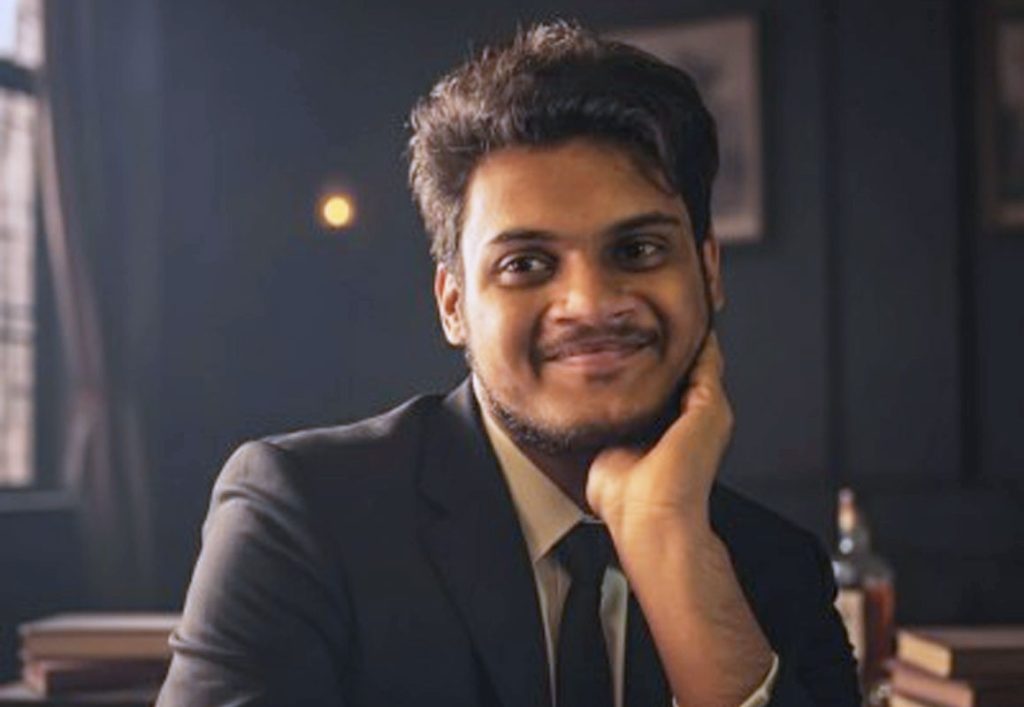
That distinction sits at the center of a conversation KoreaTechDesk recently had with Shakeel Ahamed, CEO of WisePrince LLP, a firm focused on startup fundraising readiness, governance, and company institutionalization across Asia.
Investors Often Evaluate Founders Before They Evaluate Ideas
Many founders enter fundraising discussions believing investors are primarily assessing innovation, product quality, or market potential.
Ahamed, who has advised startups across Asia on fundraising readiness, governance, and institutionalization, argues that assumption frequently misses what happens in the room.
“Investors are not evaluating your idea. They never really were.”
Drawing on years of working with founders preparing for investor scrutiny, Ahamed says experienced investors are often trying to determine whether founders understand their own businesses with enough depth to navigate uncertainty, answer difficult questions, and build a durable company.
That perspective aligns with broader venture capital research. A survey of hundreds of venture capital firms summarized by the National Bureau of Economic Research found that investors consistently rank management quality among the most important factors in investment decisions, often ahead of product, business model, or market factors.
Hence, for founders, that completely changes the nature of preparation. Fundraising then becomes less about delivering a polished narrative and more about demonstrating operational understanding.
The Numbers Founders Think They Know Can Become the Real Test
One example shared by Ahamed involved a founder who appeared confident discussing growth plans and product strategy. But then, the conversation changed when he was asked a simple question: what does it cost to acquire a customer, and how long does it take to earn that money back?
The founder provided a range but could not truly explain how the figure had been calculated. Sales effort, onboarding costs, and customer churn had not been properly incorporated into the analysis.
“He wasn’t being dishonest. He genuinely believed that was the answer. But it wasn’t close.”
The lesson extends beyond customer acquisition costs.
Investors increasingly examine burn rates, cash reserves, gross margins, retention assumptions, and runway calculations. Korean investment industry reports have also highlighted growing investor attention to operational efficiency and cash sustainability as funding decisions become more disciplined.
That is why when founders cannot clearly explain those fundamentals, investors may interpret the gap as a deeper operational weakness rather than a simple financial oversight.

Why Experience Changes Startup Fundraising Conversations
Ahamed believes many first-time founders misunderstand what investor meetings are designed to reveal.
Early fundraising discussions often feel like opportunities to persuade investors that a vision is compelling. Over time, founders begin to recognize that investors are testing assumptions, probing weaknesses, and examining decision-making processes.
“The founders who close rounds are almost always the ones who can say those things clearly and without flinching.”
That shift becomes visible as founders accumulate experience.
“In the early pitches, they’re defending their idea. By pitch ten or twelve, they’ve stopped defending and started explaining.”
The difference may sound subtle, but it changes the entire conversation. Because when founders focus on defending an idea, discussions can become adversarial, with investors probing for weaknesses.
But when they focus on explaining the business, the conversation becomes more collaborative, centered on understanding risks, assumptions, and opportunities.

Why This Matters for Korean Startups Preparing to Raise Capital
The Korean startup ecosystem is entering a period where funding recovery and investor selectivity are advancing at the same time.
More capital is being deployed, but investors are demanding stronger evidence that founders understand how their businesses operate beneath the surface.
Hence, for Korean startups, it means preparation should extend beyond pitch decks and storytelling exercises. And the founders preparing for fundraising may need clear answers to questions such as:
- What is the precise customer acquisition cost?
- How long is the payback period?
- What assumptions support revenue projections?
- How much runway remains under current spending patterns?
- Which parts of the business model are still uncertain?
- What conditions must be met before the next funding round?
Those answers are becoming increasingly important because investors often view them as initial indicators of how founders will make decisions when conditions become difficult.
The Difference Between Knowing and Believing for Startups
Ultimately, the strongest fundraising conversations are rarely the most theatrical.
They are often the ones where founders can describe their businesses with clarity, including weaknesses, uncertainties, and unresolved questions. That level of understanding creates a different kind of credibility than confidence alone.
And as capital returns to Korea’s venture ecosystem, more founders will undoubtedly gain access to more investor meetings. That is why the challenge is that access no longer guarantees consideration.
In the end, yes, investors may still care deeply about ambitious ideas. But before they reach that discussion, many are asking a simpler question: does the founder truly understand the company they are asking these investors to fund?
Key Takeaway
- Korea’s venture market is recovering, with venture investment reaching KRW 13.6 trillion in 2025 and growth continuing into 2026.
- Investor-readiness is becoming a critical fundraising filter, particularly as investors concentrate capital more selectively.
- Investors often evaluate founders’ understanding of their businesses before assessing the ideas themselves.
- Operational understanding matters increasingly, including customer acquisition costs, payback periods, burn rates, and business assumptions.
- Fundraising success depends on explanation rather than performance, especially during serious investor scrutiny.
- For Korean founders, business literacy and financial clarity are becoming as important as vision and product quality when seeking institutional capital.
– Stay Ahead in Korea’s Startup Scene –
Get real-time insights, funding updates, and policy shifts shaping Korea’s innovation ecosystem.
➡️ Follow KoreaTechDesk on LinkedIn, X (Twitter), Threads, Bluesky, Telegram, Facebook, and WhatsApp Channel.
🤝 Looking to connect with verified Korean companies building globally?
Explore curated company profiles and request direct introductions through beSUCCESS Connect.