
In South Korea, many young jobseekers are not underprepared in the usual sense. They study longer, collect certificates, pay for private job-preparation services, build portfolios, and submit repeated applications. Yet many still miss the roles they are trying to reach. Today, in Korea’s employment scene, the problem is becoming less about effort itself and more about whether that effort is aimed at the right market signal.
Korea’s Jobseekers Are Preparing More, But Direction Is Still Weak
Korea’s youth employment challenge is often discussed as a lack of opportunity, but recent data points to a more complex problem. Many jobseekers are preparing actively, yet their preparation does not always improve role fit, employer relevance, or hiring conversion.
Statistics Korea’s 2025 youth supplementary survey found that 14.5% of economically inactive young people were preparing for employment exams, up 0.6 percentage points from the previous year. Among those preparing, 36.0% were focused on general private companies, followed by 18.2% preparing for general civil service and 17.8% preparing for functional certificates or other fields.
This means preparation has become a form of labor-market waiting in South Korea. Instead of entering a role, testing fit, and adjusting direction, many young people remain in a prolonged preparation cycle. That cycle can look productive on paper, but it does not always clarify what job they are targeting or what proof employers need.

The Real Problem Is Not Effort, But Market Interpretation
While discussing Korea’s growing mismatch between job preparation and actual labor-market alignment, Min Jeong Kim, CEO of Career Road Lab (커리어로드), told KoreaTechDesk that many jobseekers are not lacking effort or activity at all.
Instead, the problem often emerges when preparation expands without being connected to a clear job target or realistic understanding of role demand.
“Some job seekers try to accumulate more education, certifications, and credentials when they feel anxious. However, if they continue adding experiences without a clear job goal, their employment strategy may become scattered.”
Her point is important because Korea’s job-preparation culture has long rewarded visible signals. Degrees, English scores, certificates, internships, and portfolio projects can all matter. But when these signals are collected without a clear understanding of role demand, they may not tell employers what problem a candidate can solve.
Now, this is not a moral failure by jobseekers. It simply reflects a labor market where the rules are hard to read, feedback is limited, and many applicants respond to uncertainty by adding more credentials.
Korea’s Job Preparation Is Becoming More Expensive
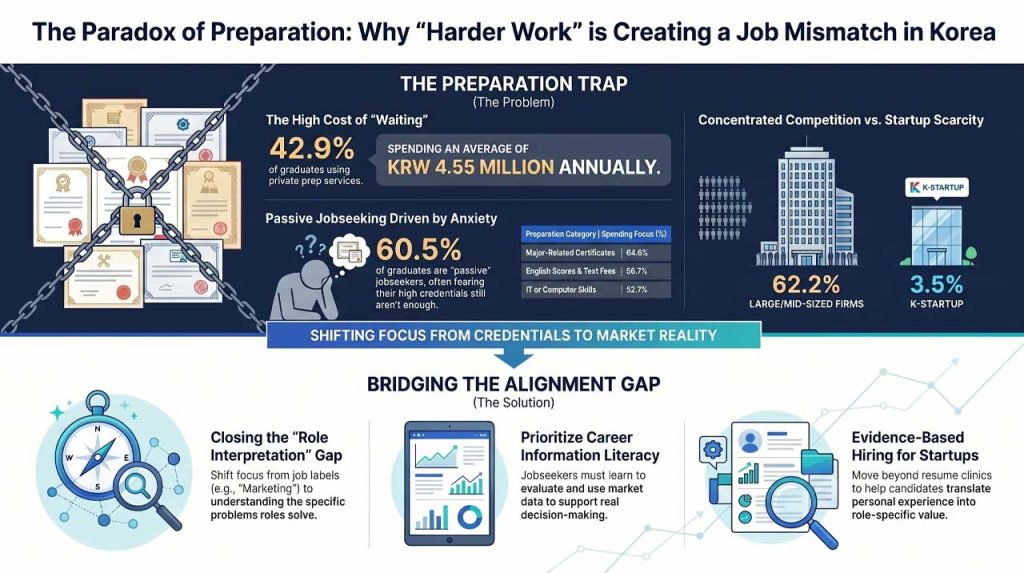
The financial burden of this preparation race is also rising. A JobKorea survey reported by Electronic Times found that 42.9% of 485 graduated jobseekers had used private employment-preparation services, up from 31.6% in 2021.
Those who used such services spent an average of KRW 380,000 per month, or about KRW 4.55 million per year. The most common spending categories were major-related certificates at 64.9%, English scores and test fees at 56.7%, non-major certificates at 37.0%, and IT or computer skills at 32.7%.
These numbers show that Korean jobseekers are not passive. Many are even investing real money before they even earn their first stable income. The risk is that preparation becomes a market in itself, while the actual job market keeps asking a different question: What can this person do in this role, under these conditions, for this company?
Many Applicants Still Struggle to Read the Role
One major gap is role understanding. Job titles can appear familiar, but the actual work behind them can vary widely by company size, industry, and business model.
Kim explained this issue through common career choices among young jobseekers.
“Many people say, ‘I want to work in marketing,’ ‘I want to work in HR,’ or ‘I want to work in data analysis,’ but they may not clearly understand what problems those roles solve, how tasks are performed, or what outcomes are expected.”
This distinction is crucial for Korea’s startup and technology ecosystem. A candidate who says they want marketing may be thinking about content production, while a startup may need someone who can read customer behavior, test messaging, analyze conversion, and work with product teams. A candidate interested in data analysis may know the tools, but may not know how different companies use data in real decisions.
The role label hides the actual work. When preparation focuses on the label rather than the work system, mismatch grows.
Passive Jobseeking Shows the Anxiety Behind the Preparation Race
The Federation of Korean Industries’ 2025 college employment perception survey found that 60.5% of fourth-year university students and graduates were passive jobseekers.
Among them, 37.5% said they were passive because they lacked sufficient skills, knowledge, or capability and needed more preparation. Another 22.0% felt they were unlikely to secure employment even if they searched, while 16.2% cited a lack of jobs in their field of interest.
This data helps explain why preparation keeps expanding. Many young people do not simply want to delay work. They feel the market is difficult to enter and fear that their current profile is not enough.
The danger is that additional preparation can become a substitute for sharper decision-making. If a jobseeker does not know which role fits, which company type matches their tolerance for risk, or which experience proves job relevance, more preparation may only add volume, not direction.
Preferred Employers Narrow the Market Further
Korean jobseekers’ company preferences also shape the mismatch.
A Korea Chamber of Commerce and Industry survey found that 62.2% of young jobseekers preferred medium-sized or large companies, with 33.8% preferring mid-sized firms and 28.4% preferring large companies. Only 11.4% preferred SMEs, while 3.5% preferred venture startups.
This preference is not irrational. Larger employers often offer clearer training, stronger brand recognition, better pay structures, and more stable career paths. Jobseekers are responding to real differences in job quality.
But the effect is still important. When many applicants concentrate around a limited set of preferred employers, competition rises and preparation becomes more standardized. Meanwhile, SMEs and startups may struggle to attract candidates, even when they offer faster learning opportunities or broader responsibility.
This does not mean jobseekers should simply lower expectations. It means career decisions need a clearer reading of trade-offs: stability, salary, learning speed, role breadth, company risk, and long-term career direction.
Korea Needs Career Information Literacy, Not Just More Information
Kim argues that jobseekers need more than access to job postings or career content. They need the ability to interpret that information.
“What job seekers need is not simply more information, but the ability to compare, evaluate, and use information in ways that support their career decision-making.”
This idea is especially relevant for Korea’s evolving labor market. Career information literacy means understanding what a job actually requires, how roles differ across company types, how personal experience becomes evidence, and how to adjust strategy when applications fail.
For founders and startup operators, this matters because many applicants may appear active but not role-ready. For policymakers and universities, it suggests that career support should move beyond resume clinics and certificate guidance. Jobseekers need help reading the market, not only preparing for it.

What This Means for Korea’s Startup Ecosystem
Finally, Korea’s talent issue is not only about how many people are educated, trained, or available. It is also about how well individuals understand where their skills fit.
For startups, this creates a practical hiring challenge. Applicants may bring strong preparation but weak role interpretation. Founders may receive many resumes, yet still struggle to identify candidates who understand customer problems, execution demands, and startup operating conditions.
For global investors and ecosystem operators, the lesson is broader. Korea has a deep talent base, but talent readiness depends partly on how well the market helps people translate preparation into role-specific value. A labor market full of prepared jobseekers can still produce mismatch if preparation is disconnected from employer reality.
Key Takeaway
- Korea’s jobseekers are preparing intensely, but more preparation does not always produce stronger labor-market fit.
- 14.5% of economically inactive young people were preparing for employment exams, showing how preparation has become a waiting mode for many.
- 42.9% of graduated jobseekers used private job-preparation services, spending an average of KRW 4.55 million per year.
- The core issue is not effort alone, but whether preparation is connected to role clarity, company needs, and job-specific evidence.
- Career information literacy as a missing layer, meaning the ability to compare, evaluate, and use job information in real career decisions.
- Young jobseekers’ preference for larger and more stable employers is rational, but it can narrow the market and intensify competition around limited roles.
- For Korea’s startup ecosystem, the challenge is not only finding educated applicants. It is finding candidates who understand the role, the company context, and the problem they are expected to solve.
– Stay Ahead in Korea’s Startup Scene –
Get real-time insights, funding updates, and policy shifts shaping Korea’s innovation ecosystem.
➡️ Follow KoreaTechDesk on LinkedIn, X (Twitter), Threads, Bluesky, Telegram, Facebook, and WhatsApp Channel.
🤝 Looking to connect with verified Korean companies building globally?
Explore curated company profiles and request direct introductions through beSUCCESS Connect.