
A cybersecurity pilot succeeds. The AI system detects threats accurately, reduces alert fatigue, and impresses technical teams during demonstrations. Months later, the deployment quietly stalls inside internal review processes. Apparently, the issue is often not about the model’s detection capability itself. Because across parts of the Middle East, regulated institutions are beginning to ask a different question before approving AI security systems at scale: can the organization fully explain, audit, and govern how the AI makes decisions?
AI Security Adoption Is Expanding Across the Gulf
The Gulf’s push toward AI-driven cybersecurity is closely tied to wider digital transformation agendas across Saudi Arabia and the UAE.
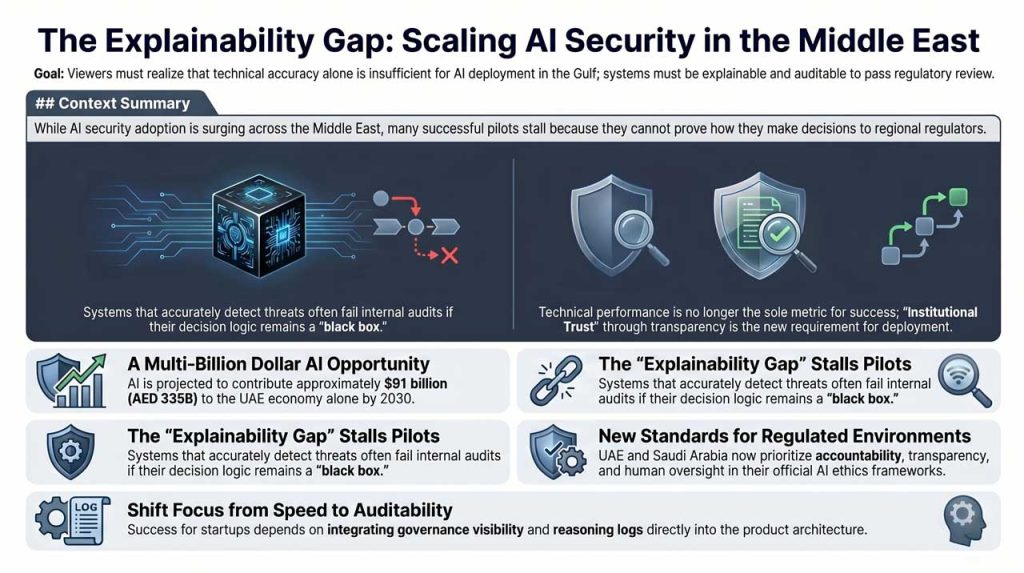
The UAE’s National Strategy for Artificial Intelligence 2031 previously estimated that AI could contribute approximately AED 335 billion (around USD 91 billion) to the country’s economy by 2030, while separate PwC estimates cited by the strategy projected AI could add roughly AED 353 billion to UAE GDP by the same period. Meanwhile, Saudi Arabia continues integrating AI governance into broader digital infrastructure modernization programs as part of its national digital transformation agenda.
At the same time, cybersecurity operations are becoming increasingly automated. According to IDC’s 2025 Middle East Managed Detection and Response assessment, regional cybersecurity providers are already expanding AI-powered security operations involving automated response systems, AI-assisted threat analysis, and compliance monitoring capabilities tied to cloud, endpoint, and identity environments.
This creates a growing opportunity for Korean cybersecurity startups specializing in AI-based threat detection, SOC automation, and compliance systems.
Over the years, South Korea has been strengthening cybersecurity and AI cooperation with Middle Eastern institutions through organizations such as the Korea Internet & Security Agency (KISA), including recent agreements involving AI-based threat response collaboration with Saudi security institutions.
Still, adoption inside regulated Gulf environments is becoming increasingly selective.
Why AI Security Pilots Are Struggling to Reach Deployment
Mohammad Alkhudari, Founder and CEO of Green Circle for Cybersecurity and VP & Chief FinTech Officer at Beeezcrowd, has worked across cybersecurity operations, AI governance environments, and fintech infrastructure projects throughout Saudi Arabia, Jordan, and the broader GCC ecosystem.
According to Alkhudari, many AI cybersecurity systems perform well during demonstrations and pilot deployments. But then, the friction begins later, when institutions start evaluating governance visibility and operational accountability.
“Adoption of AI in cybersecurity across the region is real but selective,”
Alkhudari told KoreaTechDesk during discussion on cybersecurity startups’ challenges in Middle East.
“The most active areas are SOC automation, particularly alert triage and threat correlation, and compliance monitoring.”
This distinction means that AI deployment discussions inside regulated institutions are increasingly moving beyond performance metrics alone. Buyers are now asking how AI systems arrive at decisions, how those decisions can be audited, and how organizations maintain operational control once AI becomes integrated into security workflows.
Explainability Is Becoming a New Security Requirement
Now, according to Alkhudari, the strongest barrier he had successfully identified is explainability.
“The transition from pilot to deployment most often breaks down around explainability and control,”
Alkhudari stated.
“Decision-makers in regulated institutions, especially government, are uncomfortable with AI systems where the decision logic is opaque.”
This challenge is becoming increasingly relevant as Gulf governments expand formal AI governance frameworks. The UAE’s official AI policy principles emphasize accountability, transparency, explainability, resilience, safety, and human oversight in AI systems.
Digital Dubai’s AI Ethics Guidelines similarly state that AI-driven decisions should remain understandable and interpretable for users and regulators whenever technically possible.
Not only that, but Saudi Arabia is also strengthening governance around AI deployment. The Saudi Digital Government Authority states that the Kingdom’s AI ethics principles were designed to reduce risks associated with AI systems and improve governance around security, accountability, and societal impact.
As a result, AI cybersecurity systems entering regulated environments are now being evaluated through governance frameworks that resemble financial or critical infrastructure oversight rather than traditional software procurement.

Why Technical Accuracy Alone No Longer Guarantees Approval
For many Korean AI cybersecurity startups, this creates a structural shift in deployment expectations.
“A Korean AI-based security tool that produces accurate detections but cannot explain its reasoning in a format that satisfies an internal audit committee will not get past the pilot stage,”
Alkhudari said.
That concern extends beyond technical teams. AI security deployments increasingly involve compliance departments, governance committees, internal auditors, and executive leadership evaluating operational accountability before systems are approved for broader deployment.
And the issue is not necessarily skepticism toward AI itself. Gulf institutions are actively investing in AI adoption across government and enterprise environments. However, the operational standards around AI are evolving simultaneously.
Actually, this direction has recently been reflected throughout large enterprise initiatives.
At GITEX 2025, Deloitte and IBM announced plans to expand responsible AI deployment initiatives across the GCC, including governance-focused AI systems designed for regulated industries such as banking, government, energy, and utilities.
This reflects a wider shift in enterprise AI adoption across the region. Organizations are no longer only searching for automation capability. They are increasingly prioritizing systems that can demonstrate oversight, governance compatibility, and audit visibility.
AI Governance Is Quietly Reshaping Cybersecurity Competition
The shift carries important implications for Korean cybersecurity companies targeting Middle East expansion.
South Korea remains highly competitive in AI-enabled cybersecurity technologies, especially in areas such as threat detection, endpoint protection, behavioral analytics, and automated SOC operations. However, deployment success in the Gulf may increasingly depend on how effectively companies integrate governance visibility into product architecture itself.
Korea’s own policy discussions are moving in a similar direction. A 2025 report from the Korea Information Society Development Institute (KISDI) argued that AI security and AI safety can no longer be treated separately because AI systems now influence both cyber defense and emerging cyber risks simultaneously.
That overlap is becoming highly visible in the Gulf. AI cybersecurity tools are now entering environments where regulators, government institutions, and financial operators expect explainability standards similar to those applied to critical infrastructure systems.
So for Korean startups, this changes how AI products may need to be designed before entering regulated MENA environments.
Detection capability alone may no longer determine competitiveness. Auditability, governance alignment, escalation transparency, and human oversight mechanisms are increasingly becoming part of the deployment evaluation process itself.
The Next AI Security Battleground May Be Institutional Trust
In the end, the Middle East continues investing aggressively in AI infrastructure, cybersecurity modernization, and digital governance systems. Saudi Arabia and the UAE are both positioning themselves as regional AI hubs while simultaneously expanding national cybersecurity and AI governance frameworks.
That combination is creating a new deployment environment for foreign cybersecurity vendors.
Hence, the next generation of successful AI security platforms may not simply be the systems that detect threats fastest. Increasingly, they may be the systems capable of explaining their reasoning clearly enough for regulators, auditors, and institutional decision-makers to trust them inside highly sensitive environments.
As AI adoption accelerates across cybersecurity operations in the Gulf, governance visibility is quietly becoming part of the product itself.
Key Takeaway
- AI cybersecurity adoption across the Middle East is expanding, particularly in SOC automation, threat correlation, and compliance monitoring systems.
- Middle East institutions are increasingly evaluating AI systems through governance and audit standards, not only technical performance metrics.
- Explainability and operational control are becoming major deployment barriers for AI security systems inside government and regulated environments.
- The UAE and Saudi Arabia are both strengthening AI governance frameworks, emphasizing accountability, transparency, resilience, and human oversight.
- Korean AI cybersecurity startups may face deployment friction after successful pilots if their systems cannot provide audit visibility or explain decision logic clearly.
- Institutional trust is becoming a competitive factor in AI cybersecurity deployment, especially across financial, government, and critical infrastructure sectors in MENA.
– Stay Ahead in Korea’s Startup Scene –
Get real-time insights, funding updates, and policy shifts shaping Korea’s innovation ecosystem.
➡️ Follow KoreaTechDesk on LinkedIn, X (Twitter), Threads, Bluesky, Telegram, Facebook, and WhatsApp Channel.
🤝 Looking to connect with verified Korean companies building globally?
Explore curated company profiles and request direct introductions through beSUCCESS Connect.