
The hardest part of artificial intelligence may no longer be building the model. Across industries, organizations are discovering that a successful pilot often marks the beginning of a more difficult challenge. As Korea accelerates AI adoption across manufacturing and enterprise environments, a growing question is emerging beneath the excitement: why do so many promising AI projects struggle once they enter real-world operations?
Why AI Failure Often Begins Before the Model
Artificial intelligence adoption continues to accelerate worldwide, but turning a successful demonstration into a sustainable business system remains difficult.
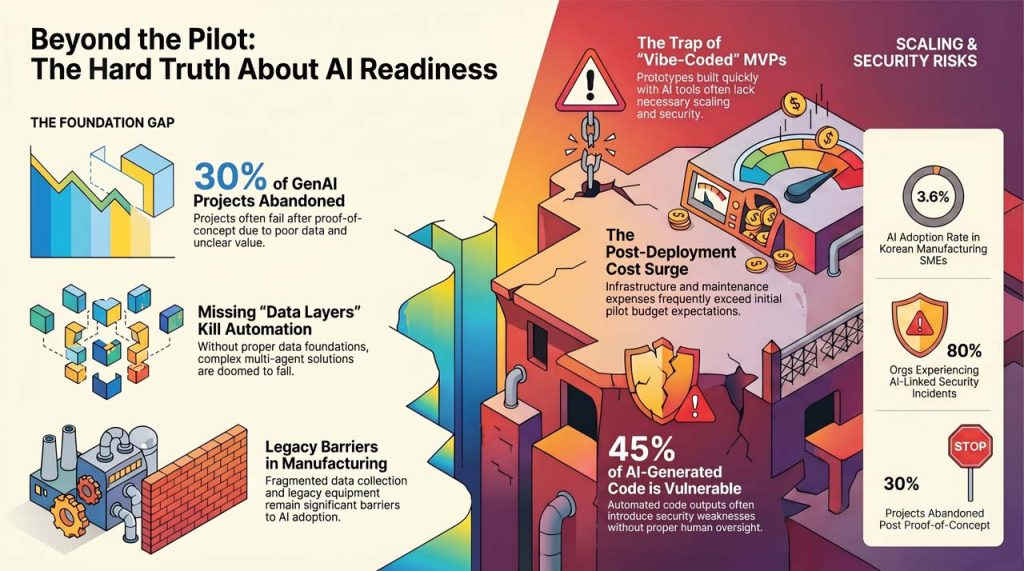
According to Gartner, at least 30% of generative AI projects are expected to be abandoned after proof-of-concept stages due to factors including poor data quality, unclear business value, escalating costs, and inadequate risk controls. The warning highlights a growing gap between experimentation and operational execution.
For Janith Dissanayake, CTO and Co-Founder of NEWNOP, many of these failures begin long before organizations deploy an AI model.
“Before we invest in implementing AI solutions, we have to understand whether the organization is ready for the scale of AI rollout,”
Dissanayake told KoreaTechDesk in an exclusive interview.
Drawing on his experience deploying AI, software, and industrial systems across multiple sectors, he argues that many companies attempt advanced AI adoption without first establishing the underlying foundations required to support it.
“Most of the companies lack even the data layers,”
he said.
“When the data layers are not properly set up, spending money on developing multi-agent solutions to automate organizational processes will result in AI adoption failure.”

What Dissanayake describes is not an isolated problem but one that many organizations are now confronting as they move from experimentation to implementation.
Cisco’s 2025 AI Readiness Index found that only a minority of organizations have fully centralized data environments or comprehensive change-management capabilities in place. The report suggests that technical readiness remains uneven despite widespread enthusiasm for AI adoption.
Data Readiness Has Become a Competitive Advantage
The AI conversation often focuses on models, algorithms, and increasingly sophisticated agents. Yet industrial deployments frequently depend on a less glamorous factor: data quality.
In enterprise environments, AI systems depend on reliable information streams generated through business software, operational systems, and structured workflows. If those foundations are incomplete, AI systems inherit the same weaknesses.
This issue remains particularly relevant as Korean businesses push deeper into digital transformation (DX). The Korea SMEs and Startups Institute noted in a recent report that only 3.6% of Korean manufacturing SMEs had adopted AI technologies, with firms continuing to face challenges involving legacy equipment, fragmented data collection, infrastructure limitations, and shortages of AI-skilled personnel.
These constraints help explain why AI adoption rates often lag behind executive expectations.
Organizations are generally eager to adopt AI, but many underestimate the amount of groundwork required to make deployments successful.
After all, building reliable data pipelines, standardizing processes, and modernizing legacy systems often takes years, which means adopting AI often requires companies to change how they manage data, processes, and teams—not just introduce new technology.

The Hidden Risk of Scaling AI Beyond the MVP
Another challenge highlighted by Dissanayake involves a growing trend within startup development.
He points to the rise of so-called “vibe-coded” applications, where AI-assisted coding tools dramatically accelerate product development and enable founders to build functional prototypes with limited engineering resources.
The approach can be effective during early validation stages. But then, problems often emerge when those systems encounter real customers, larger datasets, and operational workloads.
“I noticed that most startup solutions are vibe-coded,”
he said.
“While these solutions are effective as an MVP, they are not optimized for scaling with proper load management and data handling.”
But for Dissanayake, the issue goes far beyond whether these applications can handle more users or larger datasets. Because in his experience, AI-generated applications exposed security weaknesses, unstable workflows, and backend vulnerabilities that only became visible after deployment.
And these concerns are not merely anecdotal and increasingly align with broader industry findings.
According to a Veracode study published in April 2025, 45% of organizations reported that AI-generated code had introduced security vulnerabilities into their software, while 80% said they had experienced at least one data security incident linked to AI-generated code. The findings reinforce warnings from security researchers that relying on automated code outputs without proper architectural oversight, testing, and governance frameworks can create significant risks.
Now, that does not mean companies should avoid AI-assisted development altogether. Rather, rapid development cannot replace engineering discipline when products move into production environments.

Why Costs Become a Deployment Problem
Financial realities create another source of friction.
Organizations often evaluate AI projects based on pilot success, yet the economics can change significantly after deployment. Infrastructure expenses, data storage requirements, monitoring systems, maintenance, compliance obligations, and ongoing model management can expand costs beyond initial expectations.
Dissanayake believes this is particularly demanding for startups.
“Some solutions, even if properly developed, have costs that are higher post-deployment which founders may not be able to manage.”
This challenge is becoming increasingly important as businesses experiment with larger AI systems and agent-based architectures. While capabilities continue to improve, operational costs remain a critical factor in determining long-term viability.
Korea’s AI Push Raises the Stakes
As governments and businesses move from experimentation to implementation, South Korea is actively accelerating AI adoption across industries.
The Ministry of SMEs and Startups recently unveiled its AI-based Smart Manufacturing Innovation 3.0 Strategy, which aims to accelerate AI deployment across manufacturing environments and strengthen industrial competitiveness.
That ambition both creates new opportunities for startups, software providers, and enterprise technology vendors, and increases the importance of deployment readiness.
The central question is therefore shifting away from whether AI works, because many organizations have already demonstrated that it does. Instead, attention is increasingly turning to a more difficult issue: whether companies possess the operational maturity, data foundations, and infrastructure required to sustain AI systems at scale.
Beyond the Pilot Stage
Finally, the next phase of AI adoption may be defined less by breakthrough models and more by organizational discipline.
And companies that successfully deploy AI are likely to be those that invest in data quality, system integration, scalable infrastructure, and operational readiness before pursuing increasingly sophisticated AI capabilities.
Dissanayake’s experience offers a practical reminder that enterprise AI is not purely a technology challenge. It is also a data challenge, an infrastructure challenge, and a management challenge.
As AI becomes embedded across industrial and enterprise environments, the winners may not be the organizations with the most advanced models. They may be the organizations that prepared the ground before the model ever arrived.
Key Takeaway
- AI deployment failures often begin before model deployment, particularly when organizations lack mature data layers and operational readiness.
- Many companies pursue advanced AI systems before building the infrastructure required to support them.
- Data quality, system integration, scalability, and organizational maturity remain critical barriers to successful enterprise AI implementation.
- Vibe-coded MVPs can accelerate product development, but deployment environments expose scaling, security, and reliability challenges that prototypes often hide.
- Korea’s push toward industrial AI adoption increases the importance of deployment readiness as businesses move beyond experimentation.
- The core lesson for founders, investors, and enterprise buyers is that AI success depends on operational execution as much as technological capability.
🤝 Looking to connect with verified Korean companies building globally?
Explore curated company profiles and request direct introductions through beSUCCESS Connect.
– Stay Ahead in Korea’s Startup Scene –
Get real-time insights, funding updates, and policy shifts shaping Korea’s innovation ecosystem.
➡️ Follow KoreaTechDesk on LinkedIn, X (Twitter), Threads, Bluesky, Telegram, Facebook, and WhatsApp Channel.