
The artificial intelligence industry spends enormous attention on model breakthroughs, benchmark scores, and new capabilities. Yet a quieter question is starting to shape which AI features actually reach users. Even when a model can generate impressive results, can companies afford to deliver those results millions of times without turning every interaction into a financial burden? A recent deployment by Razer offers a practical look at why that question is becoming increasingly important.
AI Capability Is Growing Faster Than AI Economics
The rapid improvement of AI models has lowered the barriers to building consumer-facing experiences. Image generation, virtual companions, personalized content, and AI-powered gaming features are becoming easier to create than ever before.
At the same time, the economics of serving those experiences remain challenging. Every generated image, response, recommendation, or interaction consumes computing resources. As usage scales, infrastructure costs become a product decision rather than simply an engineering consideration.

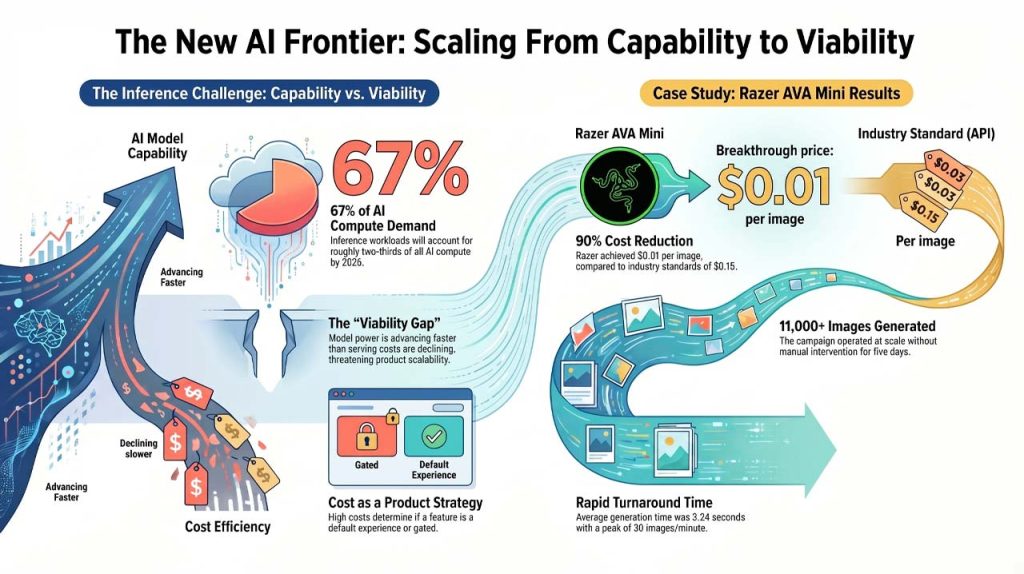
According to Deloitte’s 2026 Technology, Media & Telecommunications Predictions report, inference workloads are expected to account for roughly two-thirds of AI compute demand in 2026. The finding reflects a broader industry shift as organizations move beyond training models and focus increasingly on delivering AI outputs to users at scale.
For consumer-facing products, this creates a different challenge than the one that dominated earlier AI discussions. The question is no longer only what AI can do. It is increasingly about what AI can deliver economically.
How Razer Tested Consumer AI Economics at Scale
Razer recently expanded AIKit, its free open-source AI development toolkit, beyond text-based workflows to support image, video, and audio AI models while adding Arm64 architecture compatibility.
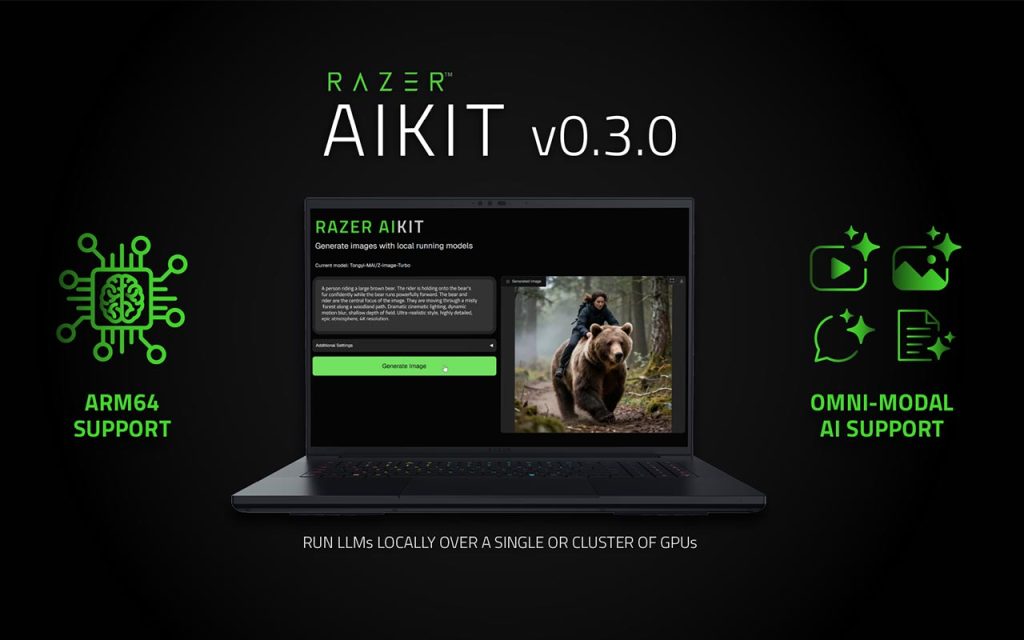
The announcement also revealed a real-world deployment that serves as a useful case study for AI economics.
During its April 2026 AVA Mini campaign, Razer invited users to upload photos of their pets and receive personalized AI-generated companion characters. The campaign ran between March 31 and April 4 and generated more than 11,000 images.
According to Razer, the deployment achieved an average turnaround time of 3.24 seconds per image, reached peak throughput of 30 images per minute, and operated without manual intervention throughout the campaign.
The company reported inference costs of approximately US$0.01 per image,compared with a typical range of roughly US$0.03 to US$0.15 per image associated with comparable image-generation API approaches.
While the campaign itself was promotional, the operational challenge behind it was far from trivial.
“We set out to deliver a highly personalized, interactive AI experience at scale that was free for users,”
Quyen Quach, Vice President of Software at Razer, told KoreaTechDesk in an exclusive interview.
“In practice, conventional cloud approaches broke on that constraint.”

The statement highlights a growing tension across the AI industry. Consumer expectations increasingly favor free, personalized, and instantly available AI experiences, while infrastructure costs remain attached to every generated output.
Why Inference Cost Is Becoming a Product Strategy Issue
Many AI discussions still focus primarily on model performance. However, product teams often face a different reality after launch.
A feature that performs well technically may still struggle commercially if serving each user interaction becomes too expensive.
Quach believes this challenge is becoming increasingly important.
“Cost is becoming the defining constraint for consumer-facing AI,”
she said.
“Model capability is advancing quickly, but serving costs are not declining at the same pace, which creates a widening gap between what is possible to build and what is viable to scale.”
The distinction matters because AI products rarely operate under laboratory conditions. Consumer platforms must support unpredictable demand, repeated interactions, and large user populations.
“That gap can be managed for paid products, but for free or mass-scale consumer use, it directly determines whether a feature can exist as a default experience or needs to be gated.”
In other words, the next generation of AI products may be shaped not only by technological breakthroughs but also by decisions about which experiences can remain economically sustainable after reaching real users.

What Razer’s Experience Means for Korean AI Startups
The discussion carries particular relevance for South Korea.
The government continues expanding AI infrastructure investments while supporting startups, researchers, and enterprises through national AI initiatives. Access to computing resources remains an important part of strengthening the country’s AI ecosystem.
Yet infrastructure access alone does not solve commercialization challenges.
Korean startups increasingly operate in sectors where AI-generated outputs are becoming central to the user experience. Gaming companies are experimenting with AI-powered characters and content generation. Consumer applications are adding personalization features. Entertainment and creator platforms are exploring AI-assisted production tools.
In many of these cases, the business challenge begins after the feature launches.
A startup may successfully build an AI capability. The harder question is whether the company can continue serving that capability as usage grows.
This is particularly relevant for free-to-use products, freemium models, and consumer applications where users expect AI functionality without directly paying for every interaction.
For founders, it provides a lesson that AI infrastructure costs should not be treated solely as backend expenses. They increasingly influence pricing models, feature design, customer acquisition strategies, and long-term scalability.
The Next AI Competition May Be About Sustainability
The AI industry often celebrates capability breakthroughs because they are easy to observe. New models generate better images, answer more questions, and perform increasingly sophisticated tasks.
What receives less attention is the cost required to make those capabilities available to millions of users.
Quach believes that reality will increasingly shape product decisions.
“Teams that can structurally lower cost across both model choice and infrastructure will be able to deliver experiences that are simply not feasible under conventional pricing models.”
The observation points to a broader shift emerging across the industry. Competitive advantage may no longer depend solely on building powerful AI experiences. It may increasingly depend on delivering those experiences sustainably.
Beyond the AI Feature Race: What Razer’s AVA Mini Reveals About Consumer AI Economics
Many AI product discussions still begin with a simple question: what can the technology do? But the more important question may be what companies can afford to deploy repeatedly, reliably, and at scale.
Razer’s AVA Mini campaign may not answer every question about the future of consumer AI. It does, however, offer a practical reminder that successful AI products require more than capable models.
As AI moves deeper into gaming, entertainment, personalization, and consumer applications, the companies that gain the greatest advantage may not be those with the most impressive demonstrations.
They may be the ones that can keep delivering those experiences consistently even after millions of users arrive.
Key Takeaway
- Razer AVA Mini generated more than 11,000 AI images, providing a real-world example of large-scale consumer AI deployment.
- Inference economics are becoming a product strategy issue, not merely an infrastructure concern.
- Quyen Quach of Razer argues that cost is becoming the defining constraint for consumer-facing AI, particularly for free or mass-scale experiences.
- AI capability and AI viability are increasingly different challenges, as serving costs continue shaping what products can sustainably offer.
- Korean startups developing AI-powered gaming, content, avatar, and personalization products face similar economic realities as AI adoption expands.
- The next competitive advantage in consumer AI may come from sustainable delivery models, not capability improvements alone.
🤝 Looking to connect with verified Korean companies building globally?
Explore curated company profiles and request direct introductions through beSUCCESS Connect.
– Stay Ahead in Korea’s Startup Scene –
Get real-time insights, funding updates, and policy shifts shaping Korea’s innovation ecosystem.
➡️ Follow KoreaTechDesk on LinkedIn, X (Twitter), Threads, Bluesky, Telegram, Facebook, and WhatsApp Channel.