

Korea’s proposed Digital Asset Basic Act is entering a decisive stage as policymakers move toward limiting major shareholder stakes in cryptocurrency (crypto) exchanges. The measure, which could cap ownership at 20 percent with possible exceptions up to 34 percent, is expected to trigger significant governance restructuring across the country’s largest trading platforms.
For global investors and founders watching Korea’s fintech and Web3 landscape, the debate signals how the country intends to govern digital financial infrastructure as the sector matures.
South Korea Moves Toward a 20% Ownership Cap for Crypto Exchange Shareholders
South Korea’s ruling Democratic Party has effectively settled on an internal policy framework to limit major shareholder stakes in cryptocurrency exchanges under the upcoming Digital Asset Basic Act, widely referred to as the second phase of the country’s digital asset legislation.
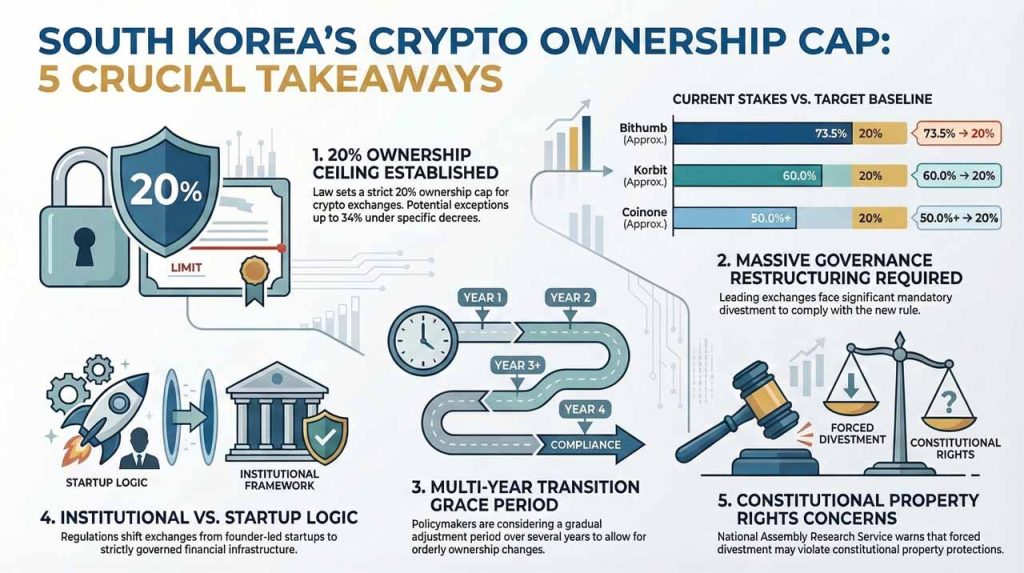
According to multiple Korean media reports citing industry sources, the party is considering a system in which the law itself sets the ownership ceiling for major shareholders at 20 percent, while enforcement decrees could allow exceptions of up to 34 percent within parameters determined by the Financial Services Commission (FSC).
The framework reportedly emerged from a closed-door meeting on March 3 between the Democratic Party’s policy committee leadership and members of its Digital Asset Task Force. Industry participants expect the party to finalize the proposal following consultations with the Financial Services Commission and to disclose the legislative bill soon afterward.
A grace period is also under discussion. Rather than immediate enforcement, policymakers are considering a transition period of up to several years that would allow exchanges to adjust ownership structures gradually, potentially extending toward the end of the current administration.
The policy proposal builds on earlier government discussions suggesting that major shareholder stakes in exchanges should be limited to roughly 15 to 20 percent. Regulators argue that cryptocurrency exchanges increasingly function as quasi-financial institutions, holding investor assets, mediating transactions, and overseeing listing processes for digital tokens.
Constitutional Concerns and Industry Pushback
The proposal has quickly triggered legal and industry debate. South Korea’s National Assembly Research Service (NARS) recently indicated that the policy could raise constitutional questions.
In a written response to an inquiry from lawmaker Kim Sang-hoon of the People Power Party, the research body stated that limiting ownership stakes could conflict with constitutional protections related to property rights, freedom of occupation, and freedom of business activity.
The report noted that shares are considered constitutionally protected property, and restrictions tied to regulatory penalties or licensing decisions could potentially infringe on those rights. The research service also warned that forcing shareholders to dispose of stakes acquired legally in the past could raise issues related to retroactive legislation, unless justified by significant public interest.
Industry participants have warned that forcing exchanges to restructure ownership could disrupt governance and investment in the sector.
The National Assembly Research Service also pointed out that similar ownership caps are difficult to find in major international jurisdictions, including the European Union, Hong Kong, and Singapore, according to the analysis cited in the reports.
Uneven Impact Across Korea’s Major Exchanges
If implemented, the ownership cap could affect major Korean exchanges in different ways depending on their existing governance structures.
Current shareholding arrangements cited in Korean reports include:
- Dunamu, the operator of Upbit, where Chairman Song Chi-hyung holds roughly 25.5 percent.
- Bithumb, where Bithumb Holdings controls about 73.5 percent.
- Coinone, where founder and CEO Cha Myung-hoon holds more than 50 percent.
- Korbit, where NXC owns roughly 60 percent.
Under a strict 20 percent cap, several exchanges may need to adjust ownership structures or sell shares to meet the proposed limits.
Some proposals discussed in the policy process suggest that the largest exchanges may need to adjust ownership structures within roughly three years, while smaller exchanges might receive longer adjustment periods.
The possible impact has already sparked speculation within Korea’s digital asset sector.
Industry observers note that exchanges with concentrated ownership structures could face the most significant adjustments if the policy is enacted in its current form.
Why Policymakers Are Focusing on Ownership
South Korean regulators have increasingly framed cryptocurrency exchanges as critical infrastructure within the country’s digital financial system.
Exchanges now manage large volumes of retail investor funds and serve as the primary gateway to digital asset trading for millions of users. Policymakers argue that concentrated ownership structures could raise concerns about governance transparency, potential conflicts of interest, and investor protection.
This perspective reflects a broader regulatory approach that seeks to integrate digital asset exchanges into a more formal regulatory framework.
The Digital Asset Basic Act is expected to become a central pillar of this effort, building on earlier legislation such as the Virtual Asset User Protection Act, which focused primarily on safeguarding customer assets and market integrity.
What the Debate Signals for Korea’s Startup and Web3 Ecosystem
For Korea’s startup ecosystem, the ownership cap debate highlights a structural transition underway in the country’s digital asset sector.
Many Korean exchanges originated as technology startups built around founder leadership, operating in a rapidly evolving market with relatively flexible governance structures.
The proposed policy introduces a different logic, treating exchanges more like financial infrastructure entities whose governance should align with stricter oversight principles.
For global investors and founders evaluating Korea’s Web3 landscape, the discussion offers several signals.
First, policymakers appear determined to institutionalize the digital asset sector, aligning it more closely with financial regulation.
Second, the policy could accelerate governance restructuring across major exchanges, potentially reshaping the competitive dynamics within Korea’s crypto trading market.
Third, the debate illustrates the ongoing challenge governments face worldwide when integrating fast-growing digital asset platforms into traditional financial regulatory frameworks.
These developments are closely watched by international investors because South Korea remains one of the largest retail cryptocurrency markets globally, with trading activity concentrated in a handful of domestic exchanges.
Strategic Outlook for Korea’s Digital Asset Regulation
The final design of the ownership cap remains subject to legislative negotiations and regulatory consultations.
Some policymakers emphasize the need to balance investor protection and market transparency with maintaining a competitive digital asset ecosystem.
Industry groups, meanwhile, continue to call for a regulatory approach that reflects the sector’s origins as a technology-driven startup industry, rather than applying frameworks designed for traditional financial institutions.
As discussions continue, the Digital Asset Basic Act is shaping into one of the most consequential regulatory developments for Korea’s cryptocurrency market in recent years.
The outcome will likely determine how the country positions itself in the next phase of global digital asset regulation.
Key Takeaways on Korea’s Cryptocurrency Exchange Ownership Cap
- South Korea is considering a 20% ownership cap for major shareholders of cryptocurrency exchanges under the proposed Digital Asset Basic Act.
- Enforcement decrees may allow exceptions up to 34%, according to policy discussions cited in Korean reports.
- The proposal could require major governance restructuring across leading exchanges such as Upbit, Bithumb, Coinone, and Korbit.
- The National Assembly Research Service has raised concerns that the measure may conflict with constitutional protections related to property rights and business freedom.
- Industry participants warn that forced ownership restructuring could create market disruption.
- The policy debate reflects South Korea’s broader effort to integrate digital asset platforms into a formal financial regulatory framework while balancing innovation and investor protection.
🤝 Looking to connect with verified Korean companies building globally?
Explore curated company profiles and request direct introductions through beSUCCESS Connect.
– Stay Ahead in Korea’s Startup Scene –
Get real-time insights, funding updates, and policy shifts shaping Korea’s innovation ecosystem.
➡️ Follow KoreaTechDesk on LinkedIn, X (Twitter), Threads, Bluesky, Telegram, Facebook, and WhatsApp Channel.