KoreaTechDesk | Korean Startup and Technology News

Mon, March 02, 2026

Sign in

Virtual Demo Day
Menu
  • Home
  • Startup News
    • AI & Big Data
    • AR & VR
    • Blockchain
    • Clean Technology
    • Content & Games
    • Cybersecurity
    • Enterprise & SaaS
    • FinTech
    • Gadgets & Electronics
    • Health & Bio
    • Manufacturing
    • Press Release
    • IoT
    • Marketplaces & E-commerce
    • Robotics
    • Transportation
    • Investments
    • Ecosystem & Lists
  • Governments
    • Artificial Intelligence Industry Cluster Agency
    • Daegu Technopark
    • GANGNAM-GU
    • Gyeonggido Business & Science Accelerator
    • Hwaseong Industry Promotion Agency
    • Invest Seoul
    • Korea Creative Content Agency
    • Korea Internet & Security Agency
    • Korea Information Security Industry Association
    • Korea Institute of Startup & Entrepreneurship Development
    • Korea Tourism Organization
    • Korea Trade-Investment Promotion Agency
    • Ministry of Culture, Sports and Tourism
    • Ministry of SMEs & Startups
    • National IT Industry Promotion Agency
    • Pangyo Techno Valley
    • Seoul Business Agency
    • Seoul FinTech Lab
    • South Gyeongsang Province
    • Seoul Metropolitan Government
  • Events
    • COMEUP
    • Korea Fintech Week
    • K-Content Expo
    • NextRise
    • Try Everything
  • Interviews
    • Investors’ interviews
    • Founders’ interviews
  • Programs
    • Asan Voyager
    • CAPA Global Program
    • Campus Town Program
    • SGSC Global Bootcamp
    • Gangnam-gu Global Roadshow
    • Global SaaS Marketplace Support Project
    • LAUNCHPAD
    • COMEUP STARS 120
    • K-Startup Grand Challenge
    • TIPS X beSUCCESS Global Project
    • SFL Global Program
    • KTO Global Showcase
    • Yonsei Univ Global Class
    • KOSME Global Program
  • Partner With Us
    • Press Release
    • Startup Scouting
    • Business Agencies
    • Global Mentorship Program
    • Investment Opportunities
    • K-Scouter Program
  • Lists
  • Home
  • Startup News
    • AI & Big Data
    • AR & VR
    • Blockchain
    • Clean Technology
    • Content & Games
    • Cybersecurity
    • Enterprise & SaaS
    • FinTech
    • Gadgets & Electronics
    • Health & Bio
    • Manufacturing
    • Press Release
    • IoT
    • Marketplaces & E-commerce
    • Robotics
    • Transportation
    • Investments
    • Ecosystem & Lists
  • Governments
    • Artificial Intelligence Industry Cluster Agency
    • Daegu Technopark
    • GANGNAM-GU
    • Gyeonggido Business & Science Accelerator
    • Hwaseong Industry Promotion Agency
    • Invest Seoul
    • Korea Creative Content Agency
    • Korea Internet & Security Agency
    • Korea Information Security Industry Association
    • Korea Institute of Startup & Entrepreneurship Development
    • Korea Tourism Organization
    • Korea Trade-Investment Promotion Agency
    • Ministry of Culture, Sports and Tourism
    • Ministry of SMEs & Startups
    • National IT Industry Promotion Agency
    • Pangyo Techno Valley
    • Seoul Business Agency
    • Seoul FinTech Lab
    • South Gyeongsang Province
    • Seoul Metropolitan Government
  • Events
    • COMEUP
    • Korea Fintech Week
    • K-Content Expo
    • NextRise
    • Try Everything
  • Interviews
    • Investors’ interviews
    • Founders’ interviews
  • Programs
    • Asan Voyager
    • CAPA Global Program
    • Campus Town Program
    • SGSC Global Bootcamp
    • Gangnam-gu Global Roadshow
    • Global SaaS Marketplace Support Project
    • LAUNCHPAD
    • COMEUP STARS 120
    • K-Startup Grand Challenge
    • TIPS X beSUCCESS Global Project
    • SFL Global Program
    • KTO Global Showcase
    • Yonsei Univ Global Class
    • KOSME Global Program
  • Partner With Us
    • Press Release
    • Startup Scouting
    • Business Agencies
    • Global Mentorship Program
    • Investment Opportunities
    • K-Scouter Program
  • Lists
Home Government Policies

The Death of the Silo: Why Korea’s New Data-Sharing Laws are the Ultimate Deterrent for Policy Fund Fraud

by Dae-jung Park
March 2, 2026
in Government Policies
0

When a startup secures 1 million USD in state-backed liquidity only to have its CEO quietly convicted of tax fraud in a separate court, the system hasn’t just failed—it has been blindfolded. For years, South Korea’s massive policy finance apparatus operated in data silos, where the agency cutting the check often had no legal window into the applicant’s criminal or tax standing. The introduction of the “Policy Fund Management 2-Act” signals that the era of administrative “hide and seek” is officially nearing its end.

Korea’s Proposed Amendments to Codify Cross-Agency Data Sharing

On February 28, 2026, Representative Kim Won-i of the Democratic Party of Korea moved to fundamentally alter the plumbing of state-backed SME financing by lead-sponsoring amendments to the Small and Medium Enterprises Promotion Act and the Act on the Protection and Support of Micro Enterprises.

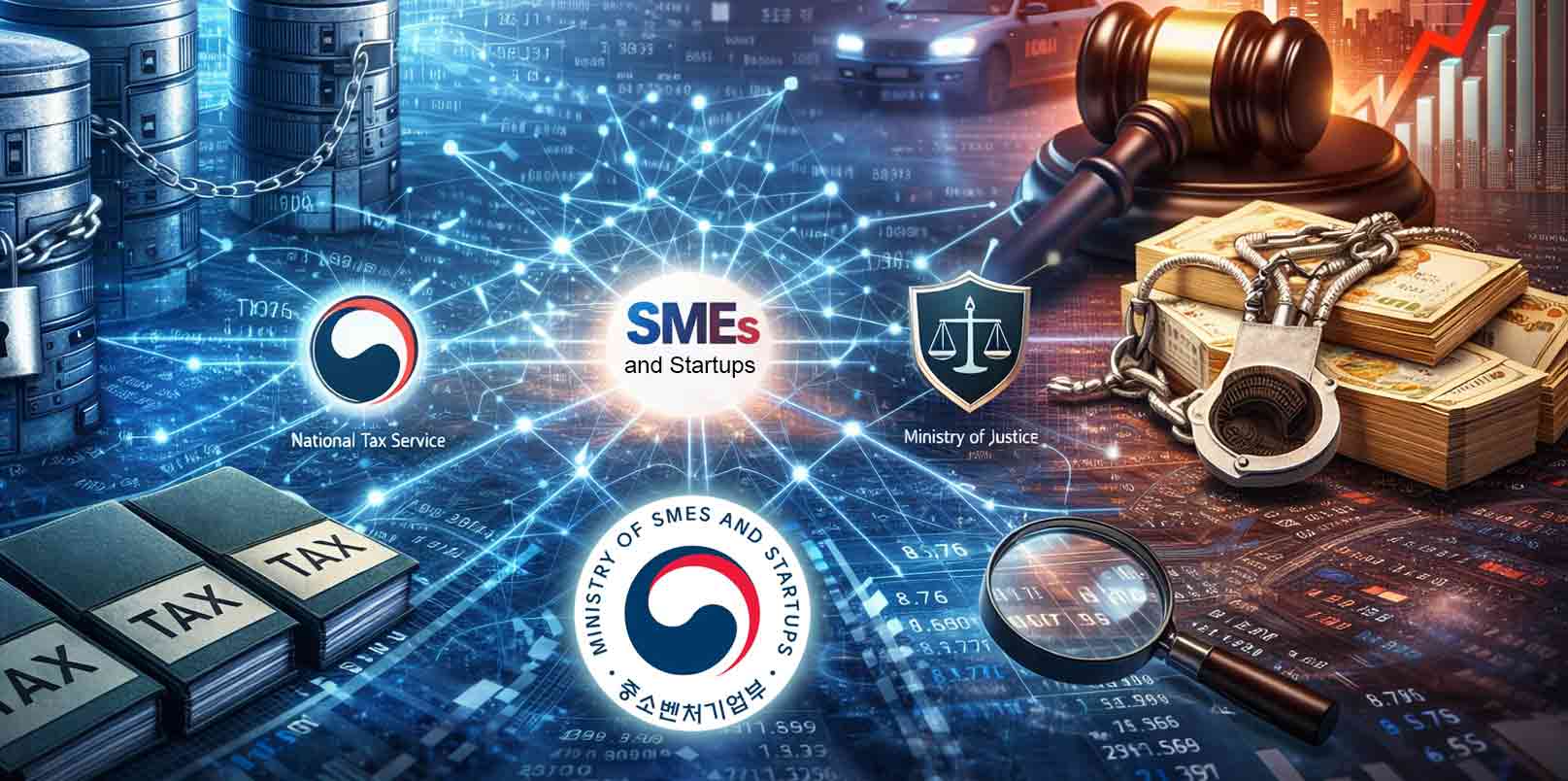
These proposed bills seek to empower the Ministry of SMEs and Startups (MSS) to directly request tax data and criminal conviction records from the National Tax Service (NTS), the Police, and the Ministry of Justice.

The move follows a directive from President Lee Jae-myung, who warned that “stealing the people’s blood tax will lead to absolute ruin.” This is not just rhetoric as the legislation addresses a specific structural failure where agencies like the Korea SMEs and Startups Agency (KOSME) disbursed over KRW 1 billion to a startup, only to find out through a National Audit—not their own systems—that the founder had already been sentenced for issuing fraudulent tax invoices.

Under the new framework, such data will be shared during the screening process and throughout the post-disbursement lifecycle.

Why the Death of the Silo Proposal Redefines Korea’s Startup Governance

If passed, this legislative pivot moves the conversation from “catching brokers” to “integrated oversight. Previous efforts, such as the KIBO enforcement task force, focused on external intermediaries, but this proposal targets the internal blind spots of the government itself. By seeking to institutionalize a cooperative system between the MSS, NTS, and the Ministry of Justice, Korea is signaling the construction of a “God View” of capital flow..

“We must establish a coordination system to share major economic crime data,” Representative Kim Won-i noted, emphasizing that the goal is a system where fraudulent receipt is blocked at the source.

For the ecosystem, this signals that policy fund eligibility may soon transition from a static application check into a continuous, data-verified compliance obligation.

The Friction of Radical Transparency: Can Compliance Scale Without Slowing Down?

While the policy ambition is clear, the execution reality introduces a new kind of friction: the “Compliance Bottleneck.”

If every policy fund application now triggers a multi-agency data request involving the NTS and the Ministry of Justice, the administrative lead time for a seed-stage startup could theoretically balloon.

There is also the human incentive problem. Founders who made minor, non-criminal administrative errors in the past may now fear that a hyper-connected government will flag them alongside actual fraudsters.

The challenge for the MSS will be ensuring that “Radical Transparency” doesn’t become “Radical Bureaucracy.” If the data-sharing infrastructure isn’t as fast as the AI-led application tools recently introduced, the very speed that makes the Korean ecosystem competitive could be compromised by its own quest for integrity.

What the Proposed Framework Enables—And Where Gaps Remain

The “Policy Fund Management 2-Act” designed to eliminate the tactic of using fraudulent tax invoices to inflate sales figures—a primary method used by illegal brokers to “guarantee” fund access. It would enable the government to perceive criminal convictions in real-time, allowing for the recovery of funds without waiting for a media exposé or an annual audit.

However, the law does not yet resolve the “Quality Gap.” Even with perfectly clean data, the government still faces the challenge of picking winners in an increasingly crowded tech landscape. While the law ensures that “thieves” are kept out, it doesn’t necessarily ensure that “innovators” are being prioritized.

The system is getting much better at saying “No” to bad actors, but it is still fine-tuning how to say “Yes” to the right ones.

Strategic Implications for Global Investors and Cross-Border Founders

For international VCs, this legislative direction is a de-risking signal. When a Korean startup lists government grants on its balance sheet, those funds will eventually come with a “Data-Verified” stamp of approval. It reduces the due diligence burden for foreign investors who previously had to worry about the “reputational contagion” of a co-invested startup being caught in a subsidy scandal.

Global founders entering the Korean market must now treat their tax and legal hygiene as a primary asset. In the 2026 landscape, a “clean” record is as important as a “clean” cap table.

As Korea moves to align its public venture capital with global compliance standards, it positions itself as a more predictable destination for institutional capital.

Toward a Governance-Led Innovation Model

Korea is attempting to turn state-backed capital into a high-trust asset by legislating away the shadows. The success of this move won’t be measured by the number of founders “ruined,” but by whether legitimate startups gain faster access to capital because the “noise” of fraud has been filtered out.

Trust is not built by announcements, but by the relentless, quiet application of data. If the MSS can balance this impending oversight with the speed required by the venture world, they won’t just have a cleaner system—they’ll have a global model for how a government can function as a disciplined, data-driven limited partner in its national innovation economy.

Key Takeaways for the 2026 Ecosystem

  • Proposed Data Integration: The “2-Act” package seeks legal authority for the MSS to bypass silos and access NTS tax data and Ministry of Justice criminal records.
  • Targeting Fraudulent Sales: The move specifically aims to stop the inflation of sales figures via false invoices, the most common leverage point for illegal brokers.
  • Investor Confidence: The legislation signals Korea’s intent to move toward “ongoing eligibility monitoring,” making state funds more transparent for international co-investors.
  • Compliance Burden: While document volume has been halved, the “legal weight” of an application is increasing; a clean tax/legal record is now a prerequisite for state liquidity.
  • Systemic Deterrence: Following Presidential orders, the bills focus on “prevention and punishment,” aiming to build a high-integrity environment for the “Venture 4 Powerhouse” strategy.

🤝 Looking to connect with verified Korean companies building globally?
Explore curated company profiles and request direct introductions through beSUCCESS Connect.


– Stay Ahead in Korea’s Startup Scene –
Get real-time insights, funding updates, and policy shifts shaping Korea’s innovation ecosystem.
➡️ Follow KoreaTechDesk on LinkedIn, X (Twitter), Threads, Bluesky, Telegram, Facebook, and WhatsApp Channel.

Tags: illegal brokersInvestmentKorea policy fund brokersKorean StartupsMinistry of SMEs and Startups (MSS)policy fund brokerspolicy fund brokers crackdownpolicy fundsSMEs and StartupsSMEs and Startups fundingSMEs and Startups PolicySMEs and Startups protectionSMEs and Startups supportthird-party broker
Previous Post

$6.4 Billion at Stake: The Hidden Friction in Korea’s “Middle East Boom” Following Khamenei’s Death

Next Post

Why the Next ‘Dunamu’ Might Be Born in Singapore, Not Seoul: The Hidden Risk in Korea’s Digital Asset Act

Next Post

Why the Next ‘Dunamu’ Might Be Born in Singapore, Not Seoul: The Hidden Risk in Korea’s Digital Asset Act

MOST READ ARTICLE OF THE WEEK

1.
The 150-Day Window: How Trump’s Section 122 Tariff Shift Resets Strategic Planning for Korean SMEs
24 Feb 2026
2.
Korea Bets ₩87B on Field-Ready AI: What Manufacturing Startups and Global Investors Should Watch
24 Feb 2026
3.
Korea Passes Semiconductor Special Act — But Its ₩2T Funding Engine Won’t Start Until 2027
25 Feb 2026
4.
How Korea’s Startup Support System Actually Works: A Map for Foreign Readers
25 Feb 2026
5.
Korea’s Industrial AI Ambition Meets Global Compute Infrastructure as Mithril Joins NVIDIA Inception
25 Feb 2026
Register for Event

[the_ad id=”18508″]

List Article

1.
Inside Korea’s Startup Funding Machine: From Government Budget to Venture Capital to Bank Account
27 Feb 2026
2.
How Korea’s Startup Support System Actually Works: A Map for Foreign Readers
25 Feb 2026
3.
6 Reasons Why Seoul Is Poised to Become a Top 5 Global Economic Hub by 2030
20 Aug 2024
4.
Top Co-working Spaces for Startups & Companies to Explore in South Korea
3 Apr 2024
5.
Top Accelerators in South Korea Shaping Startup Success
29 Nov 2023

Similar Articles

Government Policies

Korea Passes Semiconductor Special Act — But Its ₩2T Funding Engine Won’t Start Until 2027

More
Government Policies

Korea Bets ₩87B on Field-Ready AI: What Manufacturing Startups and Global Investors Should Watch

More
Government Policies

Korea Moves to Shield 6,000 Exporters After U.S. Supreme Court Tariff Ruling

More

Topics

Menu
  • AI & Big Data
  • AR & VR
  • Blockchain
  • Clean Technology
  • Content & Games
  • Cybersecurity
  • Enterprise & SaaS
  • FinTech
  • Gadgets & Electronics
  • Health & Bio
  • IoT

Program

Menu
  • Asan Voyager
  • CAPA Global Program
  • SGSC Global Bootcamp
  • LAUNCHPAD
  • COMEUP STARS 120
  • K-Startup Grand Challenge
  • TIPS X beSUCCESS Global Project
  • SFL Global Program
  • KTO Global Showcase
  • Yonsei Univ Global Class
  • KOSME Global Program

About

Menu
  • About Us
  • all articles
  • Terms of Use
  • Privacy
  • Cookie-policy
  • twitter

Subscribe and be informed first hand about actual Korean startup news.

All the day’s headlines and highlights, direct to you every morning.

Contact us : [email protected]

Topics

Menu
  • AI & Big Data
  • AR & VR
  • Blockchain
  • Clean Technology
  • Content & Games
  • Cybersecurity
  • Enterprise & SaaS
  • FinTech
  • Gadgets & Electronics
  • Health & Bio
  • IoT

Program

Menu
  • Asan Voyager
  • CAPA Global Program
  • SGSC Global Bootcamp
  • LAUNCHPAD
  • COMEUP STARS 120
  • K-Startup Grand Challenge
  • TIPS X beSUCCESS Global Project
  • SFL Global Program
  • KTO Global Showcase
  • Yonsei Univ Global Class
  • KOSME Global Program

About

Menu
  • About Us
  • all articles
  • Terms of Use
  • Privacy
  • Cookie-policy
  • twitter

Subscribe and be informed first hand about actual Korean startup news.

All the day’s headlines and highlights, direct to you every morning.

© 2023 Koreantech News & Media Korea Zrt. All rights reserved.

Our Spring Sale Has Started

You can see how this popup was set up in our step-by-step guide: https://wppopupmaker.com/guides/auto-opening-announcement-popups/

Our Spring Sale Has Started

You can see how this popup was set up in our step-by-step guide: https://wppopupmaker.com/guides/auto-opening-announcement-popups/

We hope you enjoy our content, May you please give us Feedback regarding our website!

Single Post Feedback

dgdfgfdgdf

What you think about Koreatechdesk, Share your idea with us!

feedback popup

Invitation submission has been closed

Insert/edit link

Enter the destination URL

Or link to existing content

    No search term specified. Showing recent items. Search or use up and down arrow keys to select an item.