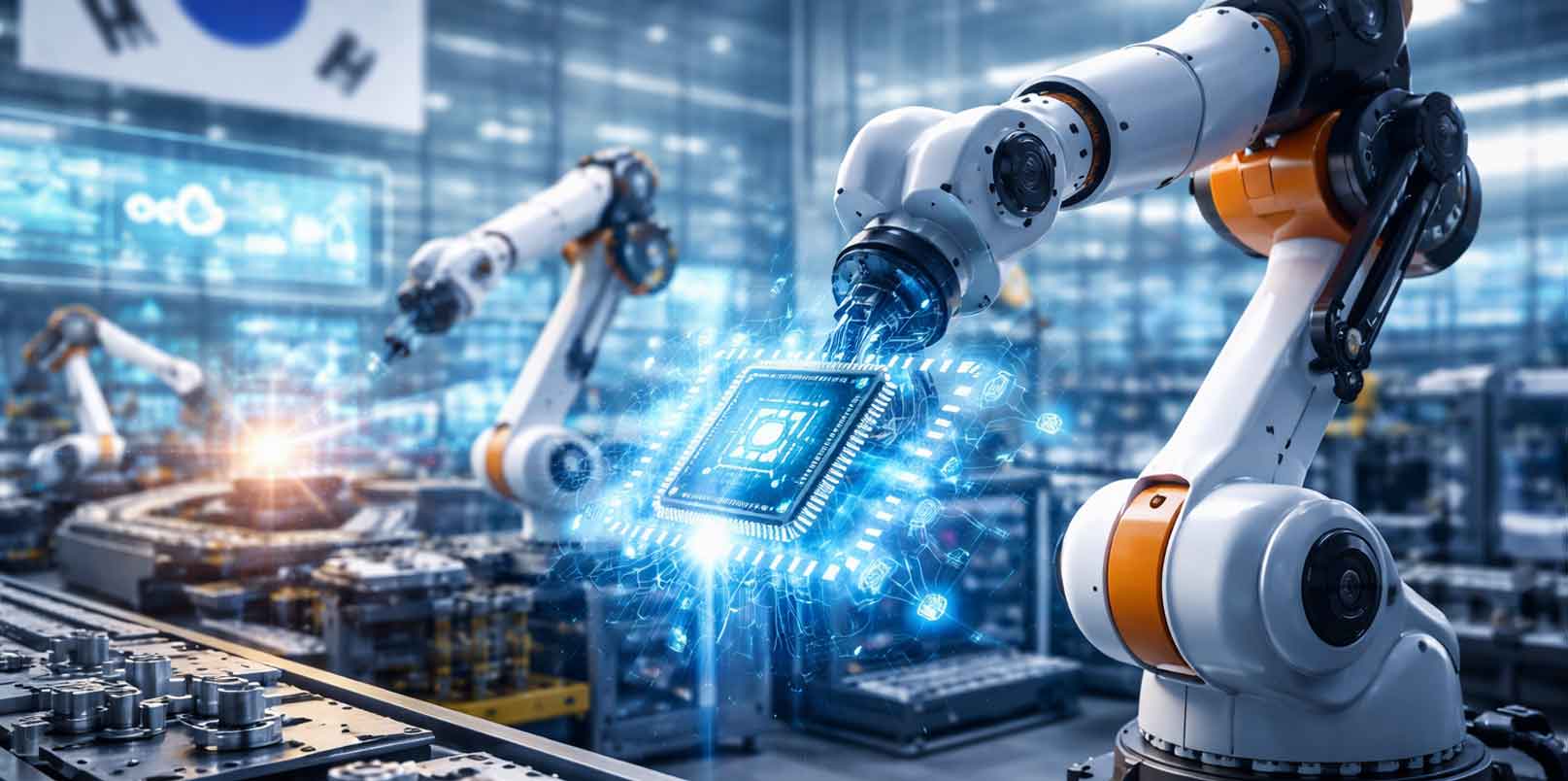
Manufacturing AI is no longer a future narrative in Korea. It is becoming a funding structure. With KRW 87 billion committed to deploy AI that works directly on production lines, the question is no longer whether small manufacturers should adopt AI. It is whether they can absorb it fast enough — and whether the startups building those systems are ready for industrial reality.
Korea Smart Manufacturing Innovation 3.0: ₩87B AI Commercialization Program
The Ministry of SMEs and Startups (MSS), the Smart Manufacturing Innovation Promotion Team, and the Korea Federation of SMEs (KBIZ) have jointly launched the AI Application Product Rapid Commercialization Support Program, committing a total of KRW 87 billion over two years to support 36 projects.
The initiative is a core execution measure under the government’s AI-based Smart Manufacturing Innovation 3.0 strategy. According to official announcements, KRW 64.5 billion will be deployed in 2026 and KRW 22.5 billion in 2027. The government will fund up to 70 percent of each project, with 30 percent matched by private participants.
Eligible applicants must form consortia centered on small and mid-sized manufacturing companies, alongside manufacturing AI technology firms, universities, research institutions, and regional innovation organizations.
The program operates under two implementation tracks:
- Manufacturing Site Problem-Solving Model, focused on resolving real factory-floor issues such as safety risks, product defects, production delays, and labor shortages through AI deployment.
- Regional Industry Development Model, where a leading regional anchor company establishes a successful AI case and expands it across suppliers and companies within the same sector.
Support areas are structured under four themes: industrial safety, process innovation, management innovation, and consumer experience-oriented innovation, comprising 16 detailed sub-themes.
Ahn Gwang-hyun, head of the Smart Manufacturing Innovation Promotion Team, stated that the program prioritizes “AI products that operate immediately in real factory settings.” Yang Chan-hoe, head of Innovation Growth at KBIZ, emphasized the need to rapidly expand AI adoption across sectors where utilization remains low.
The initiative will be jointly implemented by ten government ministries across manufacturing, agriculture and fisheries, bio-health and environment, defense and security, and land and transportation sectors. Detailed guidelines are expected through an integrated public announcement in March.
Why Korea’s SME AI Commercialization Push Signals a Structural Shift
This is not a fresh budget story. Korea has already expanded smart factory and manufacturing AI allocations in recent months. What distinguishes this move is its operational specificity.
The government is not funding research labs or abstract AI pilots. It is explicitly targeting deployable, factory-ready AI solutions tied to measurable site-level problems. That changes the risk profile for participating startups.
Under the Korea SME AI commercialization program, funding is structured around real industrial pain points — safety incidents, defect rates, production delays. The policy language repeatedly references “immediate use” and “field application.” That narrows the margin for theoretical solutions.
For the ecosystem, this represents a shift from policy ambition to execution architecture. The public-private partnership model — 70 percent government, 30 percent private — forces some level of market validation while still lowering adoption barriers for SMEs that cannot absorb large upfront AI costs.
The regional anchor company model is also notable. Instead of subsidizing isolated projects, the government is attempting controlled diffusion: prove viability in one firm, then scale across an industry cluster.
Whether that diffusion works remains an open question. But structurally, it signals a move from one-off grants toward ecosystem-level intervention.
The Absorption Challenge Beneath Korea’s Manufacturing AI Investment
Still, money does not equal readiness.
The official program materials focus on solving safety risks, quality issues, and operational inefficiencies. But small and mid-sized manufacturers vary widely in digital maturity. Not all factories collect structured data. Not all have internal teams capable of managing AI integration.
The policy attempts to address this through consortia formation — pairing manufacturers with AI technology firms, universities, and research institutes. Still, integration complexity does not disappear because funding is available.
There is also a scaling tension embedded in the numbers. Thirty-six projects across two years—this is significant for a commercialization program, but it remains selective. The anchor-company expansion model assumes that one success can translate across suppliers and sector peers. Industrial processes, however, are rarely uniform.
The execution risk is not mismanagement. It is uneven capability.
For startups building factory-ready AI solutions, this creates a double burden. They must prove industrial performance, not just technical capability. And they must operate within structured public procurement timelines.
What This Enables — and What It Still Does Not Solve
This program lowers the barrier for manufacturing startups developing applied AI systems. A 70 percent government match reduces capital intensity for early deployment. It also gives startups structured access to real industrial environments that are otherwise difficult to enter.
For SMEs, the initiative subsidizes experimentation in areas that directly affect profitability: defect reduction, safety compliance, labor efficiency.
However, the program does not eliminate operational risk. It does not guarantee sustained post-subsidy adoption. Nor does it ensure that smaller manufacturers can independently maintain or scale AI systems after the funded phase concludes.
The initiative also focuses on applied deployment, not foundational AI model development. Startups seeking deep-tech R&D support will need to look beyond this channel.
This is industrial implementation funding, not frontier research capital.
Strategic Implications for Global Manufacturing Startups and Investors
For international industrial AI startups, this program clarifies Korea’s policy direction. The government is signaling that manufacturing AI adoption will be incentivized through structured commercialization channels rather than purely venture-led scaling.
Foreign firms partnering with Korean manufacturers may find new entry points through consortium structures, particularly in areas such as industrial safety AI, predictive maintenance, and production optimization.
For global investors, the significance lies in demand-side policy engineering. Korea is not only funding AI startups. It is subsidizing AI adoption within SMEs. That reduces early customer acquisition friction for applied AI companies operating in the Korean manufacturing market.
At the same time, investors should recognize that public-private partnership manufacturing AI models come with administrative cycles and performance benchmarks tied to government programs.
This is not a free market experiment. It is a guided one.
A Test of Industrial AI Execution, Not Just Ambition
Korea’s AI transformation policy 2026 now has operational teeth. The language of smart factories has been replaced by targeted deployment funding. The success of this phase will not be measured by how many announcements are made, but by whether defect rates drop, accident risks decline, and SMEs continue AI integration without subsidy dependency.
The government has placed its bet on field-ready AI. The next phase will reveal whether factory floors are equally prepared to respond.
Key Takeaway on Korea’s AI Smart Manufacturing Program
- Korea commits KRW 87 billion over two years to deploy factory-ready AI across 36 SME projects.
- Program operates under Smart Manufacturing Innovation 3.0 with a 70:30 public-private funding model.
- Focus is on immediate factory-floor application: safety, process optimization, management automation.
- Regional anchor company model aims to scale proven AI use cases across industry clusters.
- Execution success depends on SME absorption capacity and sustained post-subsidy adoption.
– Stay Ahead in Korea’s Startup Scene –
Get real-time insights, funding updates, and policy shifts shaping Korea’s innovation ecosystem.
➡️ Follow KoreaTechDesk on LinkedIn, X (Twitter), Threads, Bluesky, Telegram, Facebook, and WhatsApp Channel.
🤝 Looking to connect with verified Korean companies building globally?
Explore curated company profiles and request direct introductions through beSUCCESS Connect.