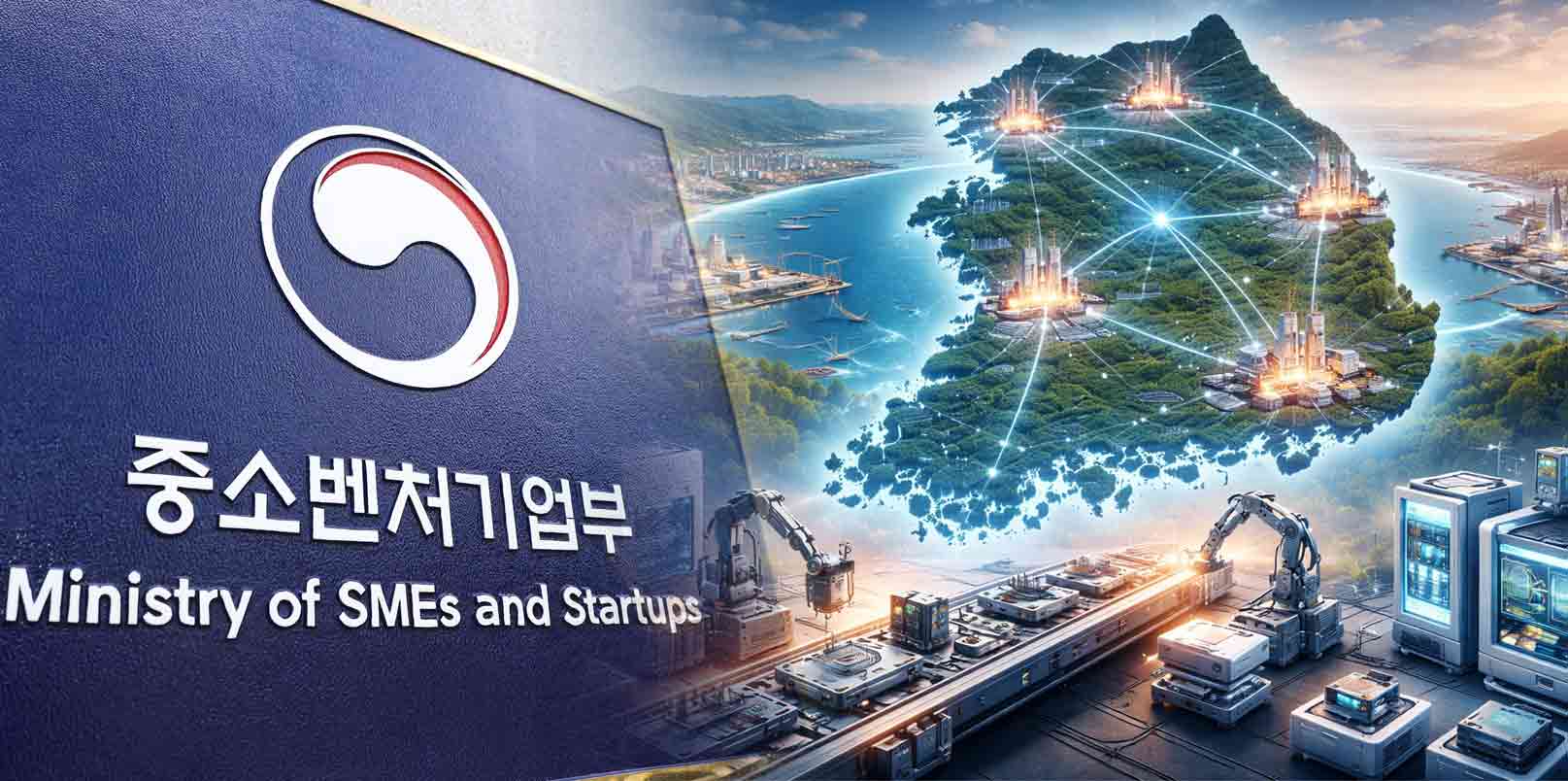
South Korea’s startup policy is shifting again — this time to the ground floor of advanced manufacturing. The Ministry of SMEs and Startups (MSS) has introduced a new program that turns regional innovation infrastructure into growth engines for early-stage manufacturers. It’s a signal that the government wants startups not just to invent but to actually produce — locally, sustainably, and at scale.
A New Scale-Up Initiative for Regional Advanced Manufacturing Startups
According to reports from News1, Herald Economy, Seoul Economic Daily, and Newsis, the MSS has officially launched the Advanced Manufacturing Startup Scale-Up Support Program, a new national initiative designed to help manufacturing startups in regional areas move from prototypes to early-stage production.
Starting February 2, the ministry will accept applications from regional innovation institutions — including Technoparks, universities, and research centers — to serve as managing organizations.
Two will be selected from 14 non-metropolitan regions to operate the program.
Each organization will select about 20 advanced manufacturing startups and provide customized support worth up to KRW 100 million (~ USD 75,000) per company. Funding categories include testing and analysis, verification, pilot production, and investment linkage, enabling startups to verify their technology and prepare for scale-up.
MSS Startup Policy Director Cho Kyung-won said,
“This program was designed to help startups utilize essential infrastructure tailored to their region’s conditions. We aim to create a stable ecosystem where advanced manufacturing startups can scale sustainably through regional innovation institutions.”
Why This Moment Matters for Korea’s Manufacturing Ecosystem
For years, Korea’s startup manufacturing policy has centered on digital transformation — smart factories, AI transformation, and R&D-led innovation. Yet these programs often favored larger SMEs or Seoul-based enterprises with access to national infrastructure.
This new initiative marks a structural shift toward inclusion and execution. It complements earlier efforts like the All-in-One Pack Production program — which tackled prototype-to-production gaps — but takes a regional lens: empowering local manufacturing startups to scale within their own industrial clusters.
By repurposing existing facilities in Technoparks and universities, the MSS aims to eliminate redundant spending and shorten the time from idea validation to market entry. The message is clear — startup growth should not be determined by geography.
The Friction Beneath Korea’s Scale-Up Ambition
The new policy addresses a long-standing imbalance: Korea’s Seoul-centric innovation economy.
Nearly 70% of startup support infrastructure — from labs to accelerators — is concentrated in the capital region. Startups in industrial cities like Daegu, Ulsan, and Gwangju often struggle to find accessible equipment or mentoring.
But decentralization comes with trade-offs. Regional innovation institutions vary widely in expertise and capacity. Without standardized evaluation frameworks or long-term funding continuity, program quality could diverge sharply across regions. The MSS has yet to specify performance metrics beyond participation numbers.
Another friction point is talent mobility. Many advanced manufacturing startups still rely on engineers and mentors based in Seoul or Daejeon, limiting real regional independence. Unless collaboration networks are formalized, the “regional scale-up” could risk staying symbolic.
How Korea’s New Manufacturing Drive Redefines Scale-Up Reality
What this new framework enables:
- Localized production testing using existing regional facilities.
- Lower upfront costs for startups that can’t afford their own pilot lines.
- Integration between testing, certification, and investment access, reducing fragmentation in the early manufacturing cycle.
What it does not yet solve:
- Sustained capital access for post-pilot scale-up stages.
- Standardized quality assurance across regions.
- Full policy alignment with Korea’s broader AI-Transformation (AX) and Smart Manufacturing agendas, which still operate through separate frameworks.
The program’s strength lies in infrastructure utilization, not yet in long-term growth financing.
Why Global Investors Should Watch Korea’s Regional Manufacturing Shift
For international founders, investors, and industry observers, this program is an indicator of Korea’s policy evolution from innovation funding to industrial execution. It suggests a state-backed strategy to anchor startups in real production ecosystems, mirroring industrial decentralization trends seen in Europe and Japan.
Investors exploring Korean manufacturing startups may now find stronger regional partners and more reliable testing grounds. Global accelerators seeking local collaboration can leverage these designated institutions as entry nodes into Korea’s non-Seoul industrial zones — a previously underdeveloped ecosystem layer.
The Real Test Ahead: Can Policy Translate to Production?
Finally, Korea’s manufacturing startups today are no longer just inventing, but are being positioned to actually produce. Still, the government’s challenge now is consistency — ensuring that regional empowerment translates into measurable industrial output.
If the MSS can maintain quality across institutions, this could mark the beginning of a genuine manufacturing decentralization — one where regional startups don’t just survive the gap between prototype and production, but define the next phase of industrial growth.
Key Takeaway: How Korea’s Regional Scale-Up Policy Changes the Game
- Program Launch: MSS opens the Advanced Manufacturing Startup Scale-Up Support Program for regional institutions on Feb. 2–25, 2026.
- Funding: Up to KRW 100 million per startup, targeting testing, pilot manufacturing, and investment linkage.
- Scope: Two institutions to be selected from 14 non-metropolitan regions.
- Goal: Bridge prototype-to-production gaps using existing regional infrastructure.
- Policy Context: Follows Korea’s pivot toward execution-focused manufacturing support.
- Friction: Regional disparities in infrastructure, talent, and continuity remain.
- Implication: Decentralized manufacturing could define Korea’s next startup growth phase.
– Stay Ahead in Korea’s Startup Scene –
Get real-time insights, funding updates, and policy shifts shaping Korea’s innovation ecosystem.
➡️ Follow KoreaTechDesk on LinkedIn, X (Twitter), Threads, Bluesky, Telegram, Facebook, and WhatsApp Channel.
🤝 Looking to connect with verified Korean companies building globally?
Explore curated company profiles and request direct introductions through beSUCCESS Connect.