


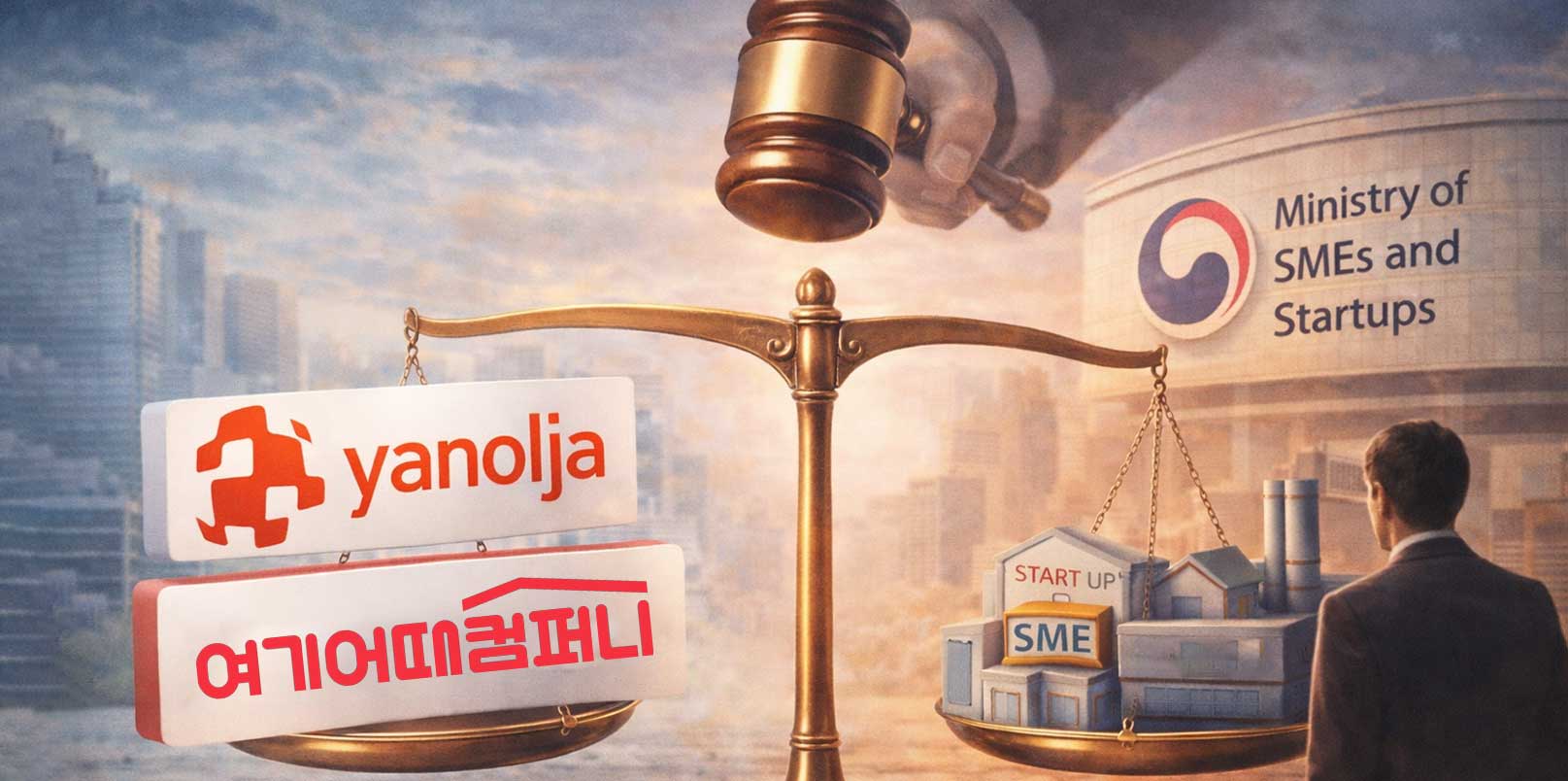
South Korea’s effort to strengthen fair trade oversight has put two of its largest accommodation platforms, Yanolja (야놀자) and Yeogi Eottae (여기어때컴퍼니), under new scrutiny. The case underscores a delicate phase for Seoul’s innovation governance — how to ensure platform accountability without undermining investor confidence in one of Asia’s most ambitious startup ecosystems.
Ministry Requests Prosecution Over Fair Trade Violations
The Ministry of SMEs and Startups (MSS) announced on January 14, 2026, that it had requested the Fair Trade Commission (FTC) to refer Yanolja and Yeogi Eottae (Good Choice Company) to prosecutors for violating the Fair Trade Act.
The ministry also sought prosecution of INFAC (인팩) and its affiliate INFAC EPM (인팩이피엠) for violations of the Subcontracting Act.
The decision came after deliberation by the 32nd Mandatory Prosecution Request Committee, a system allowing the MSS to intervene in cases the FTC has not referred to prosecutors when small businesses suffer material harm or when issues carry significant social impact. Both companies were previously fined by the FTC but now face additional criminal investigation under this Mandatory Prosecution Request System.
Because once the MSS requests prosecution, the FTC must comply by law.
Fair Trade Probe Targets Yanolja and Yeogi Eottae Over Platform Power Abuse
According to the MSS, Yanolja and Yeogi Eottae are accused of exploiting their superior transactional positions as online platform operators. Both companies allegedly sold advertising packages that included discount coupons to partner lodgings and then allowed unused coupon portions to expire without refund.
Between February 2017 and May 2024, Yanolja offered a “Nearby Coupon Advertisement” product that bundled coupons into advertising fees, resulting in approximately 1.2 billion KRW worth of unrefunded coupons. The FTC imposed a corrective order and a 540 million KRW fine in August 2025.
Yeogi Eottae’s “Premium Advertising” product, sold between June 2017 and August 2025, reportedly included coupon validity limited to one day, leading to the expiration of about 35.9 billion KRW in unused coupons. The FTC ordered corrective measures and a 1 billion KRW fine.
The MSS concluded that both companies’ actions have been abusive toward the tenants. They have harmed small lodging partners and violated the Fair Trade Act’s principle of fair transactional practices.
INFAC and INFAC EPM Subcontracting Violations
In addition to the platform cases, INFAC and INFAC EPM, both automotive parts manufacturers, were accused of unfair subcontracting practices.
Investigations found that between April 2019 and February 2021, INFAC subcontracted the production of automotive molds without written agreements and withheld or reduced payments, causing about 535 million KRW in damages. The company was fined 76 million KRW by the FTC in September 2025.
INFAC EPM, an affiliate, carried out similar transactions between January and May 2020, passing on illegal defect repair costs and failing to pay 136 million KRW, for which it received a 20 million KRW fine.
The combined loss for subcontracted SMEs totaled 671 million KRW.
The MSS said the pattern reflected long-standing issues in both platform and manufacturing sectors, where dominant firms repeatedly impose one-sided terms on smaller partners despite ongoing regulatory reforms.
Regulatory Defense vs. Platform Pushback
Vice Minister Lee Byung-kwon (이병권), who chairs the Mandatory Prosecution Request Committee, stated that the decision serves to “protect SMEs and small business owners from the unfair conduct of dominant enterprises.”
Lee said,
“The system exists to ensure that businesses with superior market positions cannot exploit weaker partners. We expect this enforcement to strengthen accountability among platform operators and improve transactional fairness.”
He emphasized that unfair practices — whether in digital platforms or traditional manufacturing — require consistent and visible enforcement to restore market trust.
The platforms, however, have framed the controversy as a legal interpretation dispute rather than deliberate wrongdoing.
Yanolja has insisted that the coupon model was designed as a marketing tool to boost advertising performance, not as a tradable asset requiring refunds. In previous FTC proceedings, the company claimed the unused coupon rate was less than one percent, arguing that the issue stemmed from advertising structure rather than malicious gain.
Yeogi Eottae has declined to comment publicly but faces greater scrutiny due to its much larger unrefunded coupon total.
Fair Trade Enforcement Meets Startup Reality
The case highlights a growing policy dilemma within Korea’s startup ecosystem.
While Seoul aims to establish Korea as a top global venture hub under its “Third Venture Boom” strategy, heavy-handed enforcement risks shaking confidence among investors and founders watching the policy environment closely.
Both Yanolja and Yeoggi Eottae have matured into influential players in Korea’s digital economy, with ambitions that reach beyond hospitality technology and into data-driven travel platforms across Asia. Yet their reputational challenges now coincide with the government’s renewed focus on platform accountability, a shift shaped by recent data security and transparency concerns.
At the same time, the Fair Trade Act remains an essential safeguard. Its enforcement protects smaller companies — many of which are startups and SMEs — from the leverage of dominant market actors. The challenge for policymakers lies not in choosing sides, but in maintaining consistency and proportionality so that protection does not erode trust in Korea’s innovation agenda.
Industry observers note that the Mandatory Prosecution Request System, first implemented in 2014, has now been applied to 57 cases, with 40 resulting in indictments. While this framework strengthens legal consistency, it also illustrates how fair trade enforcement has become a public test of Korea’s capacity to balance growth with governance.
Innovation Requires Predictable Governance
The Yanolja – Yeogi Eottae case has become more than a matter of advertising compliance — it represents how policy credibility and startup trust are now intertwined. For Korea’s innovation economy, predictability and proportional enforcement are as crucial as protection against abuse.
As the country pushes to attract cross-border capital and establish itself as a global startup hub, its ability to reconcile regulatory discipline with ecosystem confidence will define whether the “Third Venture Boom” can sustain momentum — or become yet another cycle shadowed by policy contradiction.
🤝 Looking to connect with verified Korean companies building globally?
Explore curated company profiles and request direct introductions through beSUCCESS Connect.
– Stay Ahead in Korea’s Startup Scene –
Get real-time insights, funding updates, and policy shifts shaping Korea’s innovation ecosystem.
➡️ Follow KoreaTechDesk on LinkedIn, X (Twitter), Threads, Bluesky, Telegram, Facebook, and WhatsApp Channel.


