


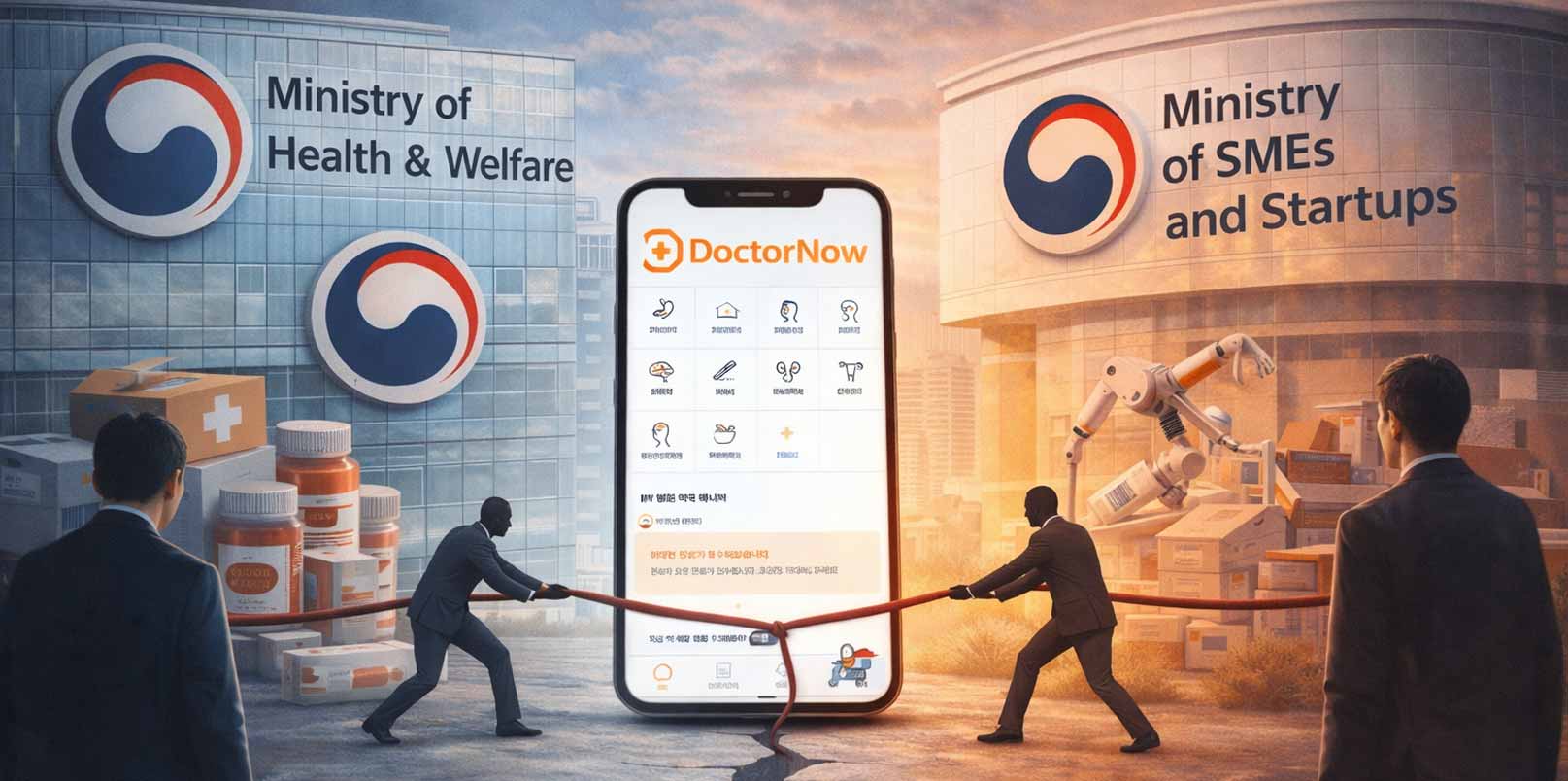
South Korea’s ambition to lead the next global startup wave is once again meeting its own structural limits. The latest clash between the Ministry of Health and Welfare and the Ministry of SMEs and Startups over the “DoctorNow Prevention Bill” shows that even at the height of Korea’s Third Venture Boom campaign, the government’s right hand and left hand are still pulling in opposite directions.
Conflicting Ministries Debate DoctorNow Bill at Joint Meeting
On January 14, Seoul hosted a joint closed-door meeting between the Ministry of SMEs and Startups (MSS) and the Ministry of Health and Welfare (MOHW) to discuss the controversial amendment to the Pharmaceutical Affairs Act—commonly referred to as the “DoctorNow Prevention Bill.” The bill would restrict telemedicine platforms from simultaneously operating pharmaceutical wholesalers.
The MOHW insists that the measure is essential to ensure transparent and fair drug distribution. Its Vice Minister Lee Hyung-hoon stated,
“The amendment allows platforms and telemedicine but simply sets clear standards for platform–wholesaler relationships to protect fairness and patient safety.”
In contrast, MSS Vice Minister Noh Yong-seok argued,
“Telemedicine can improve access to healthcare and complement the medical delivery system. For its sustainable development, the contribution of innovative startups is vital.”
The meeting included representatives from the Korea Digital Health Industry Association, the Korea Patient Federation, the Korean Medical Association, and DoctorNow itself.
Yet after ninety minutes of discussion, no consensus was reached. The divide between regulation and innovation remains intact.

A Policy Rift Exposing Korea’s Innovation Governance Gap
The disagreement reveals a deeper weakness in Korea’s institutional framework for innovation policy: there is no consistent coordination between ministries tasked with growth and those tasked with oversight. Each operates under separate mandates—one designed to protect public safety, the other to accelerate entrepreneurial expansion.
The DoctorNow Bill debate now represents more than a single health-policy dispute. It has become a case study of how Korea’s policy architecture fails to anticipate convergence industries like digital healthcare, where software platforms and regulated goods intersect.
Startups now face a policy contradiction. They are expected to accelerate innovation under one authority while at the same time, constrained by compliance demands from another. It’s a structure built for conflict, not growth.
The Friction: When Innovation Meets Institutional Boundaries
In the debate, the Ministry of Health and Welfare fears that telemedicine platforms owning wholesalers could distort fair competition and influence which drugs reach patients. And patient groups also share the same concern, warning that medicine is not a consumer commodity and must remain independent from profit-driven platforms.

On the other hand, startup advocates and telemedicine providers argue that the law overcorrects. They emphasize that structural bans discourage investment in health innovation and that most concerns—such as rebates or unfair inducement—are already covered by existing laws.
The tension further reflects a fundamental design flaw, showing that Korea’s regulatory system is still built for a clear separation between medicine, pharmacy, and distribution. Whereas digital platforms do not fit that model. But still, the law continues to treat them as if they do.
How the DoctorNow Bill Redefines Korea’s Digital Health Boundaries
Even if the bill proceeds, it will not resolve the systemic uncertainty haunting Korea’s digital health market. A ban on dual operations might clarify distribution ethics, but it does not define what platforms can do in this new legal environment.
Without a complementary framework—such as transparent data-sharing standards or fair-use provisions for telemedicine logistics—innovation will remain frozen between legal caution and entrepreneurial ambition.
Startups may comply in form while seeking loopholes in practice. Regulators, lacking a unified governance structure, will continue to respond case by case rather than through principle-driven policy.
Why Global Investors Are Watching Korea’s Startup Policy Divide
For international investors, this standoff highlights a broader risk: regulatory unpredictability. Korea promotes itself as a top-three AI and digital-health powerhouse, yet each high-profile dispute reinforces concerns about policy coherence.
Foreign founders entering the market see an ecosystem rich in talent but bound by unclear rulemaking. When ministries interpret innovation through different lenses—compliance versus competitiveness—the credibility of Korea’s entire startup policy is questioned.
Global venture funds tracking Asia’s digital-health sector are now watching whether the Korean government can reconcile its own agencies. If not, capital will flow toward jurisdictions where growth and regulation coexist without contradiction.
The DoctorNow Bill Debate: A Moment of Reckoning for Korea’s Innovation State
That is why the DoctorNow Bill conflict is no longer merely about one company or one law. It has become a mirror reflecting how Korea manages its own modernization. The government’s split over this issue signals that the country’s innovation drive may still lack a unified philosophy that capable of protecting public trust without dismantling entrepreneurial freedom.
Until that coherence emerges, every new technology that challenges an old structure will trigger the same cycle: ambition, resistance, and retreat. And each time, Korea’s claim to global startup leadership will sound a little less certain.
🤝 Looking to connect with verified Korean companies building globally?
Explore curated company profiles and request direct introductions through beSUCCESS Connect.
– Stay Ahead in Korea’s Startup Scene –
Get real-time insights, funding updates, and policy shifts shaping Korea’s innovation ecosystem.
➡️ Follow KoreaTechDesk on LinkedIn, X (Twitter), Threads, Bluesky, Telegram, Facebook, and WhatsApp Channel.


