


In policy, the real struggle rarely begins at the podium—it begins the morning after. Korea’s startup engine has capital, leadership, and an ambitious roadmap. What it doesn’t yet have is proof that a faster government can mean a faster market. For the Ministry of SMEs and Startups, 2026’s growth is less about new promises and more about whether execution itself can become innovation.
“Growth Ladder” Policy Execution Takes the Spotlight in Korea’s 2026 Startup Agenda
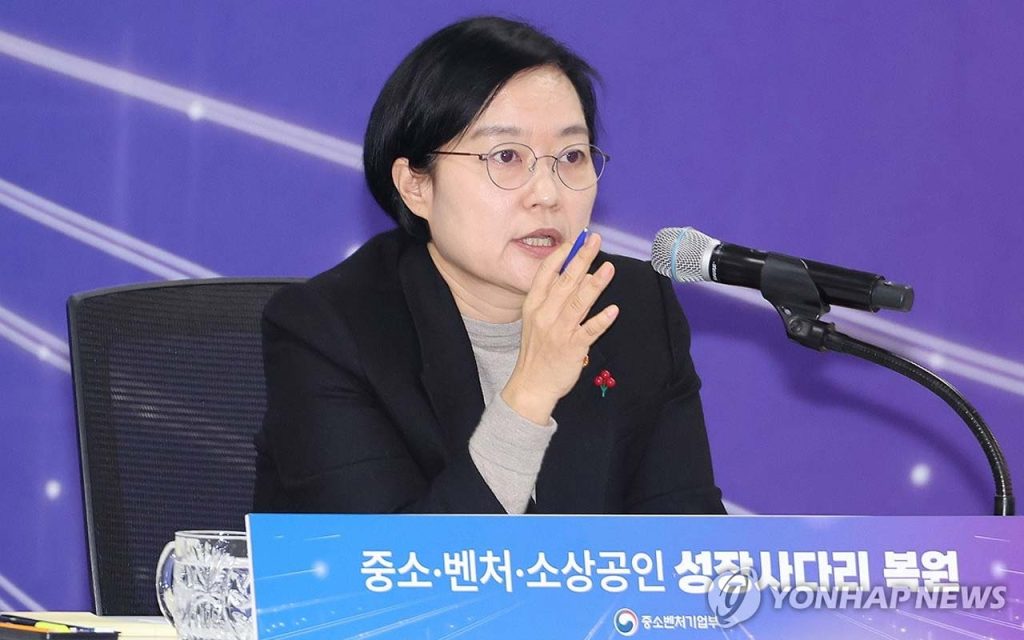
The Ministry of SMEs and Startups (MSS) began 2026 by turning its attention inward. Minister Han Seong-sook called on 15 public and partner institutions under the ministry to act with speed, precision, and accountability.
At the 2026 Work Report for Public and Related Institutions, held at the Sejong Convention Center, Minister Han emphasized,
“If policy implementation is delayed, its effectiveness inevitably diminishes. Please ensure policies are executed promptly.”
The minister delivered her clear directive to the Korea SMEs and Startups Agency (KOSME), the Small Enterprise and Market Service (SEMAS), and other affiliated organizations: deliver policies faster and make sure business owners actually feel them.
The meeting, which included institutions such as the Korea Venture Business Association (KOVA) and the Korea Federation of SMEs (KBIZ), aimed to operationalize the government’s 2026 goal of “restoring the growth ladder” for small firms, ventures, and self-employed merchants.
The ministry’s blueprint sets three main policy tracks—growth-oriented administration, regional ecosystem activation, and data-driven policy design—with four flagship initiatives spanning small merchants, startups, manufacturing SMEs, and fair-market reforms.
Why Speed Is Emerging as the True Policy Currency
The focus on speed may sound procedural, but it reflects a deeper shift in Korea’s startup administration.
Over the past year, MSS has designed ambitious programs: an AI-based SME platform, expanded Fund of Funds participation, and deep-tech prioritization. Yet, many founders still report delays between policy announcements and field execution.
Han’s message reframes this gap as structural. “The timing of impact is as important as policy content,” she said, signaling that execution efficiency now defines success as much as budget scale. The ministry’s 2026 plan follows a broader government trend—reducing administrative lag between decision and delivery to small enterprises.
This also reflects Korea’s global positioning challenge. As the nation aims to become a global venture powerhouse, bureaucratic responsiveness becomes a competitive variable. A delayed subsidy or grant can cost a startup not only a quarter’s runway but also investor confidence.
Friction Between Ambition and Execution Reality
Policy acceleration sounds logical in briefings, but in practice it collides with long-standing frictions: fragmented program ownership, inconsistent evaluation systems, and complex compliance processes.
Many SMEs still rely on paper-based or semi-digital interfaces to access funding programs. Even with the ministry’s push toward AI-based systems, the coordination between central ministries, local governments, and semi-public funds remains uneven. The result is a system where announcement velocity often outpaces execution capacity.
Minister Han’s emphasis on communication with “the field” acknowledges this bottleneck. Despite numerous programs, many business owners remain unaware of what they qualify for. The challenge is less about creating new initiatives and more about synchronizing existing ones—a structural problem every Korean administration has confronted, but few have fully solved.
The Promise and Limit of Policy Acceleration
If implemented well, Han’s directive could streamline how government capital flows through the startup economy. Faster disbursement would strengthen founder trust, particularly among early-stage entrepreneurs navigating limited private capital.
However, speed without clarity risks compounding confusion. Korea’s policy ecosystem already spans overlapping funds, accelerators, and agencies. Unless execution transparency improves, startups may experience faster but still fragmented assistance. The next phase must prioritize data integration and program consolidation—otherwise, acceleration becomes a form of noise.
Still, the focus on responsiveness marks a tangible shift. For years, Korea’s innovation agenda emphasized funding scale; 2026 could be the year process becomes policy.
A Test Case for Global Investors Watching Korea’s Policy Credibility
For international investors, the message from Seoul is both promising and cautionary. Korea is signaling that its startup policy is no longer merely about capital injection—it’s about execution discipline. That shift matters for global funds evaluating policy reliability in co-investments or public-private partnerships.
Deep-tech and AI-focused investors, in particular, will watch whether the ministry’s call for “speed and measurable results” leads to streamlined grant cycles, quicker technology validation, and predictable reporting structures.
If these reforms materialize, Korea’s policy apparatus could emerge as one of the most agile among advanced economies. If not, the credibility gap between ambition and delivery could widen, dulling the impact of its substantial venture allocations.
Execution, Not Expansion, Will Define 2026
The government’s growth ladder vision is already well-funded and politically endorsed. What remains uncertain is whether the institutions tasked with delivering it can operate at startup speed.
Korea’s startup momentum depends less on the next announcement and more on how well existing programs converge into visible outcomes for founders and investors. The next phase of innovation policy will not be judged by how much capital the government mobilizes—but by how quickly that capital turns into motion on the ground.
The “growth ladder” now meets its real test: execution as the new frontier of innovation policy.
🤝 Looking to connect with verified Korean companies building globally?
Explore curated company profiles and request direct introductions through beSUCCESS Connect.
– Stay Ahead in Korea’s Startup Scene –
Get real-time insights, funding updates, and policy shifts shaping Korea’s innovation ecosystem.
➡️ Follow KoreaTechDesk on LinkedIn, X (Twitter), Threads, Bluesky, Telegram, Facebook, and WhatsApp Channel.


