Korea’s creative industries are standing at a crossroads. Despite worldwide recognition—from Squid Game and Parasite to the global fandom economy—the domestic investment framework behind K-content has not matured at the same speed. As AI transforms production and intellectual property (IP) becomes the new currency of growth, 2026 is emerging as the critical window to turn creative momentum into a stable, scalable economic engine.
Korea’s Global Content Power vs. Its Domestic Investment Weakness
According to a December 2025 report by Startup Alliance and the Korea Culture and Tourism Institute, Korea’s content investment market remains largely project-based.
Over 80% of cultural fund investments are tied to single productions rather than corporate entities, limiting investors’ ability to share in long-term value created through IP or studio growth.
This structure means that even when a studio produces multiple international hits, investment profits dissolve after each project. At the same time, 88.6% of Korea’s content companies generate less than KRW 1 billion in annual revenue, leaving them too small to attract sustained venture capital.
The result is a fragmented market where creativity thrives, but capitalization stalls—a mismatch that threatens Korea’s ambition to build a globally competitive creative economy.
Why the Policy and Market Disconnect Persists
K-content has proved to be an extraordinary economic catalyst. Every USD 100 million increase in content exports stimulates roughly USD 180 million in exports of consumer goods such as cosmetics, fashion, and food.
In 2023 alone, Hallyu-driven consumer and tourism exports reached nearly USD 6.5 billion.
Yet Korea’s investment framework fails to capture this spillover effect.
By measuring returns only through direct production revenue, investors ignore the downstream gains that ripple through related industries. As a result, while the “K-content effect” drives consumption worldwide, the profits often flow elsewhere—to global platforms or secondary markets.
The Korean Wave Industry Promotion Act, enacted in 2024, attempted to realign policy by defining Hallyu as a multi-industry value chain rather than a set of cultural products. But the legislative shift has yet to translate into a financial one.
Stakeholders Call for an IP-Centered Investment Model
Industry leaders agree that the next phase of K-content growth depends on treating intellectual property as infrastructure, not output.
Yang Ji-hoon, Associate Researcher at the Korea Culture and Tourism Institute and author of the Startup Alliance report, argues that investors must view content as a “trigger for consumption”, not simply a finished product.
Jihun Yang proposes two complementary investment directions:
- Invest in businesses that commercialize proven IPs—for instance, consumer brands that license popular animation or drama worlds.
- Allow cross-industry participation in production, where cosmetics, food, or fashion companies fund part of a series and gain first negotiation rights for global promotions or image use afterward.
This approach would transform marketing costs into strategic investments and align value creation across sectors.
Lee Ki-dae, Head of Startup Alliance, reinforced this view, stating,
“K-content has elevated Korea’s global standing, but creator investment remains constrained by uncertainty. National-level support, similar to technology R&D programs, should be considered to stabilize creative growth.”
AI, IP, and the Rise of ‘Attachment Capital’
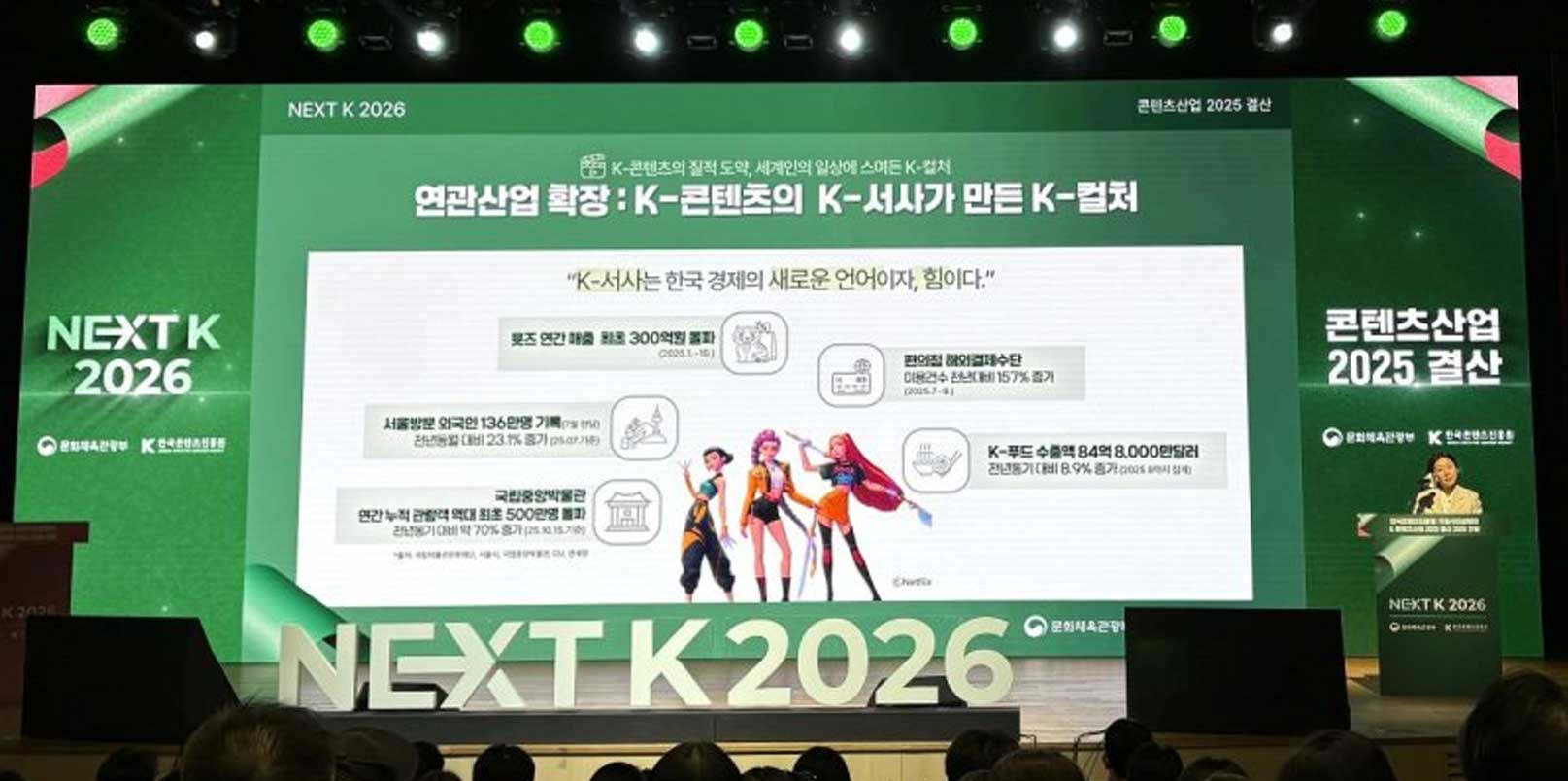
The Korea Creative Content Agency’s Next K 2026 conference positioned 2026 as the “golden age” for K-content’s structural evolution.
Generative AI is already integrated into 20% of production companies, spreading rapidly across planning, writing, production framework, and marketing. Meanwhile, IP transactions account for nearly 30% of total industry revenue, signaling the move from one-off hits to managed, expandable universes.
Another defining shift is the emergence of fandom as investment capital.
As audiences evolve into participants—creating derivative works, influencing storylines, and driving brand collaborations—fan trust itself becomes an asset. KOCCA researchers describe this as “attachment capital,” a new form of social and economic equity that can accelerate or destroy content value depending on how it is managed.
Ecosystem Significance: The Startup Opportunity
The convergence of AI-powered creativity, IP monetization, and cross-sector collaboration is opening space for startups specializing in creative technology, digital rights management, and fandom analytics.
For venture capital, this signals a broader landscape where cultural data, generative tools, and IP licensing platforms could become Korea’s next major export sectors.
However, without faster regulatory adaptation, Korea risks losing its advantage. Competing regions such as Singapore, Japan, and the UAE are already experimenting with content-IP financing and AI-driven creative funds.
If Korea’s financial and policy systems remain slow to respond, its creative economy could fall behind even as its cultural influence expands.
Connecting Creative Excellence with Sustainable Capital Formation
K-content has proven that cultural storytelling can move markets. The next challenge is ensuring that Korea’s investment system, IP laws, and innovation policy evolve fast enough to keep pace with global change.
The coming year will test whether Korea can finally connect creative excellence with sustainable capital formation—turning artistic success into an enduring economic pillar for its startup ecosystem.
🤝 Looking to connect with verified Korean companies building globally?
Explore curated company profiles and request direct introductions through beSUCCESS Connect.
– Stay Ahead in Korea’s Startup Scene –
Get real-time insights, funding updates, and policy shifts shaping Korea’s innovation ecosystem.
➡️ Follow KoreaTechDesk on LinkedIn, X (Twitter), Threads, Bluesky, Telegram, Facebook, and WhatsApp Channel.