
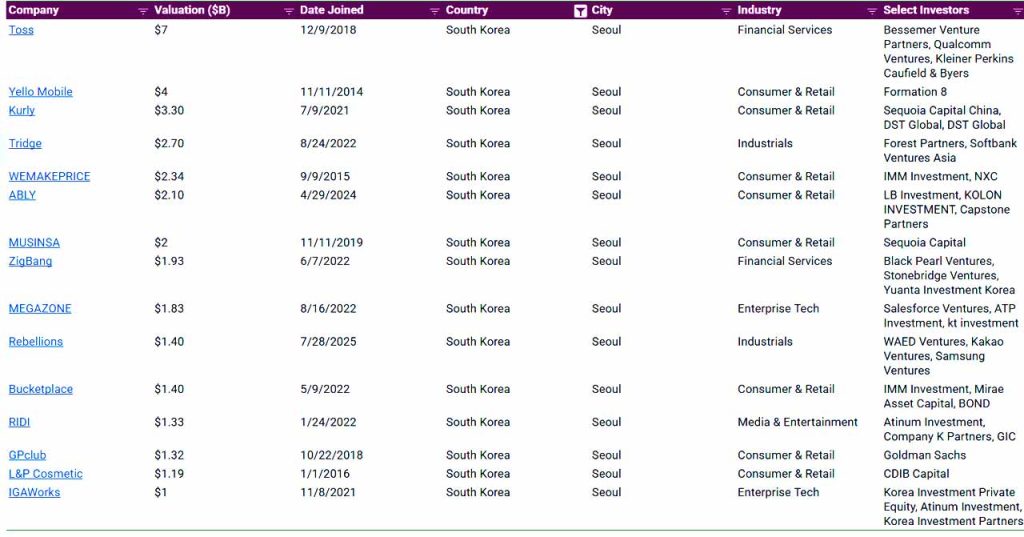
South Korea’s startup ecosystem, once seen as an emerging innovation hub, is showing signs of stagnation. The country now counts 13 unicorns—private startups valued over one trillion won—ranking 11th globally. While the United States added 229 new unicorns in the same period, Korea’s total rose by just two. The gap reflects not a lack of talent, but deep structural barriers holding back innovation and investment.
Korea Adds Only Two Unicorns in Four Years, Ranking 11th Globally
According to data from the Korea Chamber of Commerce and Industry (KCCI) based on CB Insights’ global unicorn list, South Korea currently has 13 unicorns, up from 11 in 2021. Globally, there are 1,276 unicorns as of October 2025. The United States leads with 717, accounting for 56.2% of the total, followed by China with 151.
This data shows a stark contrast because while U.S. unicorns grew by 229 in four years, representing 72% of the total global increase, Korea’s rise of two marks one of the smallest gains among advanced economies. Only China saw a decline, with 19 fewer unicorns than four years ago.
Why Korea’s Unicorn Engine Is Losing Speed
Unicorns are often viewed as a barometer of a country’s innovation strength and future growth potential. Yet Korea’s creation rate and growth speed are slowing due to systemic friction.
KCCI’s analysis identifies three main obstacles:
- Regulatory rigidity: Korea maintains a “positive regulation” system, which allows only what is explicitly permitted. This limits entry into emerging industries.
- Growth penalties: As startups scale, they face heavier compliance burdens rather than incentives, discouraging expansion.
- Limited global reach: The domestic market’s size and slow foreign capital inflow hinder the leap to global competitiveness.
A KCCI spokesperson explained that “outdated regulations and restricted capital flow are dragging down the vitality of the startup ecosystem.”
Stakeholder Insights and Global Unicorns Comparisons
Global comparisons underscore the imbalance. Israel, with 23 unicorns, and Singapore, with 16, outperform Korea despite smaller economies. Both countries actively deploy government-backed funds and regulatory flexibility to attract investors and nurture early-stage ventures.
China remains second globally despite a slowdown, largely due to U.S. investment bans on AI, semiconductor, and quantum startups. Its venture capital investment has shrunk to USD 33.2 billion in 2024—one-third of its 2021 level, according to Crunchbase.
In Korea, AI semiconductor startup Rebellions joined the CB Insight’s unicorn list in July 2025, while MegazoneCloud reached the milestone in just 4.12 years—the fastest among Korean firms.
Still, the national average time from founding to unicorn status stands at 8.99 years, much slower than the global top 10 average of 6.97 years.
Korea’s Unicorns: Consumer Giants, Not Tech Titans
Korea’s unicorns are concentrated in consumer goods and retail, which account for 46.1% of the total. By contrast, AI and IT solutions dominate 36.3% of unicorns among the top ten global economies.
This composition highlights a growing divergence: while other nations are producing tech-heavy unicorns in artificial intelligence, deep learning, and advanced software, Korea’s ecosystem remains anchored in consumption-driven sectors.
The imbalance signals a structural challenge in scaling deep tech ventures that demand longer R&D cycles and higher-risk capital.
Innovation Hubs and the Need for Policy Reform
To close the innovation gap, KCCI has called for the creation of innovation hub cities—zones designed to cluster startups, large enterprises, universities, and investors. These hubs would enable freer experimentation through a proposed “mega sandbox” policy, allowing startups to test new technologies without regulatory barriers.
Additionally, South Korea’s policy environment continues to face tension between protecting existing industries and fostering new innovation. Recent debates around the DoctorNow Prevention Bill saga and the AI Basic Law have highlighted how regulation often favors established interests over emerging technologies.
The country’s strict stance on data protection versus AI innovation has also fueled growing concern among founders who see privacy rules evolving faster than frameworks supporting responsible AI growth. And the recent Charzin court receivership filing further exposed structural fragility, showing how early-stage innovators struggle once regulatory barriers ease but market competition intensifies.
These cases illustrate a deeper irony — Korea’s strong governance framework, while designed to ensure safety and fairness, is increasingly suppressing the very innovation it seeks to promote.
Meanwhile, the U.S. model remains a benchmark: 45.3% of its unicorns—325 companies—are based in California’s Bay Area, where flexible regulations, strong academic networks, and investor density create a self-reinforcing innovation loop.
KCCI’s Economic Policy Director Kim Hyun-soo emphasized,
“The slowdown in unicorn creation signals a loss of vitality in Korea’s startup ecosystem. We need institutional reform and greater capital inflows to rebuild the unicorn growth environment.”
A Crossroads for Korea’s Innovation Future
The data reflects a broader truth about Korea’s innovation trajectory. Despite its strong base in AI, semiconductors, and digital infrastructure, policy bottlenecks and capital barriers are diluting its startup potential.
To sustain global competitiveness, Korea must pivot from control-heavy administration to flexible innovation policy—where regulation evolves with technology, not behind it. Government-backed seed funding, international investor engagement, and structural incentives for scaling firms are no longer optional.
If Korea modernizes its startup policy environment and enables faster global expansion, the next wave of unicorns could emerge not just from consumer markets, but from deep tech sectors capable of defining Asia’s innovation frontier.
– Stay Ahead in Korea’s Startup Scene –
Get real-time insights, funding updates, and policy shifts shaping Korea’s innovation ecosystem.
➡️ Follow KoreaTechDesk on LinkedIn, X (Twitter), Threads, Bluesky, Telegram, Facebook, and WhatsApp Channel.
🤝 Looking to connect with verified Korean companies building globally?
Explore curated company profiles and request direct introductions through beSUCCESS Connect.