
In a world saturated with screens, most of them still display static advertisements or ambient loops that add little cultural or emotional value. Niio, co-founded by Rob Anders and Oren Moshe, envisions something radically different — a platform where screens become portals for art, not noise.
In this exclusive interview, the founders discuss Niio’s mission to bridge the gap between digital art and everyday environments, its expansion as the company advanced with the other 40 startups at K-Startup Grand Challenge (KSGC) 2025 Phase 2, and how Korea could become the epicenter of a new era in visual culture.
Rethinking the Screen Economy with Niio
Q1. What motivated you to start this company, and what core problem were you trying to solve?
Billions of connected screens sit idle or loop low-value content instead of delivering meaningful visual culture that transforms spaces and creates measurable value.
I founded Niio after recognizing that two major revolutions—technological and cultural—had evolved in parallel but never converged. Digital and moving-image artists, now increasingly working with AI, were creating museum-grade works that rarely reached beyond festivals, private collections, or one-off installations. At the same time, more than three billion connected screens were appearing in homes, hotels, offices, and healthcare environments, yet most remained underused or filled with generic loops.
This showed a clear structural gap, there was no streaming platform dedicated to visual culture and no reliable system that allowed artists to distribute their work at scale while maintaining rights and revenue. Businesses, on the other hand, lacked a professional, licensing-safe way to enrich their environments with high-quality digital art.
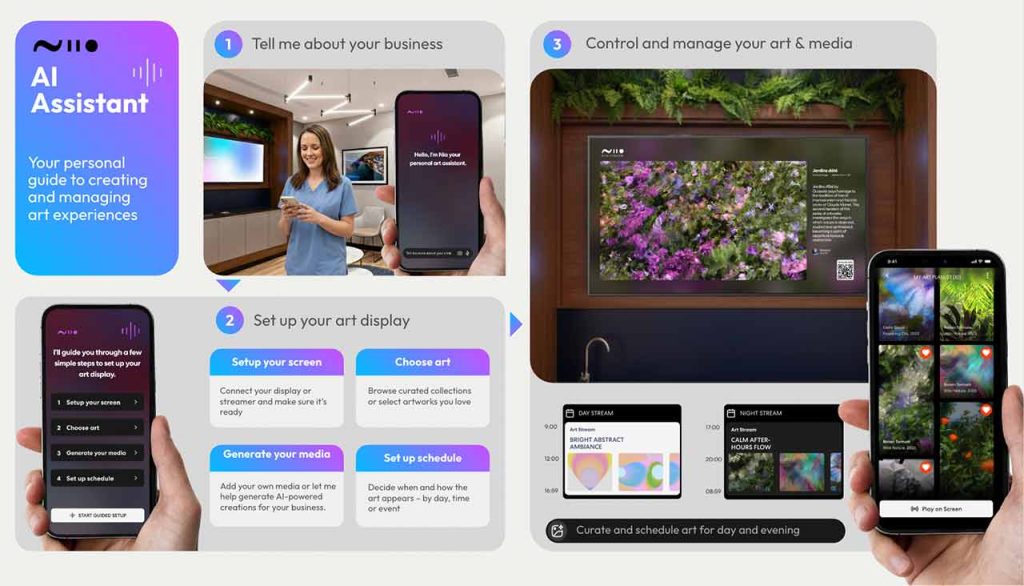
Niio was built to bridge this divide. With over $20 million raised, we developed a full-stack streaming service for visual culture—featuring a rights-cleared catalog of more than 30,000 works, professional playback technology, and OEM integrations—enabling screens in any setting to function as cultural surfaces.
The need for this convergence is especially visible in Korea, where world-class displays and digitally native audiences coexist with limited access to rights-managed visual culture.
Why Korea’s Digital Culture Offers the Perfect Canvas
Q2. What opportunity or unmet need did you identify in the Korean market, and what early signals convinced you that your solution could gain real traction here?
In Korea, we discovered a particularly strong alignment between Niio’s value proposition and local market conditions. The country has a rapidly expanding digital art ecosystem, a design-driven consumer base, and the world’s most advanced display infrastructure. Yet, despite premium screens being installed across hotels, clinics, and mixed-use developments, there remains no scalable platform that delivers curated visual culture into everyday environments.
Most venues still depend on generic digital signage or costly one-off media façades. What Korea lacks is an accessible, subscription-based visual culture layer that operates on standard displays and enhances ambience, wellbeing, brand identity, and customer experience.
Our early signals for market fit were immediate and persuasive. Korean investors, developers, and AV integrators quickly recognized the distinction between low-value content loops and curated visual culture. OEM-adjacent discussions further validated Niio’s potential as a premium service layer for Korean-built screens.
Early engagements—including collaborations involving Samsung, cultural initiatives linked to Hyundai Card, and a paid hospitality deployment in Seoul—confirmed that Korean audiences respond strongly to Niio’s quality and curation. We also received inbound interest from partners seeking a globally compliant, rights-cleared platform to integrate premium art into new developments.
Korea’s combination of hardware leadership, cultural sophistication, and digitally native audiences positions it as one of the most naturally compatible markets for Niio worldwide.
Korea as the Cultural Hub of the Next Digital Art Revolution
Q3. During KSGC, were there any mentors, partners, or specific insights that significantly influenced your product or strategy?
Yes. During the program, a local ecosystem advisor challenged us to redefine how we viewed Korea’s role in Niio’s next stage of growth. His insight was simple yet transformative: Korea should not be treated as just another market, but as the primary Asia hub for Niio’s long-term commercial and cultural expansion.
He encouraged us to align our roadmap with three of Korea’s core strengths:
- Display OEM leadership – Korea produces the world’s most advanced screens, and Niio can serve as the premium cultural layer built atop this hardware.
- Flagship hospitality, healthcare, and smart-building environments – spaces where ambience and wellbeing are critical, and where Niio already demonstrates measurable impact worldwide.
- K-culture momentum and digital art policy – Korea’s cultural leadership can help us export both Korean and global digital artists through Niio’s platform.
This guidance pushed us to refine our messaging, localize our curations, strengthen OEM-ready packaging, and design clear B2B2C journeys that let consumers experience Niio in Korean venues before adopting it at home. The result was a complete strategic shift—transforming our approach to Korea from exploratory to fully committed.
Turning Vision into Market Execution
Q4. After joining KSGC, what has been the most meaningful change for your company, and what evidence supports this growth?
The most meaningful change was Korea’s transformation from a long-term “future market” into a structured, near-term expansion with defined verticals, partners and execution steps.
Before joining KSGC, Niio had already built a solid global foundation—strong funding, a mature platform, and deployments across hospitality and commercial environments, supported by partnerships with OEMs and cultural networks. Although Korea was always recognized as an important market, our approach remained broad and exploratory.
Through KSGC, Niio has gone through these three concrete shifts:
- Korea became the anchor of our Asia strategy.
We reframed Korea as our primary Asian hub for OEM alignment, reference sites and B2B2C engagement flows. - We gained precise go-to-market clarity.
We identified Korean verticals where Niio could create immediate impact—premium hospitality, smart hospitals, and media-art smart-city zones—and mapped the partner categories needed to deliver: AV integrators, OEM-related channels, property developers, and cultural institutions. - We strengthened local capacity and insight.
With the help of a senior on-the-ground advisor, we were able to sequence partnerships and prioritize opportunities, building on early collaborations with Samsung, Hyundai Card’s cultural initiatives, and our hospitality deployment in Seoul.
These developments produced a clear execution roadmap, a prioritized partner list, and a localization plan tailored to Korea. The combination of global readiness and local insight transformed our interest in Korea into a concrete, actionable expansion strategy.
Building the Global Streaming Platform for Visual Culture
Q5. Looking ahead, what is the most important vision or long-term goal your company aims to achieve, and what steps are you taking to move toward it?
Niio’s long-term vision is to become the global standard for how visual culture appears on connected screens. Just as Spotify redefined music and Netflix redefined film, Niio seeks to shape the streaming category for visual culture—transforming idle screens into cultural surfaces and enabling digital artists to reach audiences worldwide in a sustainable way.
This vision is built on two strategic pillars:
- Owning the cultural layer on devices
We are deepening integrations so Niio can be activated—or embedded—seamlessly across new screens, particularly those manufactured in Korea. - Scaling a B2B2C flywheel
We start with high-impact environments such as hotels, hospitals, and offices, where millions experience Niio passively, and then convert that exposure into home subscriptions and art purchases.
In realizing this vision, Korea plays a central role. Our next steps include:
- Localizing our curations, products, and storytelling for Korean users.
- Building structured partnerships with Korean OEMs, AV integrators, and ecosystem collaborators.
- Developing flagship Korean reference sites that demonstrate the measurable impact of curated visual culture on wellbeing, dwell time, and brand experience.
- Continuing to invest in AI-driven curation and engagement tools that personalize experiences and support creators globally.
A key part of this future is empowering Korean digital artists to reach international audiences through Niio, positioning Korea not only as our APAC hub but also as a leading exporter of digital culture.
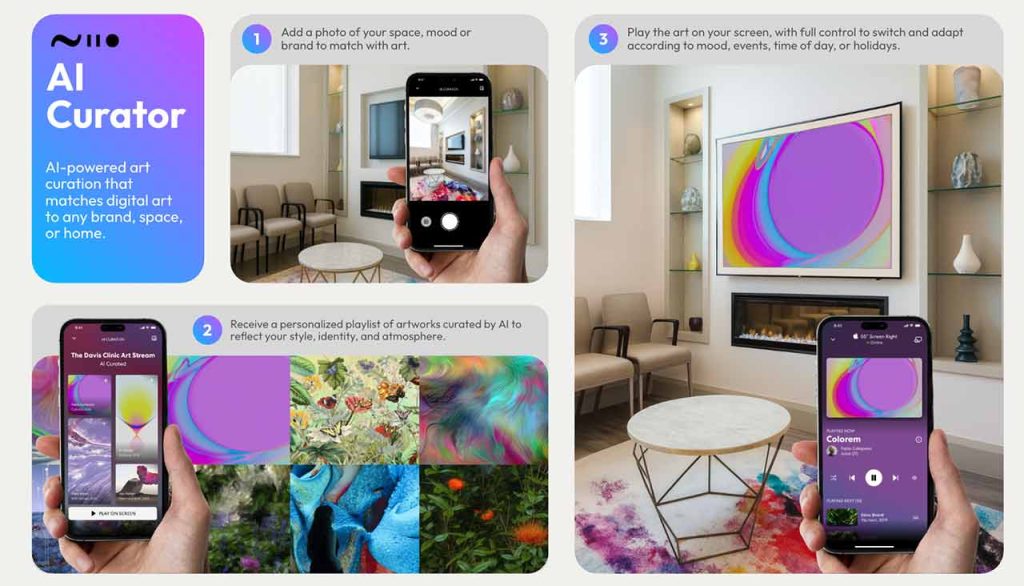
With its advancement at Phase 2 of K-Startup Grand Challenge 2025, Niio isn’t just is now redefining how the world experiences art, beyond South Korea. By blending advanced display technology, rights-cleared creativity, and localized curation, the company is turning the world’s screens into a living gallery that evolves with its viewers.
“KSGC helps us produced a clear execution roadmap, a prioritized partner list, and a localization plan tailored to Korea, turning it into structured, near-term expansion with defined verticals, partners and execution steps.”
About This Series
This article is part of the “K-Startup Grand Challenge 2025 Interview Series,” featuring 40 global startups from Phase 2 of Korea’s leading accelerator program. The series highlights how international founders are scaling innovation through Korea’s startup ecosystem.
Read more stories from the K-Startup Grand Challenge 2025 Interview Series on KoreaTechDesk.
– Stay Ahead in Korea’s Startup Scene –
Get real-time insights, funding updates, and policy shifts shaping Korea’s innovation ecosystem.
➡️ Follow KoreaTechDesk on LinkedIn, X (Twitter), Threads, Bluesky, Telegram, Facebook, and WhatsApp Channel.
🤝 Looking to connect with verified Korean companies building globally?
Explore curated company profiles and request direct introductions through beSUCCESS Connect.