
Acquisitions often look successful on announcement day. Investors focus on valuations, market expansion, and projected synergies. Still, many deals begin losing value almost immediately after closing. And it’s not because the strategy was wrong, but because companies underestimate the operational shock of integration itself. Across global startup and venture ecosystems, post-merger integration is increasingly becoming the real test of whether acquisitions create long-term growth or quietly destroy it.
The Global M&A Recovery Is Increasing the Cost of Integration Failure
Global M&A activity has returned to growth, but the structure of the market is changing.
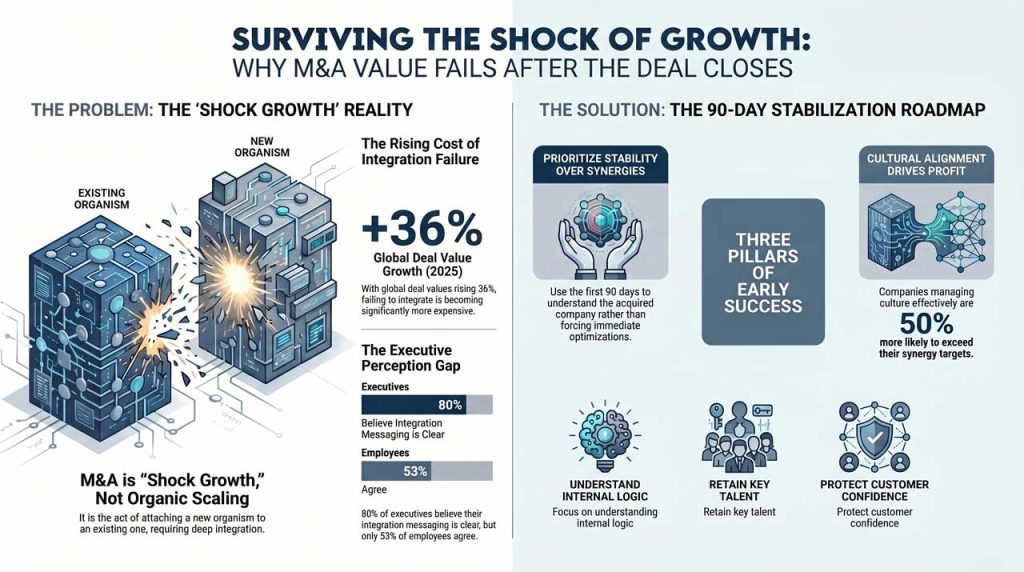
According to PwC’s 2026 Global M&A Industry Trends Outlook, global deal value increased 36% in 2025 even though overall deal volume rose only 1%. The rebound was driven largely by sizable strategic transactions and megadeals.
Not only that, but a similar pattern also emerged in South Korea.
The Korea Fair Trade Commission reviewed 590 business combination cases in 2025, down from 798 cases in 2024. However, the total transaction value climbed to KRW 358.3 trillion, roughly 30% higher than the previous year, according to FTC data summarized by the Korean Fair Competition Federation.
As deal sizes grow larger, integration failure becomes significantly more expensive.
And this challenge is no longer limited to large conglomerates or private equity firms. Startup ecosystems are increasingly treating acquisitions as a growth strategy, especially in competitive sectors where expansion through organic growth alone is becoming harder and slower.
Still, many companies remain far more prepared to negotiate acquisitions than to absorb them operationally afterward.
Why Acquisitions Become “Shock Growth” for Organizations
Igor Strečko, Founding/Managing Partner at NeoZone Collective, Managing Director at Strecko Investment, former CEO of Webglobe, and a global investor-advisor, has led more than 25 strategic acquisitions across multiple markets while scaling the hosting and digital infrastructure company.
According to Strečko, many organizations misunderstand the nature of acquisition-driven growth itself.
“With organic growth, you gradually increase resources and improve the company’s ability to handle higher demand over time,”
Strečko told KoreaTechDesk as discussion on startup scaling bottleneck continues.
“M&A is different. It is shock growth. You are effectively attaching an entirely new organism to an existing one.”
He compared the process to software architecture rather than conventional expansion.
“Instead of simply scaling server capacity to process more requests, you are building API interfaces capable of handling a sudden migration of data and integration with an entirely different application.”
The analogy extends far beyond technical systems. In real acquisitions, companies are integrating employees, internal processes, management structures, communication systems, customer relationships, and organizational culture simultaneously.
And this complexity explains why many acquisitions begin deteriorating after closing despite appearing strategically logical beforehand.
A 2024 Boston Consulting Group report warned that even acquisitions built on strong strategic rationale can destroy value if post-merger integration is poorly executed. The firm also noted that companies with repeatable acquisition capabilities consistently outperform organizations approaching M&A as isolated transactions.

The First 90 Days Are Not About Synergies
Now, one of the biggest misconceptions in acquisitions is the belief that immediate optimization creates faster value.
In practice, Strečko argues the first 90 days after an acquisition should focus less on extracting synergies and more on stabilizing the acquired organization.
“The first 90 days are not about synergies.
They are about stabilizing the acquired company and truly understanding it.”
Even detailed due diligence rarely reveals how a company actually functions internally until both organizations begin operating together. Premature intervention can damage the very capabilities the buyer intended to acquire.
“If you immediately jump into changes or start optimizing the company in the first week, you will almost always push away the very people you acquired the business for in the first place,”
Strečko stated.
Instead, he believes the early integration phase should focus on three priorities:
- understanding the company’s internal operating logic,
- retaining key people, and
- protecting customer confidence.
This remains particularly important in startup acquisitions, where critical knowledge often exists inside small teams rather than formal systems.
McKinsey’s 2026 M&A capability research similarly found that management attention to cultural fit and employee retention strongly influences post-acquisition performance.
The consultancy reported that companies with repeatable acquisition programs place significantly greater emphasis on communication and talent retention during integration.
Customer Erosion Quietly Destroys Acquisition Value
Integration failure does not always appear immediately on financial reports. In many cases, the damage begins through gradual customer erosion.
Customers acquired through M&A often become uncertain about service continuity, pricing changes, support quality, or product direction. If communication weakens during integration, retention can deteriorate quickly.
“Many companies assume that once they have bought the customers, those customers will automatically stay after the acquisition,”
Strečko said.
“That is simply not true.”
He explained that customer trust must be actively stabilized during integration rather than treated as guaranteed.
“Customers naturally worry about continuity of service, pricing, and whether their product or account will still matter within a larger ecosystem.”
Research increasingly supports that concern. McKinsey’s 2025 communication analysis found major perception gaps during integrations. While 80% of executives believed their integration messaging was effective, only 53% of employees agreed. Similar communication gaps often affect customer-facing teams as well.
In acquisitions involving startups, the risks can become even more sensitive because customer loyalty is frequently tied closely to founders, product teams, or specialized service quality.
Cultural Integration Is Becoming a Strategic Risk
Many organizations still treat cultural integration as a secondary “soft issue” compared with financial or operational planning. Yet evidence increasingly suggests the opposite.
McKinsey’s 2024 integration research found that companies managing culture effectively during integration planning were roughly 50% more likely to meet or exceed synergy targets.
Korean research has identified similar risks. A Korean academic case study examining failed SME acquisitions found that lack of post-acquisition operating strategy and insufficient consideration of cultural differences contributed directly to integration failure.
The Korea Venture Capital Association (KVCA) has also warned that excessive integration speed can trigger organizational conflict and employee dissatisfaction, particularly when companies attempt to merge businesses with weak operational compatibility.
Strečko believes one of the most dangerous mistakes acquirers make is approaching integrations with arrogance rather than humility.
“They approach the acquisition like invaders who assume they know everything better.
That is an almost perfect recipe for problems.”
The issue is especially relevant as startup ecosystems become increasingly globalized. More acquisitions now involve cross-border teams, international expansion strategies, and different organizational cultures operating under a single ownership structure.

The Real Acquisition Work Begins After the Celebration
The public narrative around acquisitions still focuses heavily on announcements, valuations, and strategic ambition. Yet the harder challenge often begins only after the legal closing is complete.
Korean advisory firms are increasingly acknowledging that reality. Deloitte Korea’s 2025 seminar on post-merger integration and corporate value enhancement has drawn around 150 participants from major strategic investors and private equity firms, focusing specifically on operational integration, HR systems, communication strategy, and cultural alignment.
This growing attention toward post-merger integration reflects a broader shift happening across global venture ecosystems. Because now, acquisitions are no longer judged only by the attractiveness of the target or the size of the transaction.
Increasingly, value depends on whether companies can absorb growth without destabilizing employees, customers, and internal systems in the process.
And that work rarely happens on announcement day.
Key Takeaways
- Acquisition value is often lost after closing, not during negotiation. Post-merger integration failures can quietly erode strategic gains over time.
- M&A creates “shock growth” inside organizations. Companies must integrate people, systems, communication structures, and culture simultaneously.
- The first 90 days should prioritize stabilization, not rapid optimization. Premature changes frequently damage teams and customer trust.
- Customer retention is a major integration risk. Acquired customers do not automatically remain loyal after ownership changes.
- Cultural integration directly affects business performance. Research increasingly shows that poorly managed cultural transitions reduce synergy realization and long-term value creation.
- South Korea’s M&A environment is becoming larger and more strategic. As transaction values rise, post-acquisition integration is becoming a more critical capability across the startup and investment ecosystem.
🤝 Looking to connect with verified Korean companies building globally?
Explore curated company profiles and request direct introductions through beSUCCESS Connect.
– Stay Ahead in Korea’s Startup Scene –
Get real-time insights, funding updates, and policy shifts shaping Korea’s innovation ecosystem.
➡️ Follow KoreaTechDesk on LinkedIn, X (Twitter), Threads, Bluesky, Telegram, Facebook, and WhatsApp Channel.