


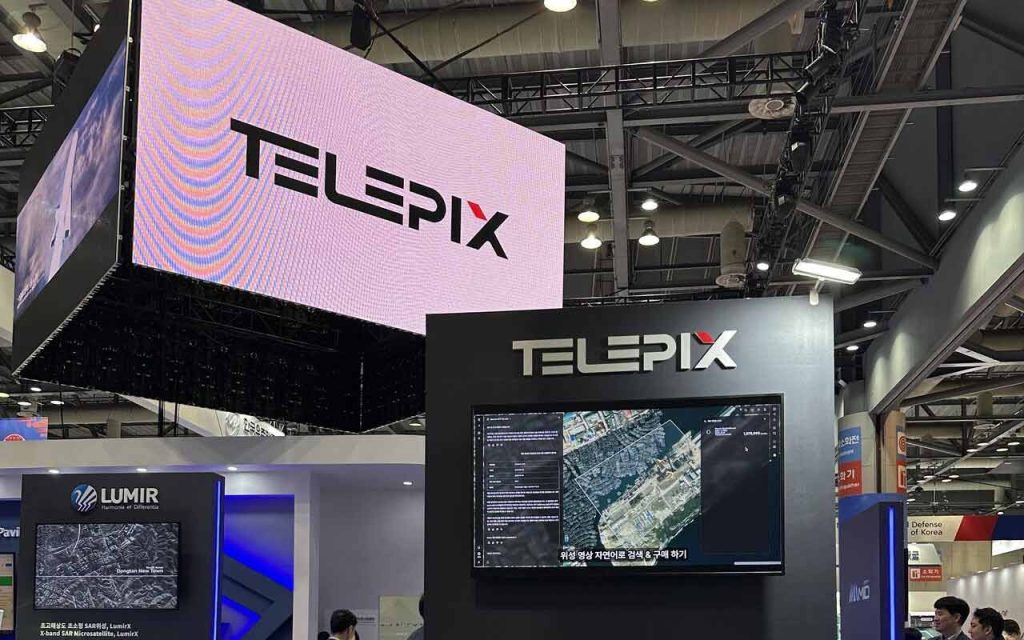
South Korea’s emerging space startup sector is beginning to enter a new stage of development. TelePIX, a satellite artificial intelligence company combining spacecraft hardware with space data processing technologies, has secured KRW 15 billion in pre-IPO funding ahead of a planned KOSDAQ listing later this year. Beyond a mere capital rising, this investment also signals how Korean space startups are starting to move from technical validation toward production capacity and global commercial operations.
TelePIX Secures Pre-IPO Funding as IPO Preparation Accelerates
TelePIX announced that it raised KRW 15 billion (about USD 11 million) in pre-IPO investment. The round was led solely by venture capital firm InterVest, according to multiple Korean reports.
The funding brings TelePIX’s total accumulated investment to roughly KRW 50 billion, including earlier backing from institutions such as Korea Development Bank, SBVA (formerly SoftBank Ventures Asia), JN Private Equity, and Daishin Private Equity.
The company plans to pursue a KOSDAQ initial public offering in the second half of the year. TelePIX previously passed Korea’s technology-special listing evaluation under the AI and Big Data category, which allows research-intensive technology firms with limited revenue to access public markets.
For deep-technology startups in Korea, clearing this evaluation is often a critical milestone. The process assesses innovation, commercial potential, and technological competitiveness before companies can pursue public listings.
Investment Reflects a Shift Toward Production Capacity
The new capital is expected to support satellite mass production and manufacturing capacity expansion, according to company statements cited in Korean coverage.
TelePIX said the funding was raised partly to respond to increasing overseas orders, particularly after securing export deals in Europe earlier this year. The investment will also support research and development as well as production facility expansion.
This distinction is important. Early-stage aerospace startups often raise capital for prototype development and initial demonstrations. The TelePIX round is tied to scaling production capacity, which suggests the company is entering a different operational phase.
For global startup observers, that transition often marks the point where deep-technology ventures begin shifting from research-driven organizations toward industrial companies capable of delivering commercial products.
European Satellite Contract Strengthens Commercial Validation
TelePIX’s recent funding comes shortly after the company signed a satellite export contract worth tens of millions of dollars in the European market in February.
The agreement involves supplying satellite technology as part of Hungary’s HULEO Earth observation satellite program, according to earlier disclosures cited in Korean media. Specific contract details have not been publicly disclosed at the request of the counterpart.
These export orders have reportedly played a role in driving the company’s latest investment round. The funding will help TelePIX expand its satellite manufacturing capabilities and meet growing international demand.
For Korean space startups, overseas contracts carry strategic importance. Many companies historically depended on domestic research programs and government projects. Securing international customers can provide stronger evidence that technologies developed in Korea can compete in global commercial markets.
TelePIX’s Technology Strategy Combines Hardware and AI
Founded in 2019, TelePIX has developed a business model that integrates satellite hardware with AI-based data processing technologies.
The company’s capabilities cover several parts of the space data value chain, including:
- satellite manufacturing and operation
- onboard AI data processing
- satellite imagery analysis and data services
TelePIX has launched and operates several technologies designed for the space environment. Korean sources identify examples such as the GPU-based satellite AI processor “TetraPLEX,” the AI CubeSat “BlueBON,” and the next-generation AI star tracker “DNAV.”
The company is also developing AI systems specialized in analyzing satellite data, reflecting a broader shift in the industry toward extracting economic value from space-based information.
Satellite data services are expanding rapidly across sectors such as agriculture, environmental monitoring, and energy infrastructure analysis. Market research cited in Korean coverage, referencing Grand View Research, estimates the satellite data services market could grow from USD 12 billion in 2024 to USD 29 billion by 2030, representing annual growth of roughly 16 percent.
This growth helps explain why investors are increasingly interested in companies positioned at the intersection of space infrastructure and data analytics.

Korea’s Space Startup Ecosystem Is Gradually Entering a Commercial Phase
TelePIX’s financing also reflects broader structural shifts inside South Korea’s space technology sector.
For decades, much of Korea’s aerospace activity centered on government-led research programs. In recent years, however, startups have begun building businesses around commercial applications such as satellite manufacturing, space data analytics, and launch technologies.
Earlier industry initiatives have attempted to strengthen this transition. For example, the K-Space Forum, launched earlier this year with participation from government agencies, venture investors, and space startups, aims to help expand Korea’s private-sector space ecosystem and encourage global partnerships.
The TelePIX investment offers a practical example of how this transition may unfold. Instead of funding only early-stage research, venture capital is beginning to support companies attempting to scale manufacturing capacity and compete internationally.
The Hard Part of Scaling Space Startups Still Lies Ahead
Despite the new funding and export contracts, scaling a space technology company remains challenging.
Satellite manufacturing and data infrastructure require substantial capital investment, long development cycles, and sustained demand from commercial or institutional customers. Even companies that demonstrate strong technical capabilities must still build stable revenue streams and manage complex supply chains.
Public market listings add another layer of scrutiny. Companies pursuing KOSDAQ IPOs must demonstrate governance structures, financial transparency, and long-term growth strategies that satisfy institutional investors.
TelePIX’s latest funding therefore represents an important milestone. Yet it also highlights the next test facing Korea’s emerging space startups: converting advanced technologies into durable global businesses.
What TelePIX’s Funding Signals for the Global Startup Ecosystem
The TelePIX investment illustrates a broader pattern seen in many emerging deep-technology ecosystems.
Early breakthroughs often originate inside research institutions or government programs. Over time, startups attempt to translate those innovations into scalable companies capable of serving international markets.
South Korea’s space sector appears to be approaching that transition point. TelePIX’s pre-IPO financing, combined with its export activity and production expansion plans, suggests that investors are beginning to fund the next stage of the industry’s development.
For founders, investors, and policymakers watching Asia’s startup landscape, the company’s trajectory offers a glimpse of how Korea’s space technology ecosystem may evolve over the coming decade.
Key Takeaways on the TelePIX Pre-IPO Funding 2026
- TelePIX raised KRW 15 billion in pre-IPO funding, with venture capital firm InterVest participating as the sole investor.
- The company’s total accumulated investment has reached approximately KRW 50 billion.
- TelePIX plans to pursue a KOSDAQ IPO in the second half of the year after passing Korea’s technology-special listing evaluation under the AI and Big Data category.
- The funding will support satellite production expansion, manufacturing facilities, and research and development as overseas orders increase.
- TelePIX recently secured a satellite export contract worth tens of millions of dollars in Europe, linked to Hungary’s HULEO Earth observation program.
- The company combines satellite hardware, onboard AI processing, and satellite data analysis technologies, positioning it within the expanding global satellite data services market.
- The investment suggests Korea’s space startups are entering a scaling phase, where production capacity and international commercialization are becoming key priorities.
🤝 Looking to connect with verified Korean companies building globally?
Explore curated company profiles and request direct introductions through beSUCCESS Connect.
– Stay Ahead in Korea’s Startup Scene –
Get real-time insights, funding updates, and policy shifts shaping Korea’s innovation ecosystem.
➡️ Follow KoreaTechDesk on LinkedIn, X (Twitter), Threads, Bluesky, Telegram, Facebook, and WhatsApp Channel.


