
KoreaTechDesk | Korean Startup and Technology News

Fri, February 27, 2026

Sign in

Virtual Demo Day
Menu
  • Home
  • Startup News
    • AI & Big Data
    • AR & VR
    • Blockchain
    • Clean Technology
    • Content & Games
    • Cybersecurity
    • Enterprise & SaaS
    • FinTech
    • Gadgets & Electronics
    • Health & Bio
    • Manufacturing
    • Press Release
    • IoT
    • Marketplaces & E-commerce
    • Robotics
    • Transportation
    • Investments
    • Ecosystem & Lists
  • Governments
    • Artificial Intelligence Industry Cluster Agency
    • Daegu Technopark
    • GANGNAM-GU
    • Gyeonggido Business & Science Accelerator
    • Hwaseong Industry Promotion Agency
    • Invest Seoul
    • Korea Creative Content Agency
    • Korea Internet & Security Agency
    • Korea Information Security Industry Association
    • Korea Institute of Startup & Entrepreneurship Development
    • Korea Tourism Organization
    • Korea Trade-Investment Promotion Agency
    • Ministry of Culture, Sports and Tourism
    • Ministry of SMEs & Startups
    • National IT Industry Promotion Agency
    • Pangyo Techno Valley
    • Seoul Business Agency
    • Seoul FinTech Lab
    • South Gyeongsang Province
    • Seoul Metropolitan Government
  • Events
    • COMEUP
    • Korea Fintech Week
    • K-Content Expo
    • NextRise
    • Try Everything
  • Interviews
    • Investors’ interviews
    • Founders’ interviews
  • Programs
    • Asan Voyager
    • CAPA Global Program
    • Campus Town Program
    • SGSC Global Bootcamp
    • Gangnam-gu Global Roadshow
    • Global SaaS Marketplace Support Project
    • LAUNCHPAD
    • COMEUP STARS 120
    • K-Startup Grand Challenge
    • TIPS X beSUCCESS Global Project
    • SFL Global Program
    • KTO Global Showcase
    • Yonsei Univ Global Class
    • KOSME Global Program
  • Partner With Us
    • Press Release
    • Startup Scouting
    • Business Agencies
    • Global Mentorship Program
    • Investment Opportunities
    • K-Scouter Program
  • Lists
  • Home
  • Startup News
    • AI & Big Data
    • AR & VR
    • Blockchain
    • Clean Technology
    • Content & Games
    • Cybersecurity
    • Enterprise & SaaS
    • FinTech
    • Gadgets & Electronics
    • Health & Bio
    • Manufacturing
    • Press Release
    • IoT
    • Marketplaces & E-commerce
    • Robotics
    • Transportation
    • Investments
    • Ecosystem & Lists
  • Governments
    • Artificial Intelligence Industry Cluster Agency
    • Daegu Technopark
    • GANGNAM-GU
    • Gyeonggido Business & Science Accelerator
    • Hwaseong Industry Promotion Agency
    • Invest Seoul
    • Korea Creative Content Agency
    • Korea Internet & Security Agency
    • Korea Information Security Industry Association
    • Korea Institute of Startup & Entrepreneurship Development
    • Korea Tourism Organization
    • Korea Trade-Investment Promotion Agency
    • Ministry of Culture, Sports and Tourism
    • Ministry of SMEs & Startups
    • National IT Industry Promotion Agency
    • Pangyo Techno Valley
    • Seoul Business Agency
    • Seoul FinTech Lab
    • South Gyeongsang Province
    • Seoul Metropolitan Government
  • Events
    • COMEUP
    • Korea Fintech Week
    • K-Content Expo
    • NextRise
    • Try Everything
  • Interviews
    • Investors’ interviews
    • Founders’ interviews
  • Programs
    • Asan Voyager
    • CAPA Global Program
    • Campus Town Program
    • SGSC Global Bootcamp
    • Gangnam-gu Global Roadshow
    • Global SaaS Marketplace Support Project
    • LAUNCHPAD
    • COMEUP STARS 120
    • K-Startup Grand Challenge
    • TIPS X beSUCCESS Global Project
    • SFL Global Program
    • KTO Global Showcase
    • Yonsei Univ Global Class
    • KOSME Global Program
  • Partner With Us
    • Press Release
    • Startup Scouting
    • Business Agencies
    • Global Mentorship Program
    • Investment Opportunities
    • K-Scouter Program
  • Lists
Home Lists and Guides

Inside Korea’s Startup Funding Machine: From Government Budget to Venture Capital to Bank Account

by Zee Cindy
February 27, 2026
in Lists and Guides
0

Korea’s startup ecosystem is often described as policy-driven and well-capitalized. Annual budget announcements, multi-trillion-won venture plans, and flagship programs regularly appear in headlines. But what receives less attention is the financial plumbing underneath those announcements.

Before capital reaches a startup’s bank account, it moves through a structured institutional chain. Understanding that chain is essential for global founders, venture capital firms, and limited partners evaluating Korea’s venture capital hub within the Asia-Pacific startup ecosystem.

This discussion focuses on Korea’s funding mechanism; especially how public budget is converted into privately managed venture capital.

Where Korea’s Startup Funding Begins: Budget Allocation and Policy Capital

The venture investment policy in South Korea begins at the national budget level.

The Ministry of SMEs and Startups, known as MSS, oversees startup and venture policy. The ministry manages a multi-trillion-won annual budget, with allocations directed toward venture investment programs and contributions to the Korea Fund of Funds (see below).

However, this allocation does not immediately become startup grants. It first becomes policy capital committed into investment vehicles.

Korea does not fund startups randomly. The government allocates the budget first, then engineers that budget into structured financial instruments.

The Conversion Layer: Korea Fund of Funds and the Role of KVIC

The core vehicle in this process is the Korea Fund of Funds, often referred to as the KFoF or “Mother Fund.”

The Korea Fund of Funds operates as a government-backed fund-of-funds. Unlike general perceptions, the fund does not invest directly into startups. Instead, it commits capital into venture capital funds managed by private firms.

The Korea Venture Investment Corporation, or KVIC, manages this vehicle. KVIC selects and oversees venture fund managers that receive capital commitments.

In this structure, the government acts as an anchor limited partner. By committing capital first, it lowers perceived risk and encourages participation from private limited partners.

This is capital engineering rather than direct company selection.
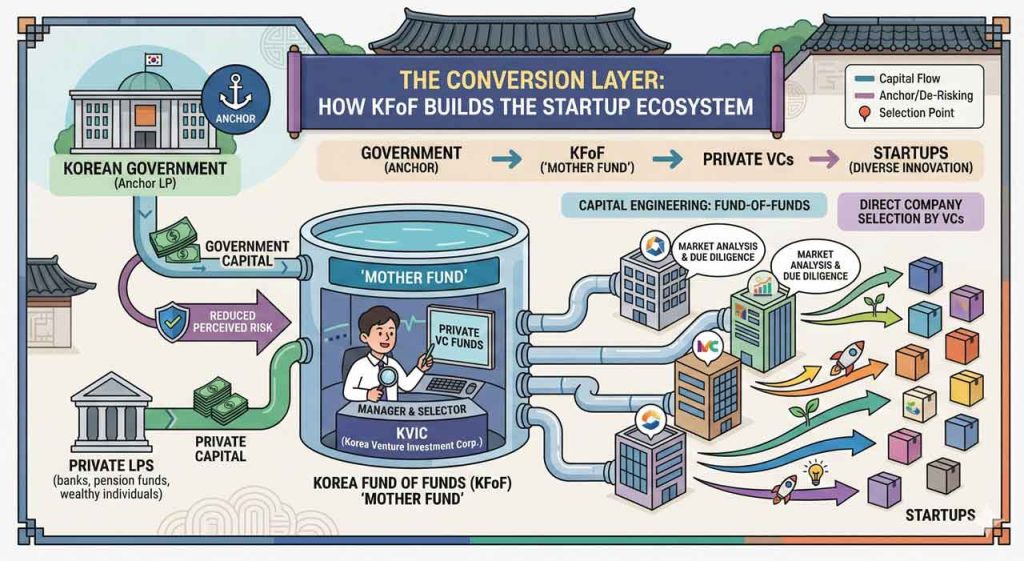
How Korea converts public budget into venture capital through the Fund of Funds and KVIC, and what this capital structure means for global founders and investors.

How Public Capital Blends into Private Venture Funds

Once the Korea Fund of Funds commits capital, private venture firms raise funds that include government-backed LP commitments alongside private institutional investors.

Those venture capital firms retain responsibility for screening startups, negotiating investment terms, and managing governance.

Public capital shapes liquidity conditions in the market. It does not replace private investment committees. The Fund of Funds emphasize that government capital is deployed through privately managed funds. The decision-making authority over individual startup investments remains with those fund managers.

The state stabilizes venture supply. The market selects companies.
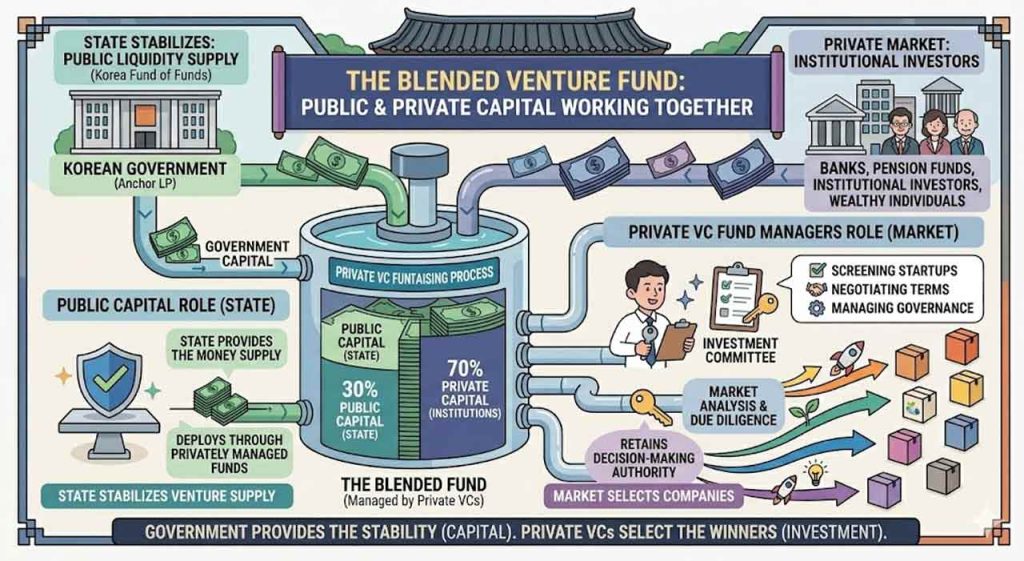
How Korea converts public budget into venture capital through the Fund of Funds and KVIC, and what this capital structure means for global founders and investors.

The Final Step: When Capital Reaches the Startup

When a venture fund backed by the Korea Fund of Funds invests in a startup, the transaction follows standard equity procedures.

Investment terms are negotiated between the venture firm and the startup. Once closed, capital is transferred into the company’s bank account as equity financing.

At this stage, public capital is embedded within a private round.

The startup does not typically receive funds directly from MSS or KVIC under this model. Instead, it receives investment from a venture fund whose capital base includes public commitments.

This answers a common point of confusion among foreign founders: government budget does not usually move straight into startup accounts. It moves through institutional layers first.
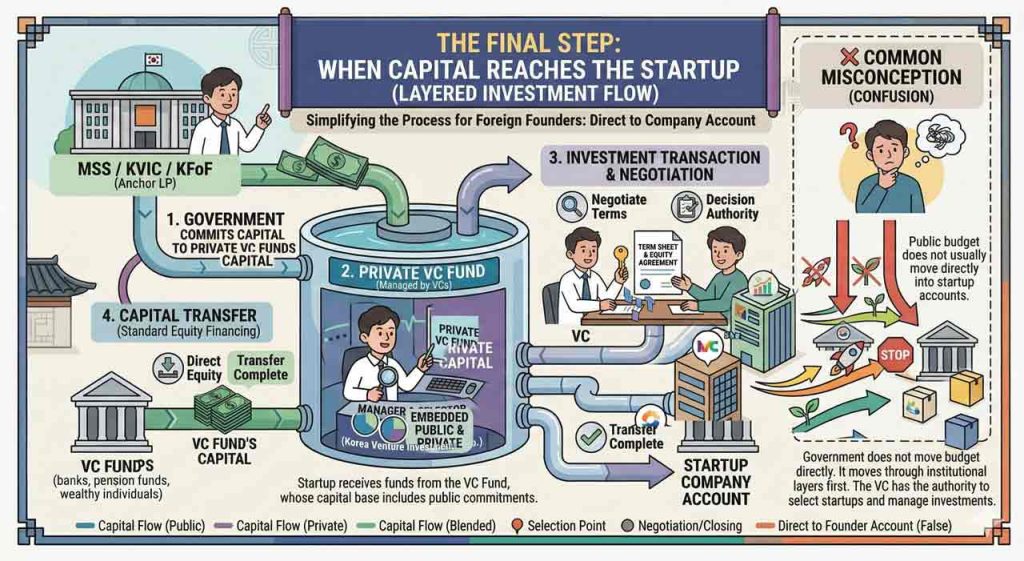
How Korea converts public budget into venture capital through the Fund of Funds and KVIC, and what this capital structure means for global founders and investors.

What This Structure Means for Global Founders and Investors

Korea’s venture capital policy is designed to reduce early-stage liquidity risk without nationalizing investment decisions.

By acting as an anchor LP through the Korea Fund of Funds, the government expands the overall pool of venture capital available in the market. That is why in recent years Korea’s government has reportedly outlined multi-trillion-won plans to mobilize venture funds through this mechanism.

For global venture firms, this signals a state-backed liquidity stabilizer.

At the same time, founders should recognize that access to public-backed capital typically depends on building relationships with locally active venture funds.

Meanwhile, institutional investors assessing cross-border venture exposure may see Korea’s model as a coordinated system where fiscal resources are channeled into market-based instruments instead of direct state ownership.

Instead of investing directly into startups, Korea relies on institutional layering to influence venture liquidity through private fund managers.

Strategic Outlook: Korea’s Venture Liquidity Model in a Shifting Capital Cycle

Across the Asia-Pacific region, governments are searching for ways to stabilize venture financing without distorting market incentives. Korea’s Fund of Funds structure reflects one such approach.

Rather than deploying capital directly into companies, the state embeds fiscal resources into privately managed vehicles. MSS allocates the budget. KVIC converts those allocations into LP commitments. Venture firms then execute investment decisions under market discipline.

This architecture changes how Korea’s venture market should be assessed. Program announcements alone do not capture the system’s depth. Liquidity conditions are shaped upstream, at the fund formation stage.

During periods of global capital tightening, anchor LP commitments can cushion fundraising slowdowns. When capital flows return, the same mechanism can accelerate fund creation.

The long-term effectiveness of this structure will hinge on fund manager selection standards, transparency in capital deployment, and the continued willingness of private LPs to participate alongside public commitments.

Key Takeaways

  • Korea’s startup funding system begins with national budget allocation under the Ministry of SMEs and Startups.
  • Public capital is committed into the Korea Fund of Funds, managed by Korea Venture Investment Corporation.
  • The Fund of Funds invests in privately managed venture capital funds, not directly in startups.
  • The government acts as an anchor limited partner to attract private LP capital.
  • Venture firms retain independent authority over startup selection and investment terms.
  • Startups receive equity capital through private venture rounds that include public-backed LP commitments.
  • The structure reduces liquidity risk while maintaining market-based decision-making.
  • For global founders and investors, access to public-backed capital typically depends on engagement with local venture funds integrated into Korea’s policy framework.

🤝 Looking to connect with verified Korean companies building globally?
Explore curated company profiles and request direct introductions through beSUCCESS Connect.


– Stay Ahead in Korea’s Startup Scene –
Get real-time insights, funding updates, and policy shifts shaping Korea’s innovation ecosystem.
➡️ Follow KoreaTechDesk on LinkedIn, X (Twitter), Threads, Bluesky, Telegram, Facebook, and WhatsApp Channel.

Tags: Asia-Pacific startup ecosystemcross-border venture capitalFund of Fundsgovernment-backed venture capital KoreaKorea Fund of FundsKorea startup funding systemKorea venture capital ecosystemKorea venture capital policyKorea Venture Investment Corporation (KVIC)KVICMother FundNational Mother FundRegional Mother Fundstartup funding in South Korea
Previous Post

K-Beauty Becomes Korea’s First Sector-Specific AI Manufacturing Push

MOST READ ARTICLE OF THE WEEK

1.
Why Korea’s Open Innovation Demand Just Spiked: Startups Move Closer to Core R&D
21 Feb 2026
2.
From IEEPA to Section 122: How America’s Tariff Shift Reshapes Risk for Korean Export-Driven Startups
21 Feb 2026
3.
Women’s Share in Korea’s Startup Workforce Has Doubled in a Decade: What Changed Inside the Ecosystem?
21 Feb 2026
4.
Korea’s AI Goes Global Under a New Rulebook: 5 Verified Companies Already Scaling Overseas
23 Feb 2026
5.
Korea Moves to Shield 6,000 Exporters After U.S. Supreme Court Tariff Ruling
22 Feb 2026
Register for Event

[the_ad id=”18508″]

List Article

1.
Inside Korea’s Startup Funding Machine: From Government Budget to Venture Capital to Bank Account
27 Feb 2026
2.
How Korea’s Startup Support System Actually Works: A Map for Foreign Readers
25 Feb 2026
3.
6 Reasons Why Seoul Is Poised to Become a Top 5 Global Economic Hub by 2030
20 Aug 2024
4.
Top Co-working Spaces for Startups & Companies to Explore in South Korea
3 Apr 2024
5.
Top Accelerators in South Korea Shaping Startup Success
29 Nov 2023

Similar Articles

Lists and Guides

How Korea’s Startup Support System Actually Works: A Map for Foreign Readers

More
Seoul
Government PoliciesGovernmentsInvest SeoulLists and Guides

6 Reasons Why Seoul Is Poised to Become a Top 5 Global Economic Hub by 2030

More
Wework
Business AgenciesLists and Guides

Top Co-working Spaces for Startups & Companies to Explore in South Korea

More

Topics

Menu
  • AI & Big Data
  • AR & VR
  • Blockchain
  • Clean Technology
  • Content & Games
  • Cybersecurity
  • Enterprise & SaaS
  • FinTech
  • Gadgets & Electronics
  • Health & Bio
  • IoT

Program

Menu
  • Asan Voyager
  • CAPA Global Program
  • SGSC Global Bootcamp
  • LAUNCHPAD
  • COMEUP STARS 120
  • K-Startup Grand Challenge
  • TIPS X beSUCCESS Global Project
  • SFL Global Program
  • KTO Global Showcase
  • Yonsei Univ Global Class
  • KOSME Global Program

About

Menu
  • About Us
  • all articles
  • Terms of Use
  • Privacy
  • Cookie-policy
  • twitter

Subscribe and be informed first hand about actual Korean startup news.

All the day’s headlines and highlights, direct to you every morning.

Contact us : [email protected]

Topics

Menu
  • AI & Big Data
  • AR & VR
  • Blockchain
  • Clean Technology
  • Content & Games
  • Cybersecurity
  • Enterprise & SaaS
  • FinTech
  • Gadgets & Electronics
  • Health & Bio
  • IoT

Program

Menu
  • Asan Voyager
  • CAPA Global Program
  • SGSC Global Bootcamp
  • LAUNCHPAD
  • COMEUP STARS 120
  • K-Startup Grand Challenge
  • TIPS X beSUCCESS Global Project
  • SFL Global Program
  • KTO Global Showcase
  • Yonsei Univ Global Class
  • KOSME Global Program

About

Menu
  • About Us
  • all articles
  • Terms of Use
  • Privacy
  • Cookie-policy
  • twitter

Subscribe and be informed first hand about actual Korean startup news.

All the day’s headlines and highlights, direct to you every morning.

© 2023 Koreantech News & Media Korea Zrt. All rights reserved.

Our Spring Sale Has Started

You can see how this popup was set up in our step-by-step guide: https://wppopupmaker.com/guides/auto-opening-announcement-popups/

Our Spring Sale Has Started

You can see how this popup was set up in our step-by-step guide: https://wppopupmaker.com/guides/auto-opening-announcement-popups/

We hope you enjoy our content, May you please give us Feedback regarding our website!

Single Post Feedback

dgdfgfdgdf

What you think about Koreatechdesk, Share your idea with us!

feedback popup

Invitation submission has been closed

Insert/edit link

Enter the destination URL

Or link to existing content

    No search term specified. Showing recent items. Search or use up and down arrow keys to select an item.