Korea’s venture and startup community opened 2026 with a unified agenda: to transform the country into a global top four venture powerhouse. Bringing together the government and five leading industry bodies, the effort signals a rare, coordinated push to reform Korea’s investment cycle, expand global scale-up, and strengthen the innovation ecosystem that anchors Asia’s next-generation growth.
Five Associations Align Under Shared National Vision
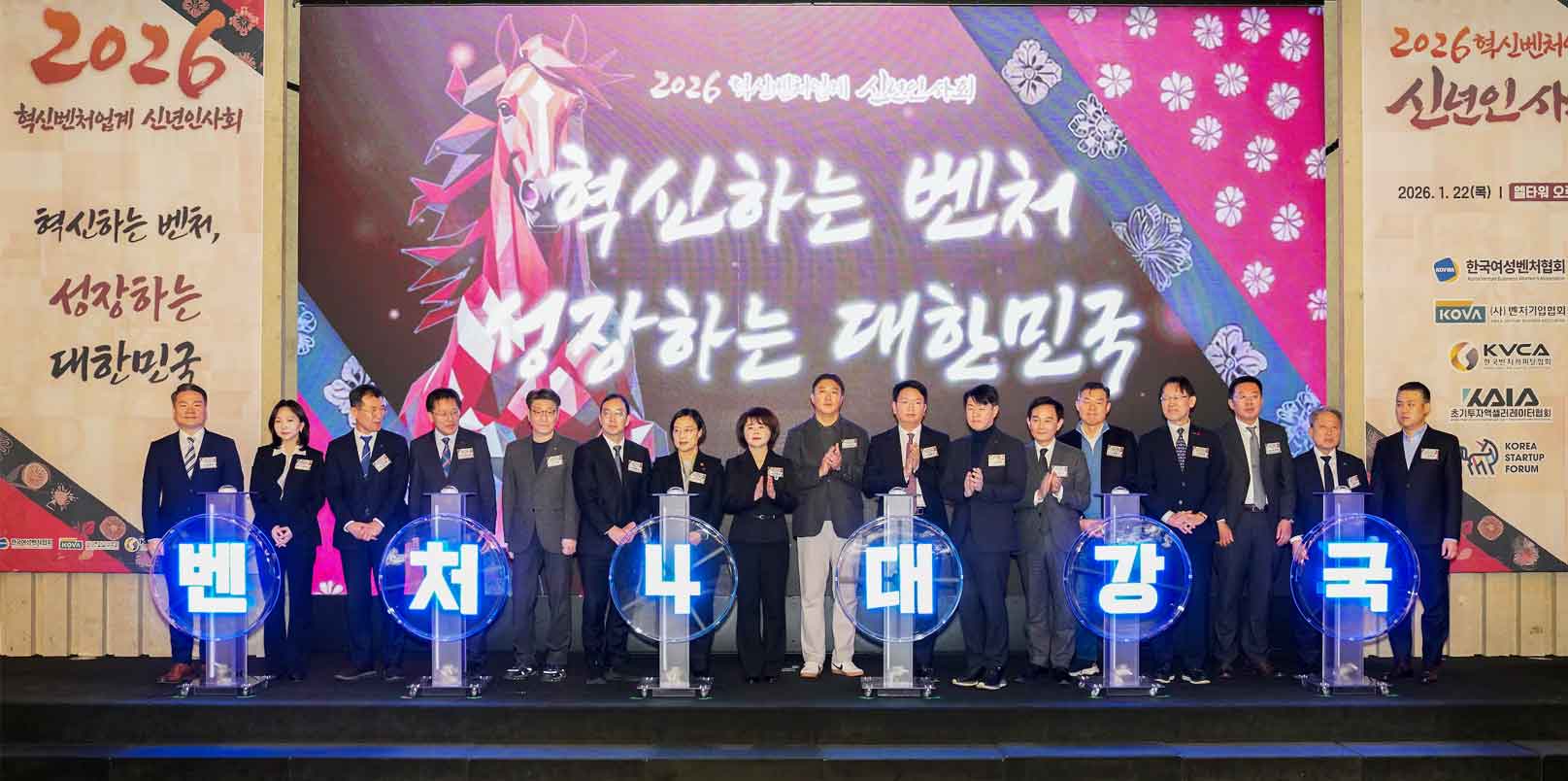
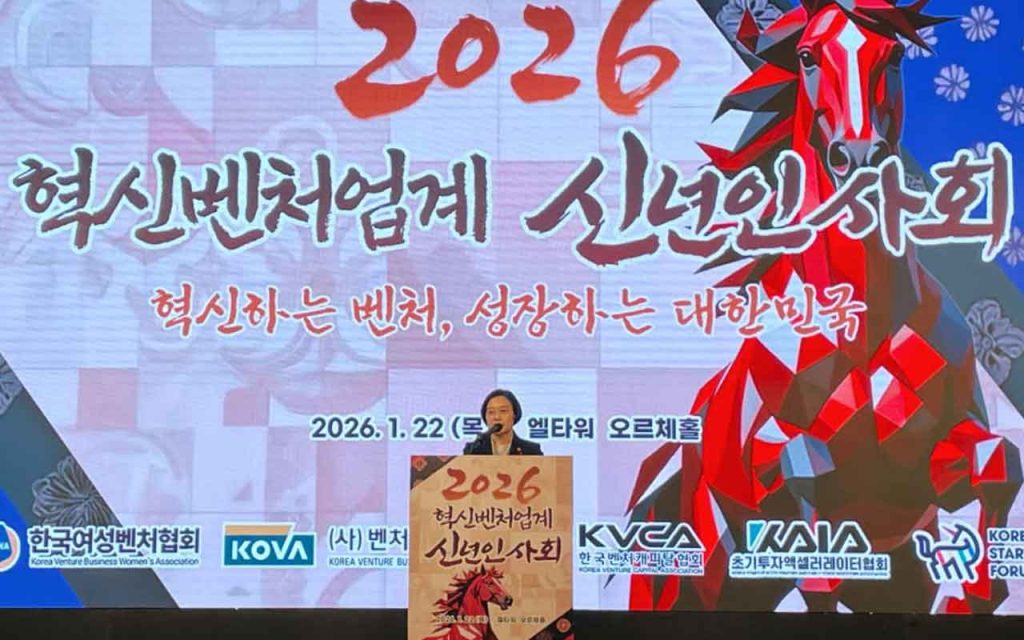
On January 22, five major organizations — the Korea Venture Business Association (KOVA), the Korea Venture Capital Association (KVCA), the Korea Women Entrepreneurs Association (KOWEIA), the Korea Startup Accelerators and Early Stage Investors Association (KAIA), and the Korea Startup Forum (KOSPO) — jointly hosted the 2026 Innovative Venture Industry New Year’s Reception under the theme “The Leap of the Innovative Venture Industry Toward Becoming a Top 4 Global Venture Powerhouse” at the L Tower in Seoul.
Around 200 participants, including Minister of SMEs and Startups Han Seong-sook, gathered under the slogan “Innovative Ventures, Growing Korea”. The event focused on Korea’s coordinated strategy to elevate its venture sector to a “Top 4” global standing alongside the United States, China, and Israel.
Minister Han reaffirmed the government’s long-term goal:
“Based on three decades of venture progress, Korea will now move beyond unicorn creation toward a new era of K-Big Tech. We will strengthen the circular startup ecosystem where capital, innovation, and growth are directly connected.”
Background & Context: From Unicorn Growth to National Competitiveness
The “Top 4 Venture Powerhouse” strategy, first outlined by the Korean government in late 2025, represents a policy shift that sees startups not as peripheral innovation units but as core pillars of national competitiveness.
After years of fragmented support systems, the new agenda emphasizes investment normalization, scale-up infrastructure, and global market integration — areas that have lagged despite Korea’s robust startup output.
The unification of five major associations under one platform is viewed by local analysts as a structural turning point. It establishes an ecosystem-level governance model that merges venture finance, startup acceleration, women entrepreneurship, and global scaling initiatives.
Stakeholder Statements: A Common Call for Execution and Reform
Seong Mi-sook, Chairperson of KOWEIA, declared,
“We will lead Korea’s economic growth through the diversity of our innovation ecosystem. Public and private sectors must collaborate seamlessly so innovators can translate their challenges into national progress.”
She also emphasized closing the gender gap in venture funding:
“Women-led startups must not miss their golden time for fundraising. We are building an investment bridge and global platform through the World Women Venture Forum.”
Song Byung-jun, Chairman of KOVA, said,
“Venture success defines national competitiveness. We’ll strengthen venture financing and scale-up support to build a cycle where investment and growth sustain one another.”
Kim Hak-kyun, Chairman of KVCA, highlighted structural reforms:
“We must expand capital inflows and normalize the exit market through M&A and secondary market revitalization. Policy finance will serve as the primer for private investment.”
Jeon Hwa-sung, Chairman of KAA, noted,
“Accelerators will anchor the foundation of sustainable entrepreneurship by improving early-stage investment diversity, exit conditions, and regulatory flexibility.”
Han Sang-woo, Chairperson of KSF, concluded,
“2026 must be a year of execution, not rhetoric. Startups must prove real-world competitiveness in AI transformation and global markets. We will connect policy, industry, and global networks to make that happen.”
Ecosystem Significance: Korea’s Bid for Global Venture Power Status
Korea’s move to become a top four venture nation reflects both ambition and necessity. The country’s venture financing and exit markets remain constrained compared to its innovation output. While the number of unicorns has steadily increased, the ecosystem still struggles with liquidity bottlenecks and limited global reach.
This year’s alignment between the Ministry of SMEs and Startups and the five industry bodies is therefore more than symbolic — it is strategic. It introduces a multi-stakeholder governance model rarely seen in Asia’s startup policy frameworks.
Experts note that by combining Korea’s venture capital depth, accelerator networks, and women-led entrepreneurship pipelines, the initiative could create a hybrid model for startup policy, one balancing public strategy with private execution.
Future Outlook: The Execution Year for Korea’s Innovation Ambition
Participants agreed that 2026 marks a decisive inflection point. As Minister Han stated,
“Policies must work on the ground, where founders and investors make daily decisions.”
Korea’s venture ecosystem now faces the task of converting coordinated vision into measurable outcomes — scaling investment reform, facilitating global expansion, and embedding startups into national industrial strategy.
The year ahead will test whether Korea can turn its momentum into structural resilience — the hallmark of every true venture powerhouse.
Key Takeaways
- Korea’s government and five major venture associations launched a unified 2026 agenda to transform the country into one of the world’s top four venture powerhouses.
- The national strategy focuses on investment normalization, scale-up infrastructure, and stronger global market integration.
- Minister Han Seong-sook emphasized policy execution that directly reflects field-level realities faced by founders and investors.
- The initiative integrates venture finance, accelerators, women-led entrepreneurship, and startup globalization under a shared framework.
- Leaders called 2026 the “execution year,” highlighting the need for measurable progress in investment reform and cross-border growth.
- The combined effort positions Korea to strengthen its role as Asia’s emerging innovation and venture capital hub.
🤝 Looking to connect with verified Korean companies building globally?
Explore curated company profiles and request direct introductions through beSUCCESS Connect.
– Stay Ahead in Korea’s Startup Scene –
Get real-time insights, funding updates, and policy shifts shaping Korea’s innovation ecosystem.
➡️ Follow KoreaTechDesk on LinkedIn, X (Twitter), Threads, Bluesky, Telegram, Facebook, and WhatsApp Channel.