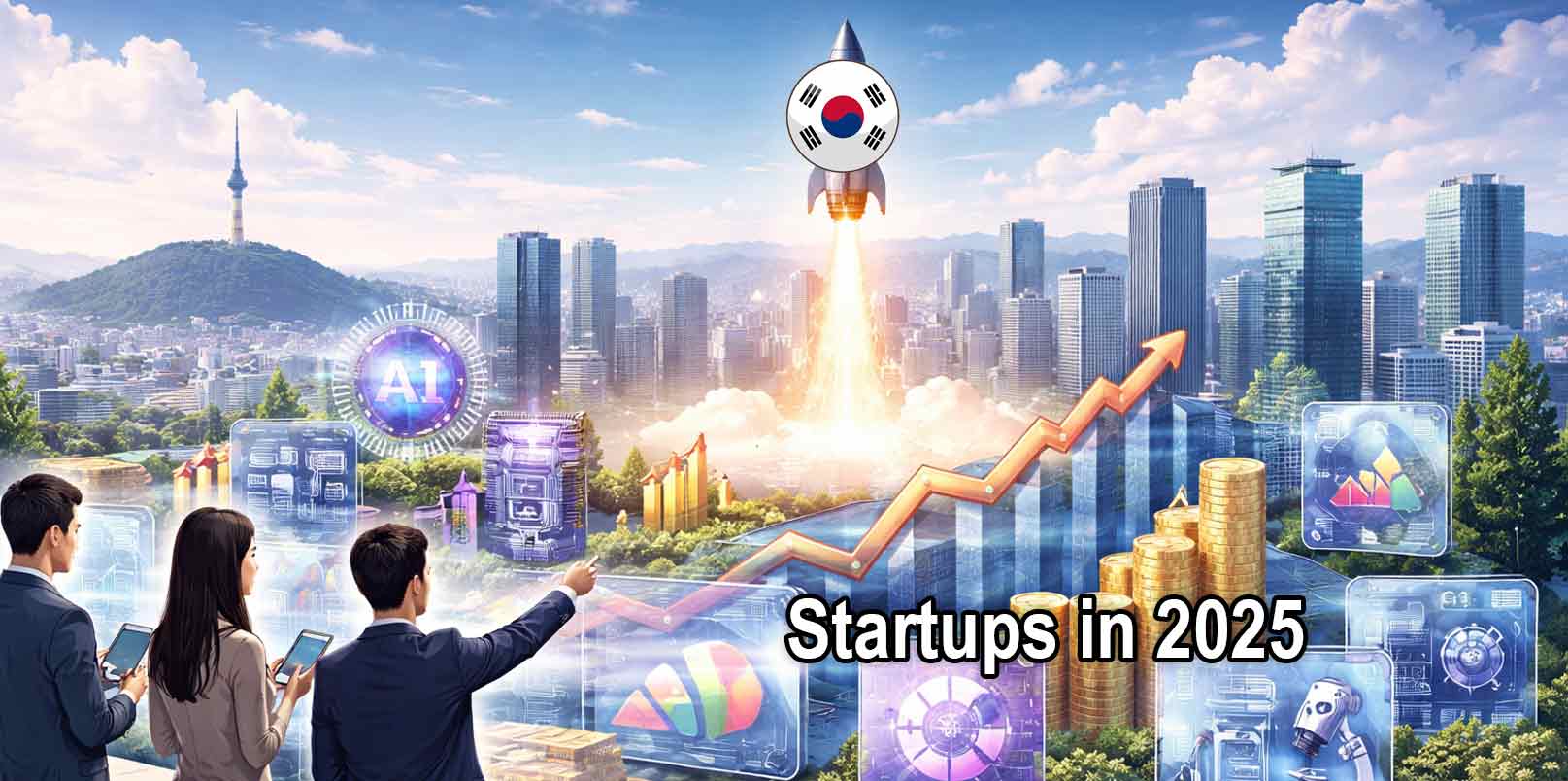
2025 redrew Korea’s innovation map in silence. Capital roared back, but the sound of progress was uneven—echoing loudest in AI chip labs while fading in small studios and early-stage workshops. And so, behind the numbers lies a harder truth: Korea’s startup ecosystem is growing stronger, but less inclusive. As 2026 begins, the real question is who still gets to build the future.
2025: The Year Korean Venture Capital Rebounded — Unevenly
In 2025, Korea’s startup and venture landscape marked a long-awaited rebound. Venture investments reached KRW 9.8 trillion in the first three quarters, surpassing KRW 4 trillion in the third quarter alone — the strongest showing in four years. Yet beneath the record figures, the ecosystem revealed widening structural imbalances.
While capital flowed back into startups, it concentrated heavily in select high-profile deals — particularly AI and semiconductor companies — leaving early-stage and service-sector innovators struggling for access.
Hence, the contrast defines Korea’s 2025 venture story: a market regaining strength, but not yet regaining balance.
Strong Numbers, Narrow Flow of Capital
According to the Ministry of SMEs and Startups (MSS), Q3 2025 venture investment reached KRW 4.04 trillion, up 32 percent from Q2 and 27.8 percent year-on-year.
Across the first nine months, total new investments reached KRW 9.78 trillion, while venture fund formation climbed to KRW 9.72 trillion — signaling a market recovery after three years of stagnation.
However, the number of companies funded dropped 9 percent to 3,136, even as the average investment per company rose 24 percent to KRW 3.12 billion. The data reveal a growing divide: fewer companies getting larger checks.
Big-ticket deals, such as Rebellions’ KRW 340 billion Series C, FuriosaAI’s KRW 170 billion Series C, and Medit’s KRW 140 billion Series B, accounted for 16 percent of all Q3 investment alone. Two of these three are AI semiconductor firms, illustrating where capital concentration lies.
AI and Deeptech Dominate; ICT and Services Fade
Nearly half of all funded startups in 2025 operated in AI-related sectors. According to industry trackers, 45.5 percent of startups receiving investment in Q3 were tied to AI, attracting approximately KRW 1 trillion in funding. Semiconductor and display investments surged by 259 percent year-on-year, while traditional ICT services declined 15.6 percent.
The shift underscores a new investment paradigm: deeptech and infrastructure-based innovation are now driving Korea’s venture narrative. Bio and healthcare startups grew 25 percent to KRW 1.7 trillion, while the content sector — gaming, film, and entertainment — posted double-digit gains, showing resilience in Korea’s creative economy.
Yet early-stage companies, particularly those under three years old, saw much slower growth. Their total funding increased by only 9.2 percent — far below the national average.
Private Capital Reclaims the Market
The recovery of 2025 was largely private-led. Of KRW 9.72 trillion in venture fund formation, 83 percent came from private investors, marking a major shift away from government dependency.
Pension and mutual aid funds invested a record KRW 837 billion, up 131 percent from 2024. Contributions from general corporations and financial institutions also rose, while government-backed policy funds dropped nearly 20 percent. Korea’s startup capital flow is increasingly market-driven — a positive sign for long-term sustainability, though it also raises concerns about inclusivity for riskier early-stage ventures.
Two New Unicorns Emerge — But Who’s Next?
2025 produced two new unicorns: FuriosaAI and BENOW, the operator behind cosmetic brands Numbuzin and FWEE. Meanwhile, AI semiconductor startup Rebellions has already become one of the year’s biggest recipients of investment, reached a KRW 1.9 trillion valuation.
Notably, regional startups outside Seoul also saw new traction. Thirteen non-metropolitan startups raised over KRW 10 billion each — a small but meaningful step toward Korea’s goal of decentralizing innovation beyond the capital area.
2026 Outlook: A Structural Transition Ahead
The government’s Comprehensive Strategy for Advancing Korea into a Global Top 4 Venture Powerhouse by 2030, unveiled in December, outlines the next decade’s direction. The plan targets 10,000 AI and deeptech startups, 50 unicorns and decacorns, and a KRW 40 trillion annual venture investment market.
Policy revisions — such as extending the Fund of Funds’ operation period and raising stock option issuance limits — aim to strengthen both capital circulation and founder incentives.
Still, the year’s data tells a cautionary story. Korea’s startup economy is expanding in scale but narrowing in diversity. As one ecosystem analyst noted privately,
“The question is no longer about how much capital we have, but how widely it circulates.”
As the whole startup ecosystem is heading into 2026, founders, investors, and policymakers face a clear but difficult task: keep the investment dollars flowing while restoring the open, opportunity-for-all culture that originally made Korea an innovation powerhouse.
Korean Startups in 2025: Balancing Power and Promise
Finally, 2025 reaffirmed Korea’s strength as a high-tech venture nation — a hub of semiconductor, AI, and biotech innovation. Yet it also exposed the fragility of that strength when growth becomes concentrated.
As 2026 dawns, the ecosystem faces its next test: ensuring that innovation thrives not only where capital already flows, but where future ideas are still waiting to be discovered.
– Stay Ahead in Korea’s Startup Scene –
Get real-time insights, funding updates, and policy shifts shaping Korea’s innovation ecosystem.
➡️ Follow KoreaTechDesk on LinkedIn, X (Twitter), Threads, Bluesky, Telegram, Facebook, and WhatsApp Channel.
🤝 Looking to connect with verified Korean companies building globally?
Explore curated company profiles and request direct introductions through beSUCCESS Connect.