South Korea is recalibrating how it defines a startup, acknowledging that early-stage companies rarely follow linear paths. By revising long-standing eligibility rules tied to business formation, the government is opening public startup support to certain firms previously excluded under specific statutory conditions. For founders, investors, and policymakers watching Korea’s ecosystem, this change in startup eligibility rules signals a shift toward more realistic, execution-driven startup governance.
Startup Eligibility Rules Revised Through Cabinet-Approved Decree
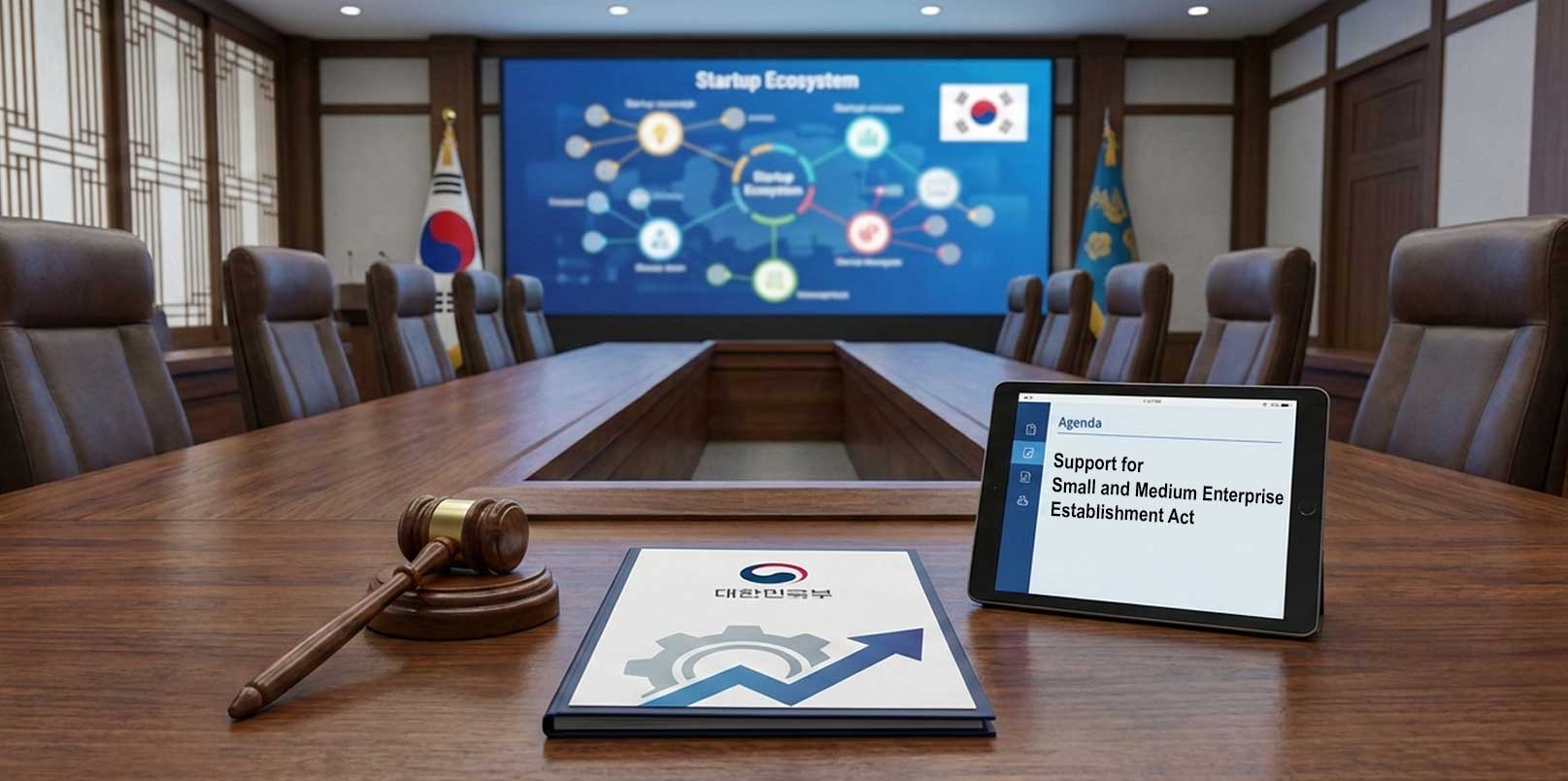
On December 16, 2025, South Korea’s Cabinet approved a partial amendment to the Enforcement Decree of the Support for Small and Medium Enterprise Establishment Act, as announced by the Ministry of SMEs and Startups.
Under the revised framework, companies that were excluded from startup status at the time of business commencement may now be recognized as startups if they resolve the grounds for exclusion within seven years of their original launch. The amended decree will take effect on January 1, 2026.
The reform applies not only to newly established firms but also to existing small and medium-sized enterprises that commenced operations less than seven years ago. Startup recognition, however, applies prospectively from the enforcement date, even if exclusion grounds were resolved earlier.
Why Korea’s Previous Startup Definition Became a Structural Bottleneck
Under existing law, a startup is defined as a newly established SME. To prevent overlapping access to public support, the Enforcement Decree excluded several scenarios from startup recognition.
These included cases where a sole proprietor launched a second business while maintaining an existing one, where a corporation or its executives established another entity with more than 50 percent ownership, or where dominant shareholders of an existing firm created a new corporation.
The issue lay in the permanence of these exclusions. Startup eligibility was assessed only at the moment of business commencement. Firms excluded due to temporary ownership structures, parallel operations, including cases involving temporary structures or regulatory interpretation issues, had no pathway to regain startup status, even after restructuring.
This rigidity increasingly conflicted with on-the-ground startup realities, where pivots, spin-offs, and corporate restructuring are common during early growth stages.
Turning Startup Status Into a Dynamic, Not Permanent, Judgment
The revised decree introduces conditional flexibility. Companies falling under specific exclusion clauses may now regain startup status once those conditions are resolved, provided this occurs within seven years of business commencement.
Recognition begins on the date the exclusion grounds are cleared, not retroactively. The overall startup recognition window remains capped at seven years from the original business start date.
For example, a sole proprietor who initially operated two businesses in parallel may now qualify for startup recognition once the original business is closed, as long as this happens within the seven-year window.
The Ministry also clarified that changes in corporate form will not automatically disqualify a firm from startup status. Based on interpretations of the Commercial Act, corporate identity is considered continuous even when legal form changes, with the original corporate registration date serving as the business commencement reference.
Inside the Government’s Rationale for Loosening Startup Eligibility
Cho Kyung-won, Director General for Startup Policy at the Ministry of SMEs and Startups, said the revision addresses long-standing gaps in Korea’s startup support framework, saying:
“This amendment is expected to ease institutional burdens for companies that were previously excluded from startup support programs and help establish a more stable foundation for growth.”
Cho then added that the government will continue refining the system to better reflect the realities of the startup ecosystem.
How Flexible Startup Recognition Reshapes Access to Capital and Support
This policy change marks a meaningful evolution in Korea’s startup governance. Regulators are introducing limited flexibility within incorporation-based judgments and acknowledging execution, restructuring, and strategic correction as legitimate parts of early-stage company development.
For domestic founders, the reform will possibly expand access to government-backed programs linked to startup status, including funding, R&D support, and policy incentives. For global founders and foreign-backed teams considering Korea as a market entry point, the shift signals a more pragmatic regulatory environment aligned with international startup norms.
At the ecosystem level, the change also aims to reduce exclusion caused by rigid classification, ensuring that firms with genuine growth potential are not excluded solely due to early technical classifications.
A More Adaptive Definition of “Startup” in Korea
By updating its startup eligibility rules, Korea is moving away from rigid, one-time assessments toward a framework that reflects how startups actually evolve. The amendment does not lower standards or expand recognition indefinitely, but it introduces measured flexibility within clear time boundaries.
In the longer view, the revision signals to global founders and investors that Korea’s public support system remains rule-based, while acknowledging the need for flexibility in early stages. It aligns with the government’s broader effort to reinforce venture growth conditions.
– Stay Ahead in Korea’s Startup Scene –
Get real-time insights, funding updates, and policy shifts shaping Korea’s innovation ecosystem.
➡️ Follow KoreaTechDesk on LinkedIn, X (Twitter), Threads, Bluesky, Telegram, Facebook, and WhatsApp Channel.