

South Korea is expanding policy support for startup acquisitions. The Ministry of SMEs and Startups has launched a new program that subsidizes due diligence and post-merger integration consulting, two operational costs that often prevent deals from progressing. The initiative reflects a shift in Seoul’s startup policy thinking. Beyond funding startups, policymakers are beginning to address the mechanics that allow acquisitions to actually happen.
Korea Expands Support for SME and Venture M&A
South Korea’s Ministry of SMEs and Startups (MSS) announced the 2026 M&A Activation Support Program, a policy designed to encourage mergers and acquisitions involving small and venture companies.
The program provides financial support for costs that arise during the M&A process and connects companies with advisory services through the government-run M&A Information Network platform.
The initiative builds on an earlier subsidy framework that supported corporate valuation costs. In 2026, the policy expands to include corporate due diligence costs and post-merger integration consulting.
MSS said the goal is to create a support system that covers the full M&A lifecycle, including preparation, execution, and post-merger integration.
Applications open on March 13 through the M&A Information Network website, with approvals granted until the allocated budget is exhausted.
The Financial Structure Behind the M&A Subsidy Program
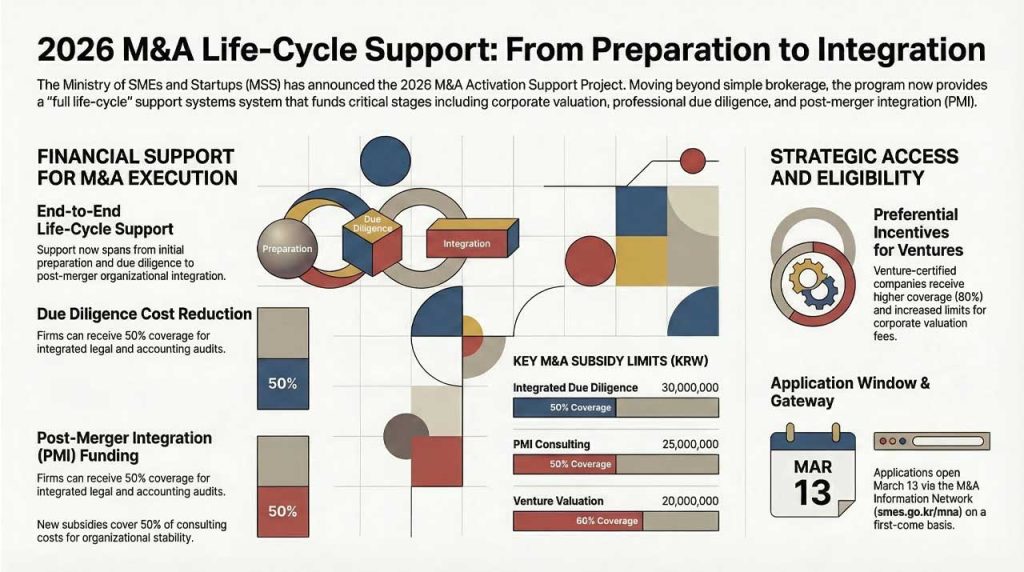
The program provides different types of financial support depending on the stage of the transaction.
Corporate Valuation Support
Companies pursuing a sale can receive support covering 40 percent of corporate valuation fees, capped at KRW 15 million. For venture companies, the support level increases to 60 percent of valuation costs, capped at KRW 20 million.
Due Diligence Cost Support
The program introduces subsidies for due diligence costs, a major expense for acquiring companies. Buyers conducting integrated legal, accounting, and tax due diligence may receive support covering up to KRW 30 million.
When due diligence is conducted separately by field, the government may subsidize 50 percent of costs up to KRW 10 million.
Post-Merger Integration Consulting
Companies can also receive support for Post-Merger Integration (PMI) consulting, which covers organizational integration work after the acquisition closes. The government will subsidize 50 percent of consulting costs, capped at KRW 25 million.
PMI consulting typically involves integrating human resources, financial systems, and operational processes.
Why Due Diligence Costs Can Stall Startup Acquisitions
The new subsidy targets a practical barrier in the M&A process.
Before acquiring a company, buyers usually conduct legal, accounting, and tax due diligence to evaluate potential financial and regulatory risks.
These reviews often require external law firms and accounting firms. For smaller deals involving startups or early-stage companies, the cost can become significant relative to the size of the transaction.
The Korean government acknowledged that cost burdens during the M&A process can act as a barrier for SMEs and venture firms.
By subsidizing these costs, the policy aims to reduce the financial risk of initiating acquisition discussions.
Post-Merger Integration Is Another Often Overlooked Challenge
The program also addresses the integration stage after a transaction closes.
Post-Merger Integration consulting helps companies align internal systems and organizational structures. This may include integrating HR frameworks, financial management systems, and business operations.
Without structured integration, acquisitions can struggle to deliver operational value.
By subsidizing PMI consulting, policymakers appear to be attempting to improve the operational success of SME acquisitions after the deal is completed.
A Policy Signal About Korea’s Startup Exit Environment
South Korea’s startup policies have historically focused on startup creation and venture funding. Government initiatives often concentrated on areas such as startup grants, research support, and venture capital funding programs.
The expansion of M&A support reflects a gradual policy shift toward startup exit infrastructure. Exit mechanisms play a central role in startup ecosystems. Acquisitions provide liquidity for founders and investors and allow larger companies to absorb emerging technologies.
By reducing some operational costs surrounding acquisitions, the government appears to be addressing practical barriers that affect smaller M&A transactions.
How Companies Can Apply
SMEs and venture companies seeking support can submit applications through the government’s M&A Information Network platform.

In addition to financial subsidies, the platform provides access to transaction information and links companies with advisory services through M&A support centers.
The ministry noted that applications may close early if the program budget is fully used.
What This Means for the Korean Startup Ecosystem
The program does not directly create acquisitions. M&A activity still depends on strategic alignment between buyers and sellers. However, the policy attempts to reduce operational costs that often discourage smaller deals.
Many acquisitions in Korea’s startup ecosystem occur between small and mid-sized companies, rather than large conglomerates. For those transactions, advisory costs can represent a meaningful share of the overall deal value.
Reducing these costs could make certain acquisitions more feasible, particularly in technology sectors where smaller venture companies seek strategic buyers.
Why Global Startup Observers Should Pay Attention
International investors and founders watching the Korean market often focus on funding levels and government startup programs. Yet the long-term strength of a startup ecosystem also depends on functional exit pathways.
A policy that reduces friction in the acquisition process can influence investor confidence and strategic investment decisions. That is why the new M&A support program suggests policymakers are beginning to look more closely at the operational mechanics that allow startup exits to occur.
For Korea’s innovation ecosystem, the message is subtle but important. Supporting startups may no longer stop at helping companies launch. The government is increasingly examining how those companies ultimately integrate into the broader corporate economy.
Key Takeaways on MSS’ M&A Activation Support Program 2026
- South Korea launched the 2026 M&A Activation Support Program to support acquisitions involving SMEs and venture companies.
- The policy expands subsidies beyond corporate valuation to include due diligence and post-merger integration consulting.
- Due diligence subsidies can reach KRW 30 million, while PMI consulting support can reach KRW 25 million.
- Applications open through the government-run M&A Information Network starting March 13.
- The program aims to reduce transaction costs that can discourage startup acquisitions in Korea’s SME sector.
🤝 Looking to connect with verified Korean companies building globally?
Explore curated company profiles and request direct introductions through beSUCCESS Connect.
– Stay Ahead in Korea’s Startup Scene –
Get real-time insights, funding updates, and policy shifts shaping Korea’s innovation ecosystem.
➡️ Follow KoreaTechDesk on LinkedIn, X (Twitter), Threads, Bluesky, Telegram, Facebook, and WhatsApp Channel.


