KoreaTechDesk | Korean Startup and Technology News

Wed, February 25, 2026

Sign in

Virtual Demo Day
Menu
  • Home
  • Startup News
    • AI & Big Data
    • AR & VR
    • Blockchain
    • Clean Technology
    • Content & Games
    • Cybersecurity
    • Enterprise & SaaS
    • FinTech
    • Gadgets & Electronics
    • Health & Bio
    • Manufacturing
    • Press Release
    • IoT
    • Marketplaces & E-commerce
    • Robotics
    • Transportation
    • Investments
    • Ecosystem & Lists
  • Governments
    • Artificial Intelligence Industry Cluster Agency
    • Daegu Technopark
    • GANGNAM-GU
    • Gyeonggido Business & Science Accelerator
    • Hwaseong Industry Promotion Agency
    • Invest Seoul
    • Korea Creative Content Agency
    • Korea Internet & Security Agency
    • Korea Information Security Industry Association
    • Korea Institute of Startup & Entrepreneurship Development
    • Korea Tourism Organization
    • Korea Trade-Investment Promotion Agency
    • Ministry of Culture, Sports and Tourism
    • Ministry of SMEs & Startups
    • National IT Industry Promotion Agency
    • Pangyo Techno Valley
    • Seoul Business Agency
    • Seoul FinTech Lab
    • South Gyeongsang Province
    • Seoul Metropolitan Government
  • Events
    • COMEUP
    • Korea Fintech Week
    • K-Content Expo
    • NextRise
    • Try Everything
  • Interviews
    • Investors’ interviews
    • Founders’ interviews
  • Programs
    • Asan Voyager
    • CAPA Global Program
    • Campus Town Program
    • SGSC Global Bootcamp
    • Gangnam-gu Global Roadshow
    • Global SaaS Marketplace Support Project
    • LAUNCHPAD
    • COMEUP STARS 120
    • K-Startup Grand Challenge
    • TIPS X beSUCCESS Global Project
    • SFL Global Program
    • KTO Global Showcase
    • Yonsei Univ Global Class
    • KOSME Global Program
  • Partner With Us
    • Press Release
    • Startup Scouting
    • Business Agencies
    • Global Mentorship Program
    • Investment Opportunities
    • K-Scouter Program
  • Lists
  • Home
  • Startup News
    • AI & Big Data
    • AR & VR
    • Blockchain
    • Clean Technology
    • Content & Games
    • Cybersecurity
    • Enterprise & SaaS
    • FinTech
    • Gadgets & Electronics
    • Health & Bio
    • Manufacturing
    • Press Release
    • IoT
    • Marketplaces & E-commerce
    • Robotics
    • Transportation
    • Investments
    • Ecosystem & Lists
  • Governments
    • Artificial Intelligence Industry Cluster Agency
    • Daegu Technopark
    • GANGNAM-GU
    • Gyeonggido Business & Science Accelerator
    • Hwaseong Industry Promotion Agency
    • Invest Seoul
    • Korea Creative Content Agency
    • Korea Internet & Security Agency
    • Korea Information Security Industry Association
    • Korea Institute of Startup & Entrepreneurship Development
    • Korea Tourism Organization
    • Korea Trade-Investment Promotion Agency
    • Ministry of Culture, Sports and Tourism
    • Ministry of SMEs & Startups
    • National IT Industry Promotion Agency
    • Pangyo Techno Valley
    • Seoul Business Agency
    • Seoul FinTech Lab
    • South Gyeongsang Province
    • Seoul Metropolitan Government
  • Events
    • COMEUP
    • Korea Fintech Week
    • K-Content Expo
    • NextRise
    • Try Everything
  • Interviews
    • Investors’ interviews
    • Founders’ interviews
  • Programs
    • Asan Voyager
    • CAPA Global Program
    • Campus Town Program
    • SGSC Global Bootcamp
    • Gangnam-gu Global Roadshow
    • Global SaaS Marketplace Support Project
    • LAUNCHPAD
    • COMEUP STARS 120
    • K-Startup Grand Challenge
    • TIPS X beSUCCESS Global Project
    • SFL Global Program
    • KTO Global Showcase
    • Yonsei Univ Global Class
    • KOSME Global Program
  • Partner With Us
    • Press Release
    • Startup Scouting
    • Business Agencies
    • Global Mentorship Program
    • Investment Opportunities
    • K-Scouter Program
  • Lists
Home Government Policies

Korea Passes Semiconductor Special Act — But Its ₩2T Funding Engine Won’t Start Until 2027

by Dae-jung Park
February 25, 2026
in Government Policies
0

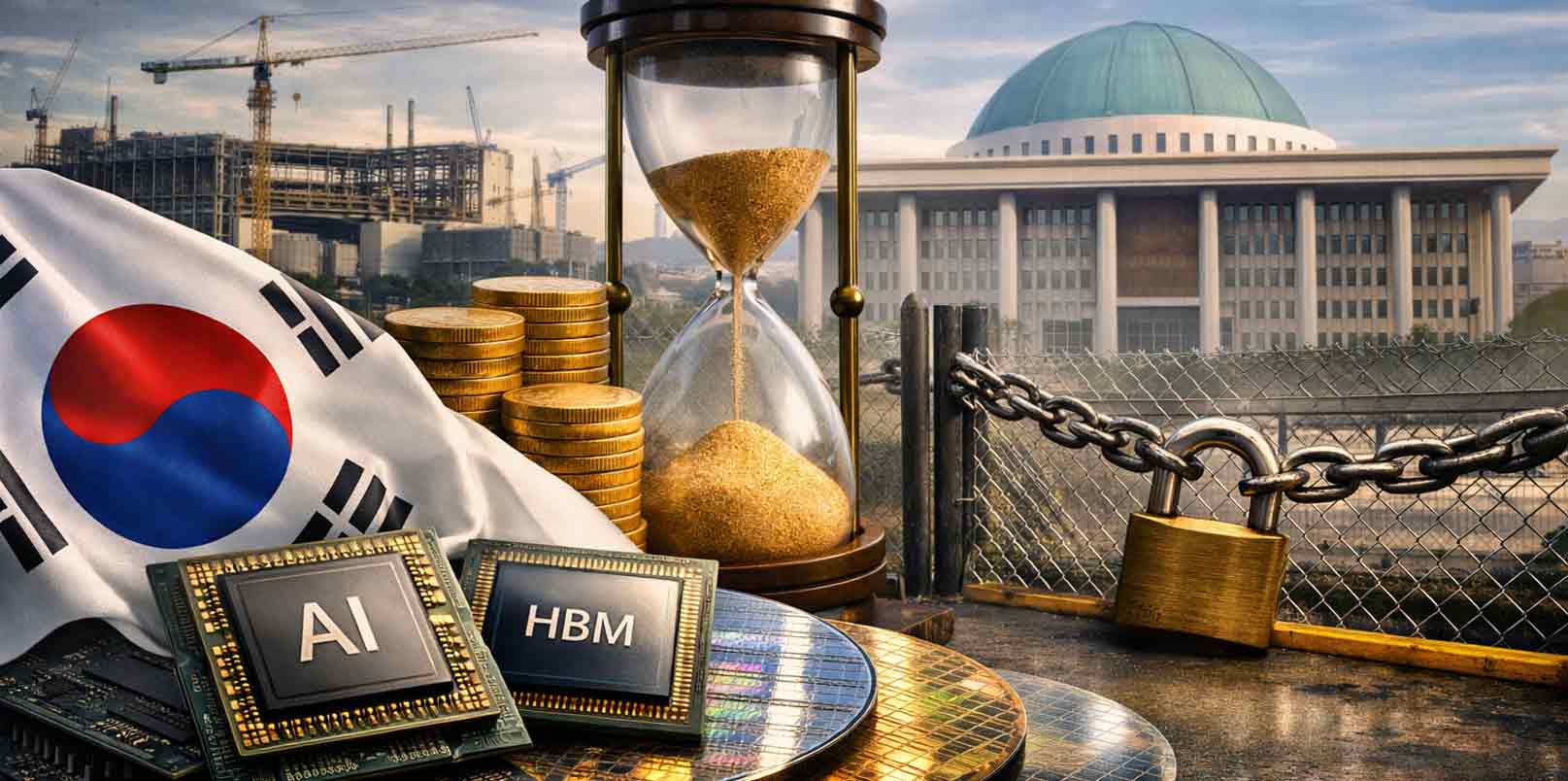
Korea has secured the law. But the money? No, not yet. And for a country positioning semiconductor at the center of its AI-era strategy, the sequencing actually matters. The National Assembly’s passage of the Semiconductor Special Act signals policy intent. Yet the KRW 2 trillion special account designed to power that intent will not operate until 2027, introducing a one-year gap between declaration and dedicated capital deployment.

Korea Semiconductor Special Act 2026 Approved, Special Account Delayed

On January 29, the National Assembly passed the “Special Act on Strengthening and Supporting the Competitiveness of the Semiconductor Industry” during its plenary session. The bill cleared with 199 votes in favor and 7 abstentions out of 206 members present.

The Act provides the legal basis for designating semiconductor clusters and supporting infrastructure development, including expansion of power, water supply, road networks, and administrative assistance such as expedited approvals and special exemptions from preliminary feasibility studies.

Industry groups welcomed the move. The Korea Semiconductor Industry Association described the legislation as “an important turning point” and “a starting point for elevating semiconductor competitiveness in the AI era.” Business organizations emphasized that national-level infrastructure support and regulatory improvements would help reduce investment uncertainty and strengthen global competitiveness.

However, according to relevant ministries, the KRW 2 trillion Semiconductor Special Account—intended as the Act’s dedicated funding mechanism—will not be established until next year

Because the necessary amendment to the National Finance Act was not processed alongside the 2026 budget deliberations, the special account is expected to begin operating in 2027. In 2026, semiconductor support will continue through dispersed general accounts across ministries.

Meanwhile, the contentious proposal to exempt semiconductor R&D personnel from the 52-hour workweek limit was not included in the final legislation.

Why South Korea Semiconductor Industry Policy 2026 Signals a Structural Shift

The Act formalizes what has been unfolding for several years: semiconductors are no longer treated as an industrial segment but as strategic infrastructure.

And the bill involves specific language: industry associations repeatedly framed competitiveness through the lens of artificial intelligence, noting that AI semiconductor capabilities are emerging as decisive factors in national strength. Governments worldwide, they said, are implementing aggressive support measures to secure leadership in advanced chips.

What changes here is institutional posture. The Korean government now has a clear legal mandate to prioritize semiconductor clusters and coordinate fiscal and administrative support. For large-scale projects—especially those requiring coordinated power and water access—legal clarity reduces long-term uncertainty.

For the global ecosystem, this confirms that South Korea’s semiconductor push is not episodic. It is embedded in national policy architecture.

Yet architecture and liquidity are not the same thing.

The ₩2 Trillion Semiconductor Special Account Delay Exposes an Execution Gap

The most consequential detail in this development is not the bill’s passage but its funding timeline.

The dedicated KRW 2 trillion semiconductor special account will only begin operating in 2027, contingent on the passage of the National Finance Act amendment alongside next year’s budget. Until then, support remains fragmented within general accounts.

This sequencing matters because dedicated accounts signal sustained, ring-fenced commitment. General accounts, by contrast, compete with other policy priorities.

The omission of the 52-hour workweek exemption for R&D personnel adds another layer of tension. Industry groups had argued that labor flexibility was critical in a fast-moving AI semiconductor race. Its exclusion reflects unresolved domestic policy friction.

None of this invalidates the Act. But it complicates the narrative of immediate acceleration. Ambition has been legislated, but tangible execution will depend on fiscal alignment and institutional follow-through.

Korea Semiconductor Cluster Infrastructure Support: What This Enables — and What It Still Does Not

Additionally, the Act strengthens the foundation for semiconductor cluster expansion. Infrastructure coordination—electricity, water, roads, administrative approvals—has historically been a bottleneck in advanced manufacturing. Legal prioritization may reduce delays and signal long-term state backing.

At the same time, large-scale memory producers and foundry operators are the most direct beneficiaries of infrastructure certainty. Advanced packaging and system semiconductor players positioned within clusters may also gain from ecosystem density.

Still, what the law does not immediately provide is the new venture-stage capital. It does not establish a startup-focused semiconductor fund. It does not introduce direct subsidy mechanisms in its current form. It does not alter labor regulations for R&D engineers.

For early-stage fabless startups and semiconductor design ventures, the act actually causes indirect impact. Cluster strength may improve supplier access and ecosystem stability over time. It does not, by itself, solve capital constraints or market access challenges.

This is industrial policy first, startup policy second.

Impact of Korea Semiconductor Special Act on Startups and Global Investors

So, for global founders and investors evaluating Korea, three signals emerge.

First, semiconductors remain central to national strategy. Policy continuity is evident across administrations and industry cycles. That reduces long-term geopolitical ambiguity.

Second, the funding gap until 2027 introduces a near-term pacing issue. International partners expecting immediate fiscal acceleration should calibrate expectations.

Third, the unresolved 52-hour workweek debate highlights a deeper policy balancing act: national competitiveness versus domestic labor standards. That tension is not unique to Korea, but it shapes operational reality.

Cross-border investors in AI hardware, advanced memory, or semiconductor equipment should read this development as institutional consolidation, not instant liquidity expansion. The ecosystem is stabilizing around infrastructure. Capital intensity remains high. Policy execution will determine whether legal intent translates into market leverage.

Strategic Closing: Policy Passed, Capacity Pending

Finally, South Korea has chosen its direction. The question now is timing.

A Semiconductor Special Act without its dedicated special account operating until 2027 creates a transitional year in which ambition runs slightly ahead of fiscal structure. That gap may prove temporary. Or it may reveal the difficulty of aligning industrial urgency with legislative process.

In the AI semiconductor race, sequencing often decides advantage.

Key Takeaway on Korea’s Semiconductor Special Act 2026

  • The Korea Semiconductor Special Act 2026 has passed, establishing legal backing for semiconductor cluster and infrastructure support.
  • The KRW 2 trillion semiconductor special account will not begin operating until 2027 due to pending National Finance Act amendments.
  • The 52-hour workweek exemption for semiconductor R&D was excluded from the final legislation.
  • 2026 semiconductor support will rely on dispersed general accounts rather than a dedicated funding mechanism.
  • The law strengthens long-term industrial infrastructure but does not introduce immediate startup-focused capital.
  • For global stakeholders, the development signals strategic continuity—tempered by short-term execution gaps.

🤝 Looking to connect with verified Korean companies building globally?
Explore curated company profiles and request direct introductions through beSUCCESS Connect.


– Stay Ahead in Korea’s Startup Scene –
Get real-time insights, funding updates, and policy shifts shaping Korea’s innovation ecosystem.
➡️ Follow KoreaTechDesk on LinkedIn, X (Twitter), Threads, Bluesky, Telegram, Facebook, and WhatsApp Channel.

Tags: ₩2 trillion semiconductor special account delay2026 startup policy52 hour workweek semiconductor R&D exemptionAI era policy KoreaAI innovation policy AsiaAI policiesAI policyAI policy South KoreaAI semiconductorFabless semiconductorgovernment policiesimpact of Korea Semiconductor Special Act on startupsinnovation policiesinnovation policyK-semiconductorKorea AI semiconductor strategyKorea AI Transformation (AX) policiesKorea AI transformation policy 2026Korea deep tech policy reformKorea innovation policyKorea National Finance Act amendmentKorea semiconductor cluster infrastructure supportKorea Semiconductor Special Act 2026Korea tech policyKorean AI semiconductor companiesKorean fabless semiconductorpoliciespolicy oversightpolicy reformSemiconductorsemiconductor policiesSemiconductorsSouth Korea semiconductor industry policy 2026
Previous Post

Korea’s Industrial AI Ambition Meets Global Compute Infrastructure as Mithril Joins NVIDIA Inception

Next Post

How Korea’s Startup Support System Actually Works: A Map for Foreign Readers

Next Post

How Korea’s Startup Support System Actually Works: A Map for Foreign Readers

MOST READ ARTICLE OF THE WEEK

1.
Three Months into the Coupang Probe, Korea Confronts the Limits of Cross-Border Enforcement
19 Feb 2026
2.
Korea’s Startup Risk Has Changed: Profitability and IPO Credibility Now Decide the Price
19 Feb 2026
3.
Korea’s Platform Risk Just Got Real: What The Coupang Fallout Taught Founders About Single-Channel Dependence
20 Feb 2026
4.
Korea’s ‘Mandatory Closure’ Model Is Colliding With 24/7 Commerce, and Policy Is Catching Up Late
20 Feb 2026
5.
From IEEPA to Section 122: How America’s Tariff Shift Reshapes Risk for Korean Export-Driven Startups
21 Feb 2026
Register for Event

[the_ad id=”18508″]

List Article

1.
How Korea’s Startup Support System Actually Works: A Map for Foreign Readers
25 Feb 2026
2.
6 Reasons Why Seoul Is Poised to Become a Top 5 Global Economic Hub by 2030
20 Aug 2024
3.
Top Co-working Spaces for Startups & Companies to Explore in South Korea
3 Apr 2024
4.
Top Accelerators in South Korea Shaping Startup Success
29 Nov 2023
5.
Top Korean Venture Capital Firms Backing Startup Success
26 Oct 2023

Similar Articles

Government Policies

Korea Bets ₩87B on Field-Ready AI: What Manufacturing Startups and Global Investors Should Watch

More
Government Policies

Korea Moves to Shield 6,000 Exporters After U.S. Supreme Court Tariff Ruling

More
Government Policies

From IEEPA to Section 122: How America’s Tariff Shift Reshapes Risk for Korean Export-Driven Startups

More

Topics

Menu
  • AI & Big Data
  • AR & VR
  • Blockchain
  • Clean Technology
  • Content & Games
  • Cybersecurity
  • Enterprise & SaaS
  • FinTech
  • Gadgets & Electronics
  • Health & Bio
  • IoT

Program

Menu
  • Asan Voyager
  • CAPA Global Program
  • SGSC Global Bootcamp
  • LAUNCHPAD
  • COMEUP STARS 120
  • K-Startup Grand Challenge
  • TIPS X beSUCCESS Global Project
  • SFL Global Program
  • KTO Global Showcase
  • Yonsei Univ Global Class
  • KOSME Global Program

About

Menu
  • About Us
  • all articles
  • Terms of Use
  • Privacy
  • Cookie-policy
  • twitter

Subscribe and be informed first hand about actual Korean startup news.

All the day’s headlines and highlights, direct to you every morning.

Contact us : [email protected]

Topics

Menu
  • AI & Big Data
  • AR & VR
  • Blockchain
  • Clean Technology
  • Content & Games
  • Cybersecurity
  • Enterprise & SaaS
  • FinTech
  • Gadgets & Electronics
  • Health & Bio
  • IoT

Program

Menu
  • Asan Voyager
  • CAPA Global Program
  • SGSC Global Bootcamp
  • LAUNCHPAD
  • COMEUP STARS 120
  • K-Startup Grand Challenge
  • TIPS X beSUCCESS Global Project
  • SFL Global Program
  • KTO Global Showcase
  • Yonsei Univ Global Class
  • KOSME Global Program

About

Menu
  • About Us
  • all articles
  • Terms of Use
  • Privacy
  • Cookie-policy
  • twitter

Subscribe and be informed first hand about actual Korean startup news.

All the day’s headlines and highlights, direct to you every morning.

© 2023 Koreantech News & Media Korea Zrt. All rights reserved.

Our Spring Sale Has Started

You can see how this popup was set up in our step-by-step guide: https://wppopupmaker.com/guides/auto-opening-announcement-popups/

Our Spring Sale Has Started

You can see how this popup was set up in our step-by-step guide: https://wppopupmaker.com/guides/auto-opening-announcement-popups/

We hope you enjoy our content, May you please give us Feedback regarding our website!

Single Post Feedback

dgdfgfdgdf

What you think about Koreatechdesk, Share your idea with us!

feedback popup

Invitation submission has been closed

Insert/edit link

Enter the destination URL

Or link to existing content

    No search term specified. Showing recent items. Search or use up and down arrow keys to select an item.