KoreaTechDesk | Korean Startup and Technology News

Tue, February 24, 2026

Sign in

Virtual Demo Day
Menu
  • Home
  • Startup News
    • AI & Big Data
    • AR & VR
    • Blockchain
    • Clean Technology
    • Content & Games
    • Cybersecurity
    • Enterprise & SaaS
    • FinTech
    • Gadgets & Electronics
    • Health & Bio
    • Manufacturing
    • Press Release
    • IoT
    • Marketplaces & E-commerce
    • Robotics
    • Transportation
    • Investments
    • Ecosystem & Lists
  • Governments
    • Artificial Intelligence Industry Cluster Agency
    • Daegu Technopark
    • GANGNAM-GU
    • Gyeonggido Business & Science Accelerator
    • Hwaseong Industry Promotion Agency
    • Invest Seoul
    • Korea Creative Content Agency
    • Korea Internet & Security Agency
    • Korea Information Security Industry Association
    • Korea Institute of Startup & Entrepreneurship Development
    • Korea Tourism Organization
    • Korea Trade-Investment Promotion Agency
    • Ministry of Culture, Sports and Tourism
    • Ministry of SMEs & Startups
    • National IT Industry Promotion Agency
    • Pangyo Techno Valley
    • Seoul Business Agency
    • Seoul FinTech Lab
    • South Gyeongsang Province
    • Seoul Metropolitan Government
  • Events
    • COMEUP
    • Korea Fintech Week
    • K-Content Expo
    • NextRise
    • Try Everything
  • Interviews
    • Investors’ interviews
    • Founders’ interviews
  • Programs
    • Asan Voyager
    • CAPA Global Program
    • Campus Town Program
    • SGSC Global Bootcamp
    • Gangnam-gu Global Roadshow
    • Global SaaS Marketplace Support Project
    • LAUNCHPAD
    • COMEUP STARS 120
    • K-Startup Grand Challenge
    • TIPS X beSUCCESS Global Project
    • SFL Global Program
    • KTO Global Showcase
    • Yonsei Univ Global Class
    • KOSME Global Program
  • Partner With Us
    • Press Release
    • Startup Scouting
    • Business Agencies
    • Global Mentorship Program
    • Investment Opportunities
    • K-Scouter Program
  • Lists
  • Home
  • Startup News
    • AI & Big Data
    • AR & VR
    • Blockchain
    • Clean Technology
    • Content & Games
    • Cybersecurity
    • Enterprise & SaaS
    • FinTech
    • Gadgets & Electronics
    • Health & Bio
    • Manufacturing
    • Press Release
    • IoT
    • Marketplaces & E-commerce
    • Robotics
    • Transportation
    • Investments
    • Ecosystem & Lists
  • Governments
    • Artificial Intelligence Industry Cluster Agency
    • Daegu Technopark
    • GANGNAM-GU
    • Gyeonggido Business & Science Accelerator
    • Hwaseong Industry Promotion Agency
    • Invest Seoul
    • Korea Creative Content Agency
    • Korea Internet & Security Agency
    • Korea Information Security Industry Association
    • Korea Institute of Startup & Entrepreneurship Development
    • Korea Tourism Organization
    • Korea Trade-Investment Promotion Agency
    • Ministry of Culture, Sports and Tourism
    • Ministry of SMEs & Startups
    • National IT Industry Promotion Agency
    • Pangyo Techno Valley
    • Seoul Business Agency
    • Seoul FinTech Lab
    • South Gyeongsang Province
    • Seoul Metropolitan Government
  • Events
    • COMEUP
    • Korea Fintech Week
    • K-Content Expo
    • NextRise
    • Try Everything
  • Interviews
    • Investors’ interviews
    • Founders’ interviews
  • Programs
    • Asan Voyager
    • CAPA Global Program
    • Campus Town Program
    • SGSC Global Bootcamp
    • Gangnam-gu Global Roadshow
    • Global SaaS Marketplace Support Project
    • LAUNCHPAD
    • COMEUP STARS 120
    • K-Startup Grand Challenge
    • TIPS X beSUCCESS Global Project
    • SFL Global Program
    • KTO Global Showcase
    • Yonsei Univ Global Class
    • KOSME Global Program
  • Partner With Us
    • Press Release
    • Startup Scouting
    • Business Agencies
    • Global Mentorship Program
    • Investment Opportunities
    • K-Scouter Program
  • Lists
Home Governments

The 150-Day Window: How Trump’s Section 122 Tariff Shift Resets Strategic Planning for Korean SMEs

by Daehyun Song
February 24, 2026
in Governments
0

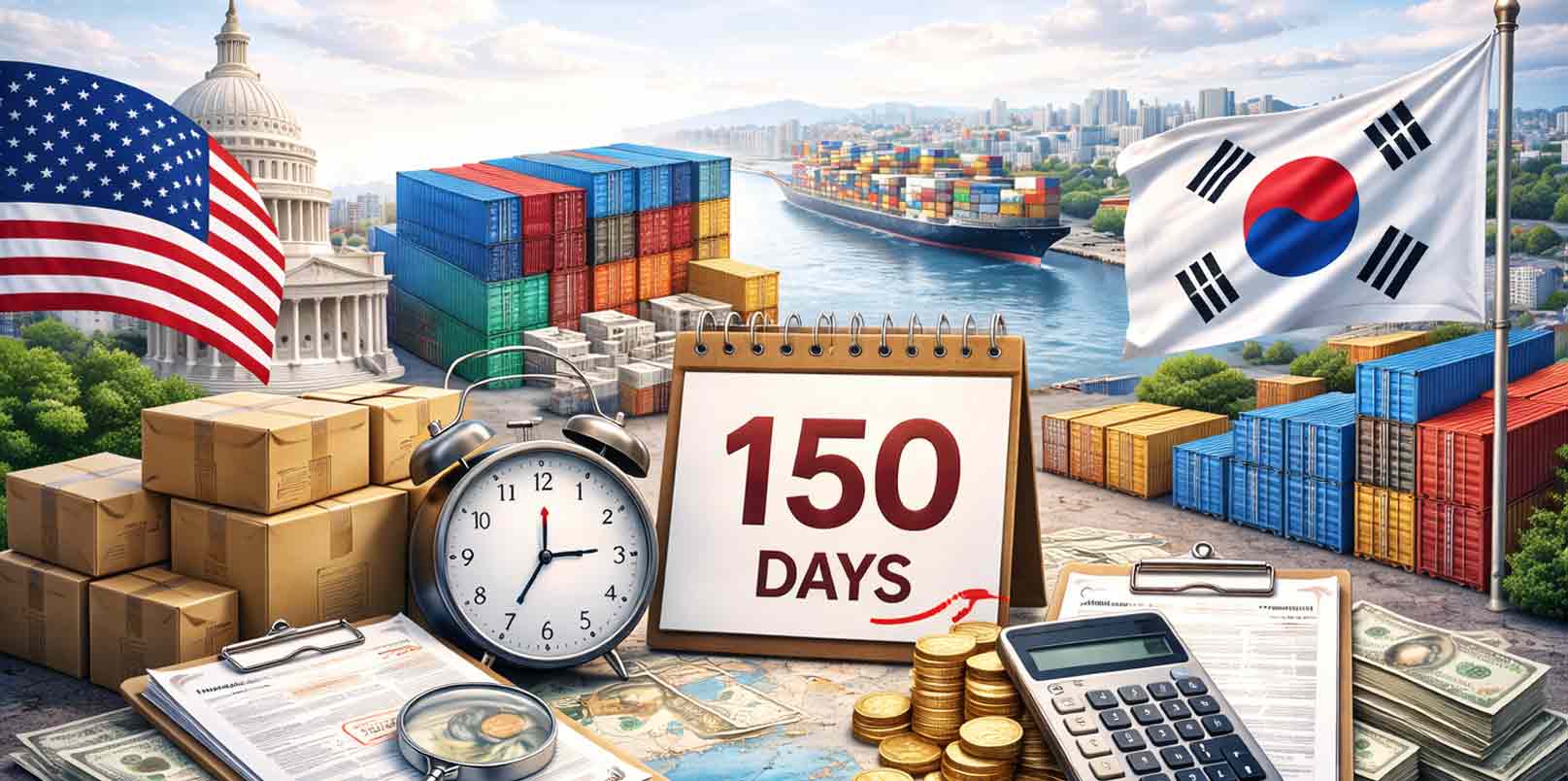
For Korean exporters, the U.S. Supreme Court’s ruling against IEEPA-based reciprocal tariffs did not bring clarity. It replaced one legal structure with another. Within days, President Donald Trump invoked Section 122 of the Trade Act to impose a global tariff, later raising it to 15 percent. For Korean SMEs and export-based startups, the shift introduces a 150-day planning window filled with strategic uncertainty.

Korea Convenes Public–Private Meeting After Section 122 Tariff Move

On February 23, the Ministry of Trade, Industry and Energy (MOTIE) convened a joint public–private response meeting at the Korea Chamber of Commerce and Industry in Seoul. Economic organizations, major industry associations, relevant ministries, and export support institutions attended.

The meeting followed the U.S. Supreme Court’s decision declaring reciprocal tariffs imposed under the International Emergency Economic Powers Act (IEEPA) unlawful. Immediately afterward, President Trump announced a 10 percent global tariff under Section 122 of the Trade Act and subsequently raised it to 15 percent.

According to the ministry, Section 232 product-specific tariffs remain in effect. The government also anticipates potential investigations under Section 301 and other alternative legal mechanisms. Officials stated that these overlapping tools could generate “complex impacts” on Korean industry and exports.

The government said it will closely monitor U.S. follow-up measures and movements by other countries, aiming to minimize uncertainty for Korean firms.

Why the 150-Day Section 122 Period Matters Now

Section 122 authorizes the U.S. president to impose tariffs of up to 15 percent for a maximum of 150 days in response to balance-of-payments concerns. That time limit is now central.

Legal experts emphasized that the 150-day window could become a turning point. If no replacement legal framework emerges after the period expires, a tariff gap could occur. At the same time, alternative mechanisms such as Section 301 investigations or expanded product tariffs under Section 232 remain available to the U.S. administration.

In practical terms, Korean exporters face at least five months of constrained visibility in U.S. pricing conditions. The uncertainty extends beyond headline tariff rates. It includes refund procedures, investigation risk, and potential sector-specific adjustments.

The Korea International Trade Association noted that if the U.S. tariff structure transitions to a “Most-Favored-Nation tariff plus 15 percent under Section 122” model, Korea’s competitiveness as an FTA partner could improve relative to non-FTA countries. That assessment, however, depends on how the framework evolves after the 150-day period.

Minister Kim Jung-kwan: “Friendly Consultations” and Competitive Adjustment

At the February 23 meeting, Minister Kim Jung-kwan stated that the government will continue “friendly consultations” with the United States to ensure that the balance of benefits secured through prior Korea–U.S. tariff agreements is not undermined.

He warned that if a uniform 15 percent global tariff is applied, changes in relative competitive conditions for Korean companies should be expected.

Kim also said the government will pursue export diversification and competitiveness policies “persistently” and ensure that companies receive timely information regarding uncertainties surrounding tariff refunds.

He noted that additional U.S. measures and developments in other major economies will be closely monitored, and that mid- to long-term response strategies will be explored calmly.

Separately, legal analysts cautioned that tariff refunds following the IEEPA ruling are not automatic. Eligibility may depend on litigation participation and the finalization status of individual import entries.

Legal Authority Shift Without Risk Reduction

The core tension is not about one tariff rate replacing another. It is about the legal architecture.

The Supreme Court invalidated tariffs under IEEPA because the statute does not explicitly authorize tariff imposition. The Trump administration responded by invoking authorities that were explicitly delegated by Congress decades ago, including Sections 122, 301, and 232.

From a Korean SME perspective, the risk did not disappear. It changed channels.

Section 122 creates a temporary tariff structure with a defined duration. Section 301 opens the possibility of targeted investigations into alleged unfair trade practices. Section 232 allows product-specific tariffs tied to national security assessments. Each mechanism carries different procedural and sectoral implications.

For export-dependent SMEs without in-house trade law capacity, the multiplicity of legal tracks complicates planning. The issue is less about a single 15 percent number and more about layered regulatory exposure.

How Section 122 Reshapes U.S. Market Strategy for Korean SMEs

Korean startups and SMEs have increasingly embedded U.S. market access into growth projections. In 2024 and 2025, trade volatility already forced pricing revisions across manufacturing-linked SMEs, especially those tied to steel, automotive parts, and industrial inputs.

Under the Section 122 framework, short-term predictability improves only marginally. A 150-day window is only sufficient for customs implementation. But it is still insufficient for capital allocation or long-term supply chain restructuring.

For technology startups exporting hardware components or advanced materials, tariff exposure intersects with cross-border venture capital decisions. Investors assessing U.S. revenue dependency must now factor in temporary tariff authorities that can be replaced by alternative legal tools at short notice.

The structural question becomes one of risk distribution. Large conglomerates can absorb legal volatility through global production networks. But not all export-based startups and SMEs can do the same. That asymmetry deepens the policy-execution gap between national trade diplomacy and firm-level resilience.

The ministry’s public–private coordination signals awareness of that imbalance. Yet coordination does not eliminate structural exposure.

Planning Inside a Moving Legal Framework

The next five months are not a pause. They are a compressed negotiation phase.

If Section 122 expires without replacement, certain goods could temporarily revert to lower tariff conditions. If replaced by Section 301 findings or expanded Section 232 measures, sector-specific pressure could intensify instead of ease.

Korean SMEs and startups exporting to the United States are therefore operating inside a conditional environment. Pricing models, contract clauses, and refund strategies must now incorporate legal volatility as a baseline assumption.

For global stakeholders, the episode highlights how trade governance is increasingly intertwined with startup risk management. Market access is no longer solely about demand. It is also about statutory interpretation and executive authority.

The 150-day window is not simply a countdown. It is a strategic test of how quickly governments and firms can recalibrate inside shifting legal boundaries.

Key Takeaway on the 150-Day Window for Korea’s Startups and SMEs

  • The U.S. Supreme Court invalidated IEEPA-based reciprocal tariffs.
  • The Trump administration invoked Section 122 to impose a 15 percent global tariff for up to 150 days.
  • Section 232 tariffs remain active, and Section 301 investigations remain possible.
  • Korea’s Ministry of Trade convened a public–private response meeting to assess impact and maintain U.S. consultations.
  • Tariff refund eligibility remains legally and procedurally uncertain.
  • The 150-day limit creates a defined but unstable planning horizon for Korean startups and SMEs exporting to the United States.
  • Legal authority shifts do not eliminate trade risk; they redistribute it across alternative statutory channels.

🤝 Looking to connect with verified Korean companies building globally?
Explore curated company profiles and request direct introductions through beSUCCESS Connect.


– Stay Ahead in Korea’s Startup Scene –
Get real-time insights, funding updates, and policy shifts shaping Korea’s innovation ecosystem.
➡️ Follow KoreaTechDesk on LinkedIn, X (Twitter), Threads, Bluesky, Telegram, Facebook, and WhatsApp Channel.

Tags: 10 percent global tariff United States150-day tariff authoritycross-border trade risk managementKorea Ministry of Trade responseKorean SME exports to U.S.reciprocal tariffsSection 122 Trade ActSection 122 Trade Act 1974Section 232 tariffsSection 301 investigationSupreme Court Trump tariffsTarifftariff crisis responseTrade Act Section 301 investigationsTrade Expansion Act Section 232Trump global 15% tariffU.S. Supreme Court IEEPA rulingU.S. TariffU.S. tariff policy impact KoreaU.S. tariff refund uncertaintyU.S. tariffs on Korean goods
Previous Post

Korea’s AI Goes Global Under a New Rulebook: 5 Verified Companies Already Scaling Overseas

Next Post

Korea Bets ₩87B on Field-Ready AI: What Manufacturing Startups and Global Investors Should Watch

Next Post

Korea Bets ₩87B on Field-Ready AI: What Manufacturing Startups and Global Investors Should Watch

MOST READ ARTICLE OF THE WEEK

1.
How Korea’s Post-Coupang Regulatory Shift is Quietly Redrawing the Startup Playbook
18 Feb 2026
2.
Medical AI Revenue Surge Brings Korea Its First Profitable Listed Player
18 Feb 2026
3.
Three Months into the Coupang Probe, Korea Confronts the Limits of Cross-Border Enforcement
19 Feb 2026
4.
Korea’s Startup Risk Has Changed: Profitability and IPO Credibility Now Decide the Price
19 Feb 2026
5.
Korea’s Platform Risk Just Got Real: What The Coupang Fallout Taught Founders About Single-Channel Dependence
20 Feb 2026
Register for Event

[the_ad id=”18508″]

List Article

1.
6 Reasons Why Seoul Is Poised to Become a Top 5 Global Economic Hub by 2030
20 Aug 2024
2.
Top Co-working Spaces for Startups & Companies to Explore in South Korea
3 Apr 2024
3.
Top Accelerators in South Korea Shaping Startup Success
29 Nov 2023
4.
Top Korean Venture Capital Firms Backing Startup Success
26 Oct 2023
5.
Top Apps for Seamless Korean to English Translation
14 Aug 2023

Similar Articles

Governments

K-Space Forum Signals Korea’s Move From Old Space to a Venture-Led New Space Economy

More
Governments

Korea Venture Investment Builds Saudi Arabia Bridge for Deep-Tech Capital Flows

More
Governments

Korea – Vietnam Innovation Bridge: How KOSPO’s New MOU Reflects Korea’s Shift Toward ASEAN Startup Integration

More

Topics

Menu
  • AI & Big Data
  • AR & VR
  • Blockchain
  • Clean Technology
  • Content & Games
  • Cybersecurity
  • Enterprise & SaaS
  • FinTech
  • Gadgets & Electronics
  • Health & Bio
  • IoT

Program

Menu
  • Asan Voyager
  • CAPA Global Program
  • SGSC Global Bootcamp
  • LAUNCHPAD
  • COMEUP STARS 120
  • K-Startup Grand Challenge
  • TIPS X beSUCCESS Global Project
  • SFL Global Program
  • KTO Global Showcase
  • Yonsei Univ Global Class
  • KOSME Global Program

About

Menu
  • About Us
  • all articles
  • Terms of Use
  • Privacy
  • Cookie-policy
  • twitter

Subscribe and be informed first hand about actual Korean startup news.

All the day’s headlines and highlights, direct to you every morning.

Contact us : [email protected]

Topics

Menu
  • AI & Big Data
  • AR & VR
  • Blockchain
  • Clean Technology
  • Content & Games
  • Cybersecurity
  • Enterprise & SaaS
  • FinTech
  • Gadgets & Electronics
  • Health & Bio
  • IoT

Program

Menu
  • Asan Voyager
  • CAPA Global Program
  • SGSC Global Bootcamp
  • LAUNCHPAD
  • COMEUP STARS 120
  • K-Startup Grand Challenge
  • TIPS X beSUCCESS Global Project
  • SFL Global Program
  • KTO Global Showcase
  • Yonsei Univ Global Class
  • KOSME Global Program

About

Menu
  • About Us
  • all articles
  • Terms of Use
  • Privacy
  • Cookie-policy
  • twitter

Subscribe and be informed first hand about actual Korean startup news.

All the day’s headlines and highlights, direct to you every morning.

© 2023 Koreantech News & Media Korea Zrt. All rights reserved.

Our Spring Sale Has Started

You can see how this popup was set up in our step-by-step guide: https://wppopupmaker.com/guides/auto-opening-announcement-popups/

Our Spring Sale Has Started

You can see how this popup was set up in our step-by-step guide: https://wppopupmaker.com/guides/auto-opening-announcement-popups/

We hope you enjoy our content, May you please give us Feedback regarding our website!

Single Post Feedback

dgdfgfdgdf

What you think about Koreatechdesk, Share your idea with us!

feedback popup

Invitation submission has been closed

Insert/edit link

Enter the destination URL

Or link to existing content

    No search term specified. Showing recent items. Search or use up and down arrow keys to select an item.