


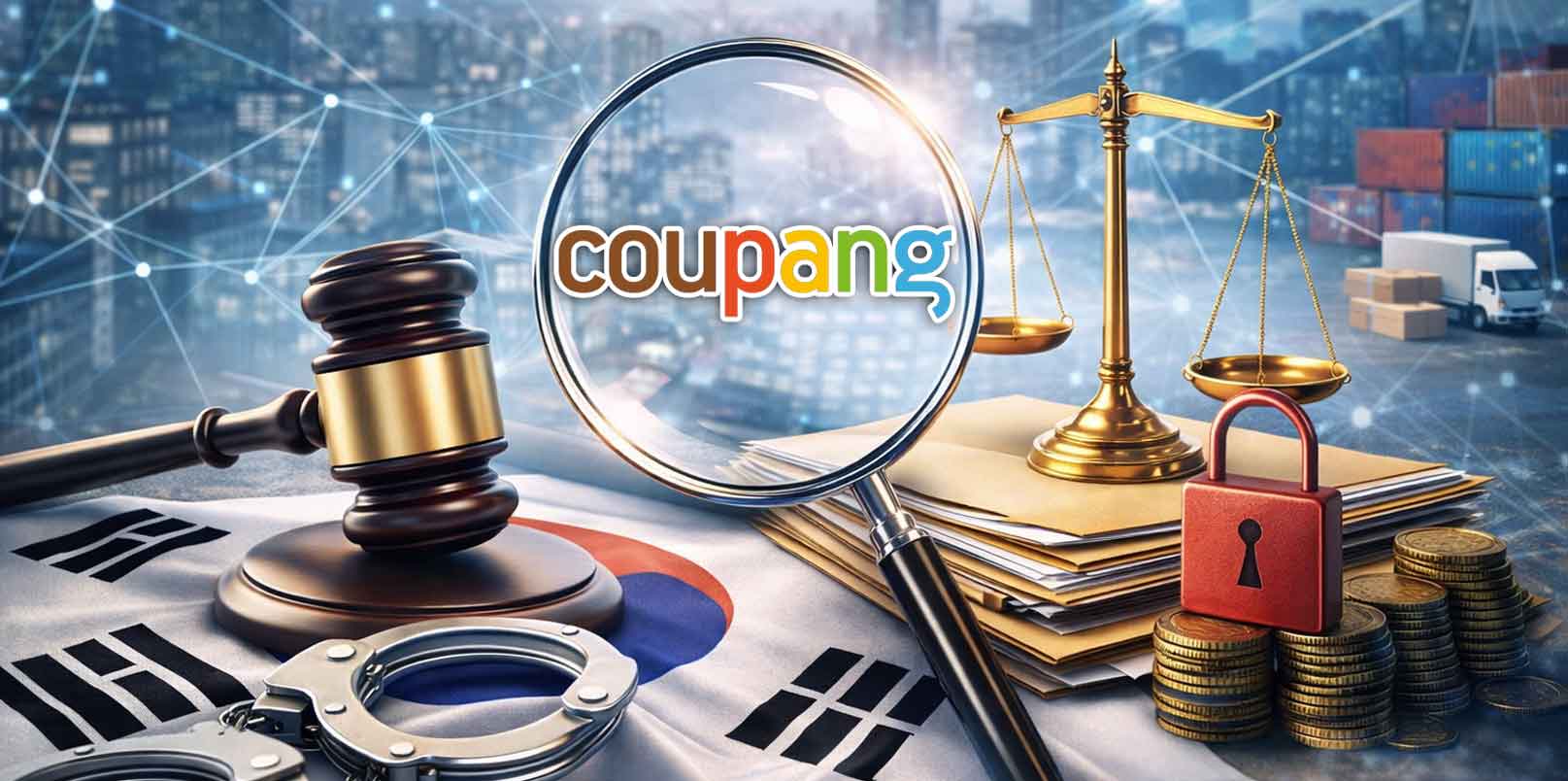
After a single data breach happening to Coupang, the rules of engagement for Korea’s platform economy are shifting in ways that reach far beyond cybersecurity. What began as accountability for one company is evolving into a broader rewrite of how digital marketplaces operate. And this provides a signal that is not just episodic but also structural for both founders building in South Korea and investor watching regulatory risk in Asia’s fourth-largest economy.
Coupang Data Breach Triggers Broad Platform Regulation Push in Korea
In November 2025, Coupang disclosed that personal information from approximately 4,500 accounts had been leaked without authorization. The company reported the incident to the Ministry of Science and ICT, the Korea Internet & Security Agency, and the Personal Information Protection Commission.
Public and political reaction was swift. Initial debate focused on whether Coupang had met its security and management obligations. But within weeks, discussions widened beyond individual corporate responsibility.
According to policy briefings and National Assembly records cited in the Startup Alliance issue paper published in February 2026, lawmakers began advancing amendments across multiple domains:
- Personal Information Protection Act revisions proposing higher administrative fines and expanded notification obligations
- Fair Trade Commission discussions on market-dominant platform designation and increased penalty ceilings
- Bills under the proposed Online Platform Fairness Act (온플법) and Food Delivery Platform Act (음플법) introducing mandatory contract clauses, shortened settlement cycles, and escrow requirements
- National Tax Service investigations examining cross-border transactions and profit transfers
- Financial Supervisory Service signals that large distribution platforms may face oversight closer to financial institutions
- Proposed collective action legislation expanding class action eligibility and introducing punitive damages
As Startup Alliance co-CEO Lee Gi-dae stated in response to the regulatory wave,
“If regulatory approaches intensify in one direction following a specific incident, the mid- to long-term competitiveness of Korea’s platform industry could be damaged.”
The issue paper’s author, Senior Research Fellow Joo-yeon Jung, framed the shift more bluntly:
“A single corporate accident has become a justification to regulate the entire platform model.”
These developments are legislative proposals and regulatory discussions. They are not yet a consolidated statute. But they have shown a completely clear direction.
Korea’s Platform Rules Shift from Enforcement to Preemptive Control
Now, the significant change is not the volume of bills. It is the philosophy.
Historically, enforcement followed violations. A breach occurred, regulators investigated, penalties followed. However, the current debate signals a move toward preemptive obligation design — embedding detailed operational duties directly into law.
The proposed Online Platform Fairness Act, for example, would require eight mandatory contract provisions, including disclosure of exposure ranking criteria and standardized settlement timelines. Some amendments contemplate requiring platforms to escrow at least 50 percent of seller proceeds.
In competition law discussions, the threshold for market-dominant designation — traditionally defined by market share benchmarks under Korea’s Fair Trade Act — is being revisited in platform-specific contexts.
Financial oversight discussions suggest that payment and settlement functions inside large platforms may trigger supervision frameworks closer to financial institutions.
The cumulative shift reframes platforms not simply as intermediaries but as multi-functional economic infrastructure.
For policymakers, this reflects concern over systemic risk. For startups, it reframes operational design as a regulatory variable rather than purely a product decision.
Why the Post-Coupang Platform Bills Hit Startups Harder Than Big Tech
So, here’s the core tension.
Many of the proposed obligations are framed generically. All “platform operators” must comply. However, compliance capacity is not generic.
The giant players can have the luxury of maintaining legal teams, internal audit systems, and capital buffers. But early-stage or growth-stage startups cannot.
The Startup Alliance issue paper highlights that regulatory costs — legal review, system upgrades, escrow structuring, reporting compliance — scale differently for smaller firms. A 10 percent administrative fine calculated on transaction volume rather than profit, for instance, carries very different implications for a loss-making growth platform than for a mature incumbent.
Settlement-cycle standardization offers another example. Travel platforms, freelance marketplaces, and custom manufacturing platforms operate on varied revenue timing structures. A uniform 20-day settlement mandate may align with some retail flows but conflict with project-based service models or external payment gateway timelines.
The friction is not about whether regulation is justified. It is about whether regulatory design recognizes heterogeneity in business models and lifecycle stages.
Uncertainty compounds the cost. Startups routinely accept market risk. Policy unpredictability is harder to price. When founders must ask whether scale itself increases regulatory exposure, growth incentives subtly shift.
What Korea’s Platform Overhaul Can Fix — and Where It Falls Short
The expansion of Korea’s platform regulation does enable certain outcomes.
It clarifies that digital platforms are no longer treated as experimental actors but as systemic participants in the national economy. Stronger data protection standards may enhance consumer trust. Formalized contract rules could reduce disputes between dominant intermediaries and small merchants. Enhanced financial oversight may reduce settlement risk.
Yet structural regulation does not automatically solve platform concentration. Nor does fee control guarantee lower end-user costs. The Startup Alliance paper references overseas examples, including New York City’s delivery fee cap, where commission ceilings led to higher consumer prices and reduced order volume. So, market responses are rarely linear.
Moreover, embedding operational specifics into law risks slowing iteration cycles. Algorithmic ranking logic, exposure design, or bundled service models are competitive tools. When they become subject to mandated disclosure or rigid formatting, differentiation narrows.
Regulation can stabilize markets. It can also standardize them.
What Global Founders and Investors Should Watch in Korea’s Platform Policy
This move has moved beyond just a simple Korean domestic issue for global readers.
South Korea is one of Asia’s most digitally dense markets, with high platform penetration and integrated logistics, payments, and data ecosystems. Policy trends here often preview regulatory trajectories in other middle and high-income digital economies balancing innovation and consumer protection.
The Korean debate reflects a broader global tension: how to regulate multi-sided platforms that combine data processing, commerce, payments, logistics, and AI-enabled recommendation systems under one roof.
For foreign founders entering Korea, regulatory due diligence must now include sector-specific legislative tracking, not just general corporate law review.
As for venture investors, compliance burn rate becomes a line item earlier in the growth cycle.
And for cross-border partners, particularly in AI-enabled commerce and marketplace infrastructure, Korea’s direction suggests a tightening environment where product design choices may intersect directly with statutory requirements.
This does not make Korea hostile to innovation. It makes it even more policy-active.
Regulation in the AI Era: Strategy or Overreach?
The deeper question is not whether platforms should be regulated. Because they already are.
Instead, the question is whether regulation is being used as strategic industrial design or as reactive accumulation. When multiple bills across privacy, antitrust, labor, tax, finance, and consumer law move simultaneously under the shadow of a single incident, coordination matters.
In this AI era, platforms are not merely distribution channels. They are data aggregation engines and training grounds for applied AI services. Hence, overly rigid frameworks could slow local experimentation. And under-regulation risks systemic fragility.
The balance is not abstract. It determines whether Korea’s next generation of platform startups sees compliance as manageable infrastructure — or as a ceiling.
Key Takeaway on Korea’s Post-Coupang Platform Regulation
- The November 2025 Coupang data breach triggered a wave of regulatory proposals extending beyond data protection into competition, labor, tax, finance, and contract law.
- Legislative discussions signal a shift toward preemptive structural obligations rather than post-incident penalties.
- Proposed measures include mandatory contract clauses, shortened settlement cycles, escrow requirements, higher administrative fines, and expanded class action frameworks.
- Uniform platform rules may disproportionately burden early-stage and growth-stage startups with limited compliance capacity.
- For global founders and investors, Korea’s platform regulation in 2026 reflects a structural policy turn that elevates compliance strategy alongside product strategy.
🤝 Looking to connect with verified Korean companies building globally?
Explore curated company profiles and request direct introductions through beSUCCESS Connect.
– Stay Ahead in Korea’s Startup Scene –
Get real-time insights, funding updates, and policy shifts shaping Korea’s innovation ecosystem.
➡️ Follow KoreaTechDesk on LinkedIn, X (Twitter), Threads, Bluesky, Telegram, Facebook, and WhatsApp Channel.


