

Korea is no longer treating startup policy as a back-office subsidy program. It is experimenting with something far more visible and more complex with Startup for All project, turning founder discovery into a public platform that links unicorn mentors, government funding, private investment, and national broadcast media. For global observers, this is less about a competition and more about how a state attempts to engineer startup momentum at scale.
MSS Expands Korea Startup for All with Unicorn Mentors & ₩50B Fund
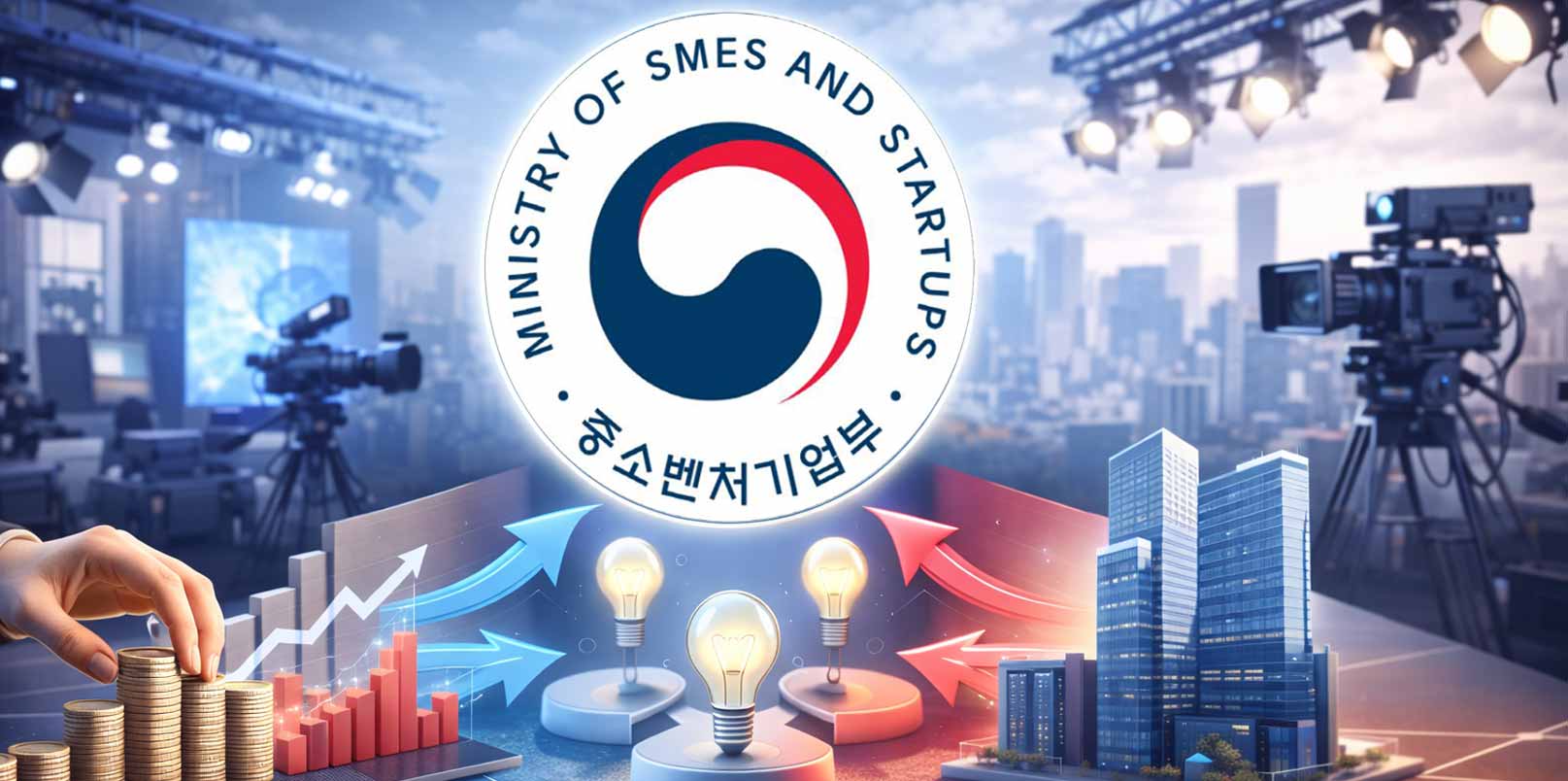
On February 12, the Ministry of SMEs and Startups (MSS) held a closed-door expert meeting at TIPS Town Seoul to advance the Korea Startup for All Project.
The project aims to identify around 5,000 prospective founders through open idea recruitment combined with an audition-style competitive process. Beyond selection, MSS plans to match participants with startup institutions nationwide, provide mentoring from experienced founders, offer AI solution support, and connect staged commercialization funding.
Senior founders from leading Korean unicorn and pre-unicorn companies—including Park Sung-hyun of Rebellions, Kang Seok-hoon of Ably Corporation, and Kwon Sung-taek of T-Order—participated in the meeting. Roughly 15 senior entrepreneurs joined discussions on how to build a cooperation framework between established founders and early-stage teams.
In the Startup for All Project (also known as Everyone’s Startup Project), the government will designate 100 “Startup Rookies”and create a dedicated KRW 50 billion investment fund focused on them. The final winner will be selected at the national startup festival COMEUP in December and receive KRW 500 million in prize money plus at least KRW 500 million in investment.
MSS Minister Han Seong-sook said,
“We will strengthen the substance of the project based on the candid opinions shared by senior founders.
MSS will also move with the agility of a startup and do its utmost so that senior and junior founders, investors, and support institutions can work as one team to open the National Startup Era.”
The project will also be produced as a television program in the second half of this year, turning the competition format into a publicly broadcast series.
Why Korea Is Linking Startup Policy, Media Production and Private Capital Now
The original framing of Startup for All focused on widening participation. The new layer adds something more structural: institutional alignment.
Three shifts are visible in the latest developments.
First, senior unicorn founders are not symbolic endorsers. They are being positioned as an organized mentorship layer inside a state-designed pipeline. This formalizes knowledge transfer rather than leaving it informal.
Second, the KRW 50 billion rookie-focused investment fund attaches capital directly to the program’s output. That reduces the gap between public selection and private funding.
Third, television production introduces mass visibility as a policy instrument. The government is not only funding entrepreneurs; it is attempting to reshape public perception of entrepreneurship as a national culture.
This convergence of mentorship, capital, and media creates a unified founder marketplace inside a policy framework. For an OECD economy with a strong incumbent corporate structure, that is an ambitious institutional design.
The Tension Between Visibility and Company-Building Capacity
The design is bold. But it also unveils predictable friction.
A televised national startup audition increases participation and lowers psychological barriers. It can also compress timelines that real companies rarely follow. Product validation, regulatory navigation, and enterprise sales cycles do not conform neatly to broadcast schedules.
There is also execution risk. The program connects 5,000 participants, more than 100 startup institutions, 500 professional mentors, and around 1,600 advisors. Consistency across regions will matter. But quality control will matter even more.
The program also provides baseline funding and structured support to all participants, and staged commercialization capital to advancing teams. Yet investment concentration increases sharply at the rookie tier, raising a practical question about how sustained opportunity will be maintained for the broader 5,000-person cohort once the competitive stages conclude.
None of these tensions invalidate the model. They have defined them instead.
What This Enables — and What It Still Does Not Solve
Startup for All enables a broad funnel. With KRW 2 million in startup activity funding per participant and structured mentoring support, first-time founders outside Seoul gain an entry point that previously required insider networks.
It also reduces early discovery costs for investors. Instead of sourcing blindly, private capital can observe curated cohorts that have passed through staged evaluation and institutional screening.
What it does not automatically solve is sustained company-building capacity. A one-year pathway can only accelerate exposure. It cannot replace long-term customer acquisition, cross-border market testing, or regulatory navigation.
Nor does media visibility guarantee product-market fit. If the platform becomes a signaling device rather than a capability engine, the underlying objective weakens.
The outcome depends less on the final spectacle and more on post-program integration.
What Korea’s Startup for All Means for Global Founders and Investors
Now, for global founders evaluating Korea, Startup for All sends a signal that Korea’s government is constructing a visible, structured pipeline that links mentoring, funding, and public recognition. Entry barriers are now being lowered at scale.
Meanwhile for international investors, this creates an organized deal flow channel tied to the Ministry of SMEs and Startups. If the fund deployment and mentorship quality hold, early-stage sourcing in Korea may become more centralized and predictable.
As for cross-border partners, the program’s scale signals political commitment. Entrepreneurship is being framed not as a niche policy but as a national growth strategy.
The global question is whether this alignment of policy, media, and capital produces companies that can compete outside Korea—or whether it mainly produces stronger domestic signaling.
Korea’s Startup Policy Is Becoming a Platform Experiment
In the end, Startup for All is no longer just an audition but an experiment in institutional choreography.
The state is attempting to synchronize founders, mentors, capital providers, and public attention inside one system. That is harder than announcing grants. It requires incentives to align across very different actors.
If it works, Korea may create a founder pipeline that is more visible and more structured than many peer economies. If it falters, it will not be because the funnel was too small, but because the middle was too fragile.
Key Takeaway on Korea Startup for All Project Development
- The Korea Startup for All Project now formally integrates senior unicorn founders, staged public competition, and a KRW 50 billion rookie-focused investment fund.
- The Ministry of SMEs and Startups is aligning mentorship, media production, and private capital under a single national pipeline.
- A televised format adds mass visibility, turning entrepreneurship into a public competition model.
- The core execution risk lies in regional consistency, post-program integration, and the sustainability of company-building beyond televised milestones.
- For global founders and investors, Korea is signaling that startup policy is moving from fragmented support tools to coordinated ecosystem design.
🤝 Looking to connect with verified Korean companies building globally?
Explore curated company profiles and request direct introductions through beSUCCESS Connect.
– Stay Ahead in Korea’s Startup Scene –
Get real-time insights, funding updates, and policy shifts shaping Korea’s innovation ecosystem.
➡️ Follow KoreaTechDesk on LinkedIn, X (Twitter), Threads, Bluesky, Telegram, Facebook, and WhatsApp Channel.


