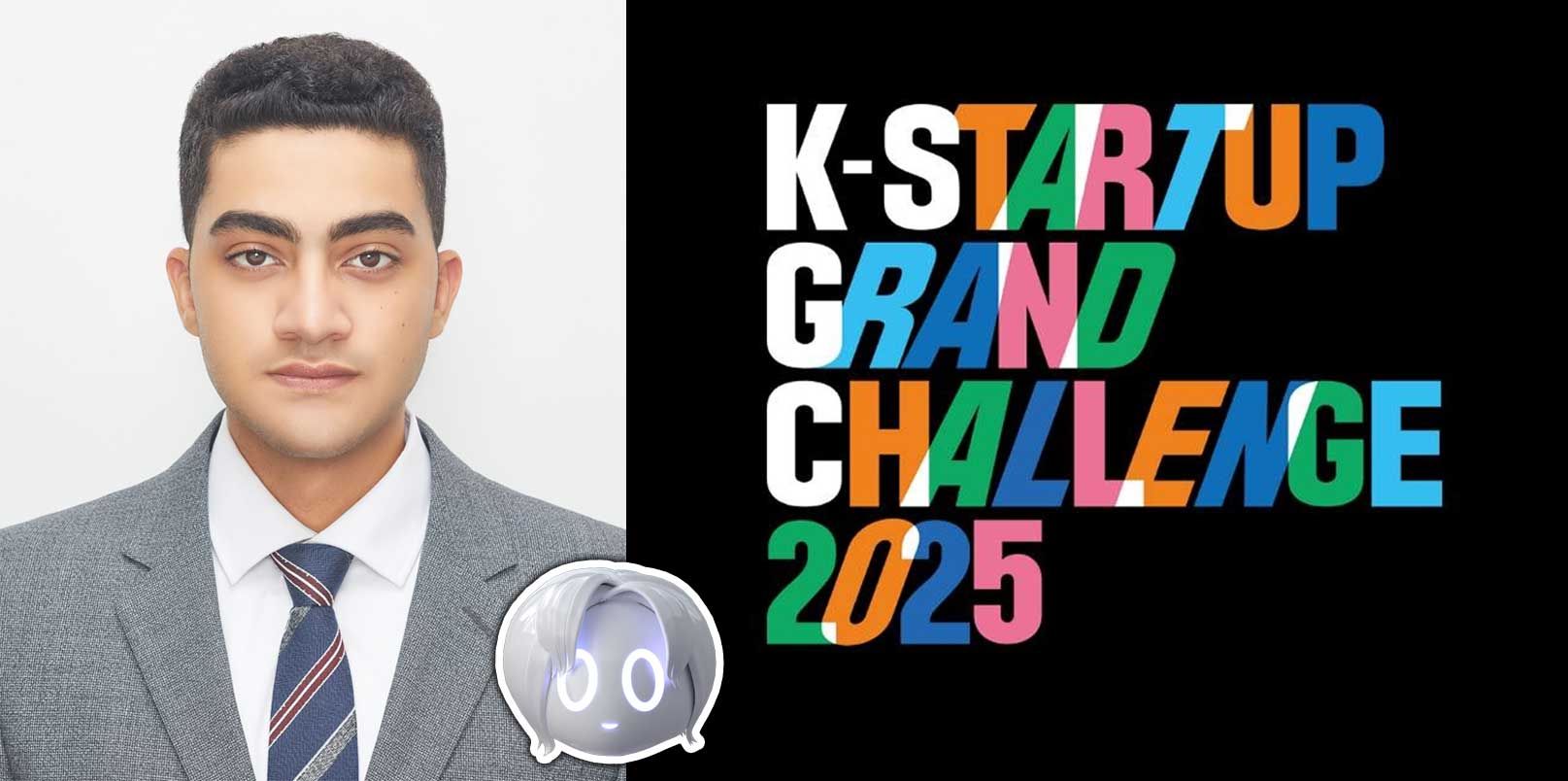
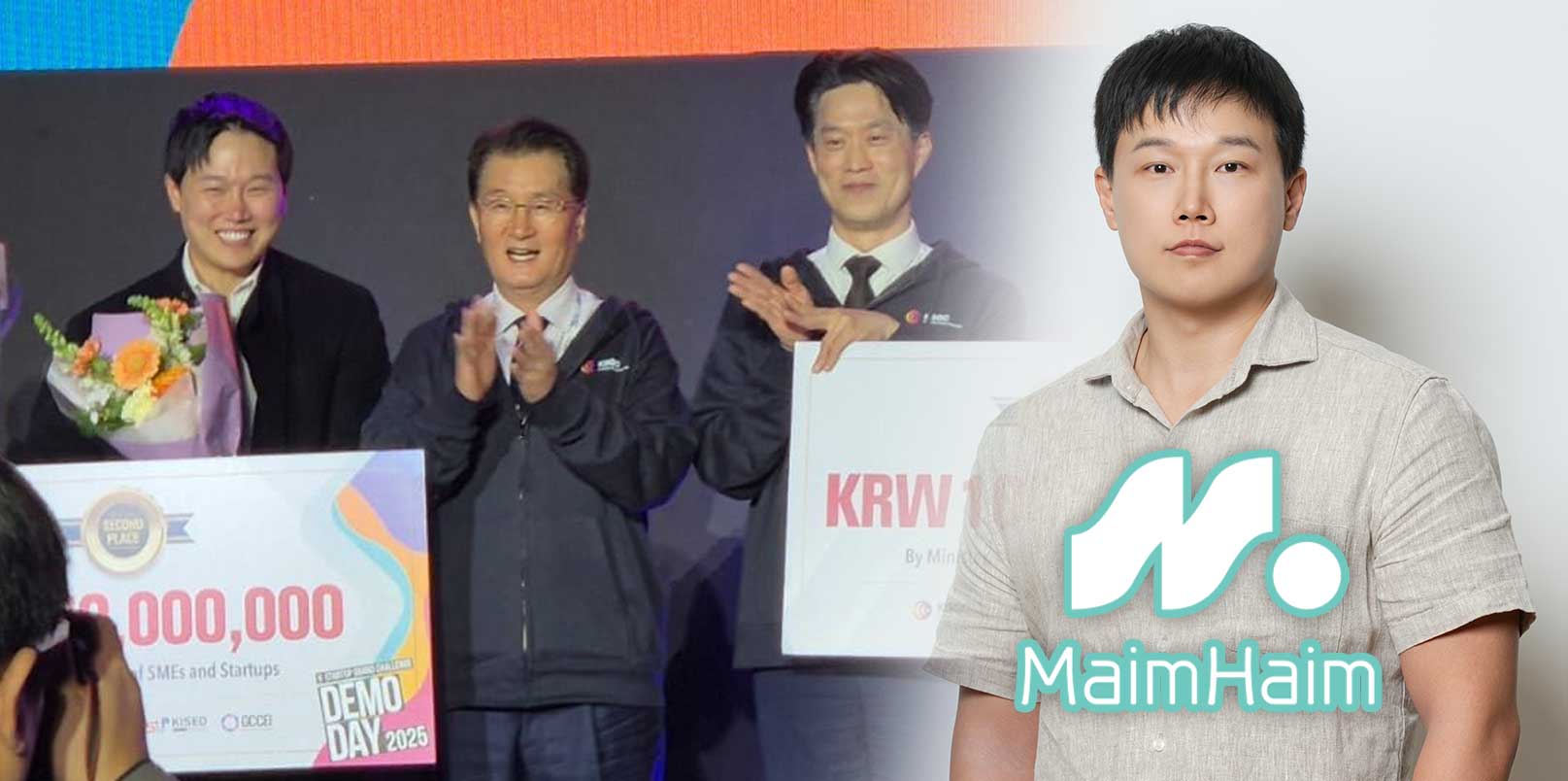
What if every check-in, payment, and ticket validation could happen automatically — without a single tap, card, or scan? Maim Haim Corp, founded by Andrew Chang, is making that vision real. With a background spanning Boston Consulting Group, energy and chemical ventures, and startup finance, Chang leads a company determined to transform Korea’s transport and service industries into fully automated ecosystems.
We spoke with the founder in an exclusive interview about Maim Haim’s growth, partnerships, and global ambition as it advances through K-Startup Grand Challenge (KSGC) 2025 Phase 2, and eventually awarded the Second Place at the KSGC Demo Day.
The Everyday Problem That Sparked a Movement at Maim Haim
Q1. What motivated you to start this company, and what core problem were you trying to solve?
Maim Haim was created based on a simple but essential goal: to create a hi-pass for everyday life.
When I first moved to Korea, I was struck by how much time people spent waiting: long lines at bus stops and subway stations, crowds queuing for events, festivals, school check-ins, or even a cup of coffee.
These daily inefficiencies were everywhere, and people had quietly adapted to them. In the United States alone, individuals waste an average of 30 to 40 minutes per day waiting for services — roughly 8 to 10 full days each year.
Hence, we founded Maim Haim to eliminate that lost time. Our goal is to automate check-in, check-out, and payment processes so that simply carrying your phone enables instant service access.
To achieve this, we developed a standardized solution built on three core technologies: IMU sensor fusion nodes, Zero-UI interaction, and digital tokenization. Together, they allow our system to automatically recognize user intent and seamlessly connect with operators, ensuring secure data exchange and effortless transactions.

Korea’s Perfect Testbed for Contactless Living
Q2. What opportunity or unmet need did you identify in the Korean market, and what early signals convinced you that your solution could gain real traction here?
Seoul is one of the most transit-dense cities in the world, with extremely high commuter volume and an advanced public transportation network.
At the same time, Korea’s smartphone penetration exceeds 98%, and over 70% of all payments are made digitally — creating ideal conditions for seamless, mobile-based infrastructure.
In 2022, the Ministry of Land, Infrastructure and Transport announced a national mandate to standardize tagless traffic systems, signaling a major shift toward contactless, automated mobility experiences.
This policy direction, combined with Korea’s strong digital adoption and commuter density, makes it the perfect environment for Maim Haim to expand our business model and demonstrate the value of our automated check-in, check-out, and payment technology across the mass transportation ecosystem.
Acceleration, Mentorship, and a Roadmap for Growth
Q3. During KSGC, were there any mentors, partners, or specific insights that significantly influenced your product or strategy?
Our accelerator, CNTTech, played a central role in shaping Maim Haim’s progress during KSGC. Under the guidance of Jayden, our main contact, we received consistent mentorship, valuable introductions, and hands-on support throughout the program. He helped us stay on track with KSGC’s fast-paced schedule, organized multiple IR pitch sessions, and provided detailed feedback that strengthened our investor presentations.
CNTTech also connected us with specialized consultants who helped us navigate Korean labor and tax regulations—areas that are often complex for foreign founders. Through HR sessions, we learned about employee contracts and case-specific labor law applications unique to Korea, while accounting specialists provided in-depth guidance on local tax compliance and financial reporting standards.
In addition, exposure to multiple IR seminars and networking events broadened our business perspective. These experiences helped us refine our roadmap and set the stage for the next phase of our business model, where we plan to expand into Korea’s mass transportation industry. We have strong confidence that CNTTech’s network will continue to support this next stage of growth.
Maim Haim at KSGC 2025: From Concept to Commercialization
Q4. After joining KSGC, what has been the most meaningful change for your company and what evidence supports this growth?
Since joining KSGC, Maim Haim has achieved major milestones across partnerships, product development, and funding.
We signed an MOU with Kyungwon Construction to develop a customized application for Namseoul Country Club, integrating automated reservation, check-in, check-out, and payment functions. Under this collaboration, Maim Haim is projected to earn a 0.5% commission on total sales, creating our first recurring revenue stream. This partnership will also serve as a model for expanding into other premium golf courses across Korea.
In the hospitality sector, we entered into an MOU with Tripbtoz, one of Korea’s leading online travel agencies. Together, we are co-developing the next-generation AI Travel Assistant and Hotel Service Solution, designed to enhance user experience through automation and real-time engagement. These two partnerships mark our initial commercialization phase and form the foundation for our transition into Stage 2, where we will apply our technology to Korea’s mass transportation industry.
Financially, Maim Haim also achieved a significant milestone by being selected for the TIPS grant in November, securing KRW 500 million (approximately USD 370,000) to advance our core technology development. This funding will be strategically used to strengthen our IMU sensor fusion, Zero-UI, and digital token technologies, preparing us for large-scale deployment in the transportation sector.
Maim Haim: Building a Future of Frictionless Mobility
Q5. Looking ahead, what is the most important vision or long-term goal your company aims to achieve, and what steps are you taking to move toward it?
Our long-term vision is to create a Mobility-as-a-Service (MaaS) solution that seamlessly connects people and services across industries and borders. We imagine a future where a traveler can arrive in Korea, move freely throughout the country, and depart—without ever needing to exchange currency or perform manual check-ins. Every entry, order, and payment will happen automatically through Maim Haim’s integrated MaaS platform.
This vision extends beyond transportation. Our solution is designed to unify experiences across airports, buses, subways, tourist attractions, hotels, retail, and even everyday purchases like a cup of coffee. By building a single, frictionless network powered by IMU sensor fusion, Zero-UI interaction, and digital tokens, we aim to redefine how people experience mobility and service access.
We chose to establish our company in Korea precisely because it offers the perfect testbed for developing and refining this technology—supported by world-class infrastructure, digital adoption, and government initiatives. With a strong foundation here, Maim Haim plans to scale globally, expanding first into Southeast Asia’s mass transportation sector and later into platforms such as Airbnb in the United States, ultimately evolving into a truly global MaaS ecosystem.
Through the K-Startup Grand Challenge 2025, Maim Haim Corp demonstrates how automation can turn waiting time into living time—creating a new paradigm of effortless mobility and redefining how people interact with services in Korea and beyond.
“Maim Haim plans to scale globally and KSGC’s mentoring program helped us refine our roadmap and set the stage for the next phase of our business model.”
About This Series
This article is part of the “K-Startup Grand Challenge 2025 Interview Series,” featuring 40 global startups from Phase 2 of Korea’s leading accelerator program. The series highlights how international founders are scaling innovation through Korea’s startup ecosystem.
Read more stories from the K-Startup Grand Challenge 2025 Interview Series on KoreaTechDesk.
– Stay Ahead in Korea’s Startup Scene –
Get real-time insights, funding updates, and policy shifts shaping Korea’s innovation ecosystem.
➡️ Follow KoreaTechDesk on LinkedIn, X (Twitter), Threads, Bluesky, Telegram, Facebook, and WhatsApp Channel.
🤝 Looking to connect with verified Korean companies building globally?
Explore curated company profiles and request direct introductions through beSUCCESS Connect.