South Korea’s startup capital market is entering a phase of stricter evaluation. The voluntary withdrawal of Seoul Robotics’ KOSDAQ listing review has become a key case illustrating how Korea’s exchange regulators now emphasize sustainable revenue and fiscal discipline over technological promise. The decision reflects an evolving market standard that may reshape how AI and deeptech ventures approach public listing in 2026.
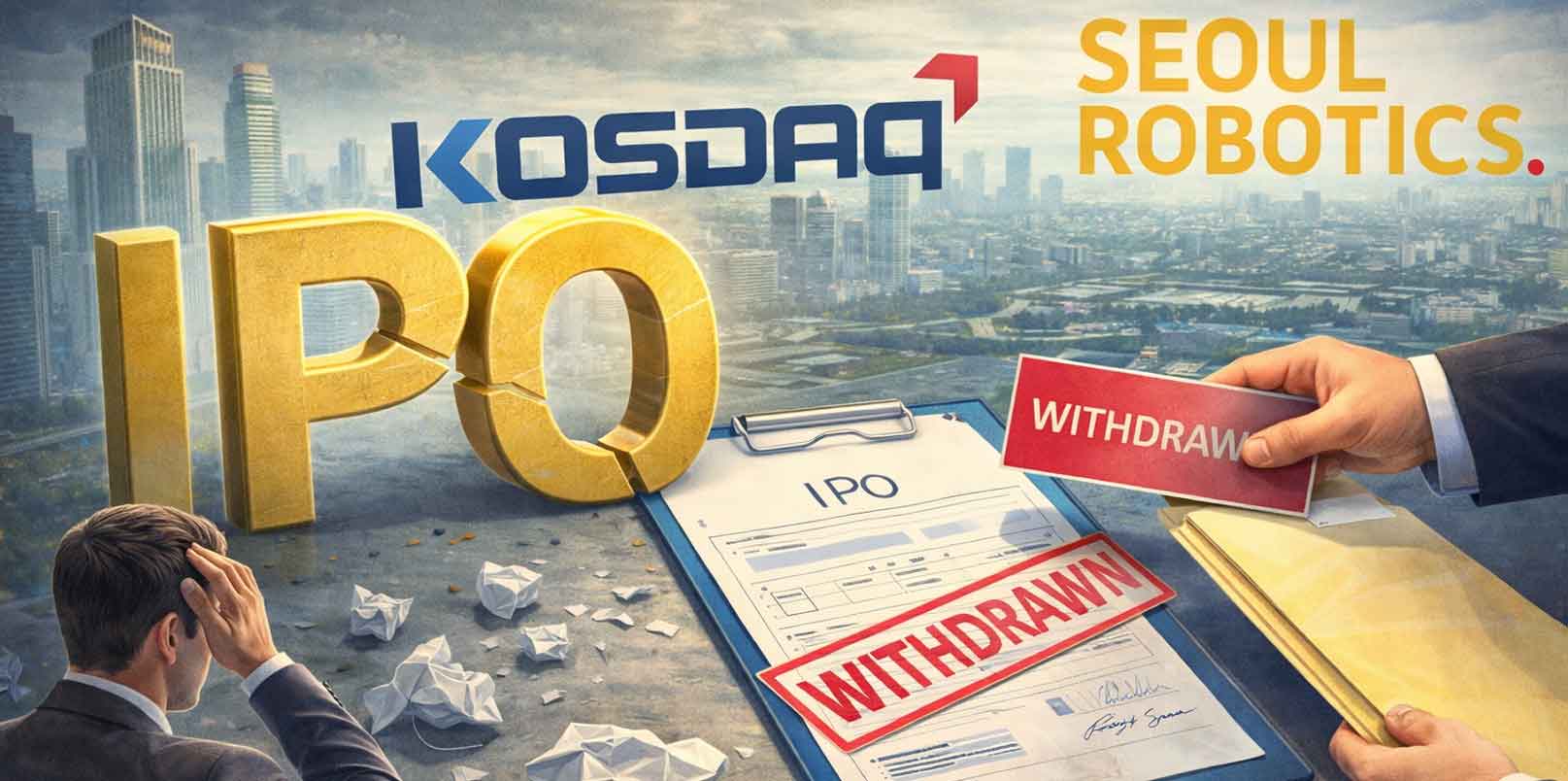
Seoul Robotics Voluntarily Withdraws KOSDAQ IPO Review
AI-based autonomous driving startup Seoul Robotics announced on January 2 that it has voluntarily withdrawn its KOSDAQ preliminary review application, roughly five months after filing in July 2025.
A company representative stated that the move was intended to enhance shareholder value, citing the need to prevent undervaluation of existing shares and present a reasonable valuation for new investors.
The company said,
“Our goal is to maintain a solid and stable share performance after listing, which we believe is the true path to long-term shareholder value.”
The decision followed feedback from the Korea Exchange (KRX) indicating that approval under the technology exception listing route would be difficult, largely due to the company’s limited revenue base despite its recognized technological competitiveness.
Korea Exchange Tightens Oversight on Tech Exception Listings
Seoul Robotics had applied for listing under Korea’s Technology Exception Track, which allows companies with strong technology but limited profits to go public based on certified technical evaluations.
While KRX reportedly acknowledged the company’s independent algorithmic capability and robust AI performance under harsh conditions, the Exchange raised concerns about insufficient revenue and ongoing losses.
In 2024, the company recorded KRW 4.2 billion (approximately USD 3.2 million) in sales and KRW 11.8 billion (approximately USD 9 million) in operating loss.
Following several high-profile post-listing failures among early-stage tech firms, regulators have begun unofficially enforcing a “10 billion KRW annual revenue” benchmark for non-biotech companies seeking exception-based listings. This shift indicates growing investor protection priorities within the Korean capital market.
Inside Seoul Robotics’ Autonomous Driving Model
Founded in 2017, Seoul Robotics develops infrastructure-based autonomous driving software that transforms conventional vehicles into self-driving systems. The technology relies on LiDAR and camera sensors installed externally—on poles or ceilings—rather than within vehicles, enabling unmanned fleet transport between manufacturing plants and ports.
Since commercializing its service in 2019, the company has reportedly achieved zero accidents, with proven stability in multi-vehicle fleet operations under extreme weather.
The firm has already secured major logistics automation projects, including contracts with Nissan Group factories, and continues negotiations with global automotive OEMs.
With successful Series B and bridge rounds in 2024–2025 totaling KRW 30.8 billion (USD 23 million), Seoul Robotics has secured over two years of operational runway, enabling execution without short-term external funding pressure.
The KOSDAQ IPO Withdrawal of Seoul Robotics: What They Say
The company framed its decision as a strategic pause rather than a setback. A spokesperson from Seoul Robotics stated,
“It is crucial to present a fair valuation for incoming investors while safeguarding the equity of early shareholders. This decision positions us to pursue a more stable and mature IPO in the near future.”
Investment banking sources quoted by Korean financial media confirmed that the Exchange’s stance has hardened since the Fadu case, with regulators placing greater weight on business continuity and revenue trajectory than on pure technical evaluations.
One industry observer noted,
“The stricter approach may help restore confidence in Korea’s capital markets, but it also risks limiting access for early-stage deeptech innovators who need capital to scale.”
From Growth to Governance
Seoul Robotics’ decision underscores a broader realignment within Korea’s startup ecosystem. As government-backed programs continue to fund AI and deeptech innovation, capital market regulators are signaling that public listing now demands operational maturity and fiscal resilience.
This trend mirrors shifts seen in the United States and Japan, where exchanges are tightening disclosure and profitability requirements for high-tech IPOs. Hence, Korea’s market climate is shifting. Investors and regulators are now paying closer attention to how startups earn, operate, and sustain themselves. Growth stories alone no longer convince; companies must prove their fundamentals before stepping onto the public stage.
If Seoul Robotics succeeds in reapplying after achieving higher revenue stability, it could become a benchmark for how deeptech startups navigate Korea’s evolving listing framework, balancing innovation with investor confidence.
While the Korea Exchange’s stricter oversight aims to protect investors and strengthen market discipline, some analysts caution that the new approach may carry trade-offs. If early-stage deeptech ventures with proven technological value face barriers to listing due to limited near-term revenue, Korea could risk slowing its innovation cycle just as global competitors accelerate their own AI and automation breakthroughs.
Industry observers note that a more balanced framework — one that evaluates both technological maturity and fiscal readiness — may be needed to sustain Korea’s long-term competitiveness in strategic fields like autonomous systems, robotics, and AI-driven manufacturing.
A Turning Point Toward Disciplined, Credibility-Driven Capital Market
Beyond what seemed to be just another corporate decision, the Seoul Robotics KOSDAQ IPO delay has actually captured a turning point in Korea’s path toward a disciplined, credibility-driven capital market for technology ventures.
As AI and autonomous technologies take a central role in shaping Korea’s industrial direction, the spotlight is shifting to how companies sustain growth responsibly. The coming years will test how well innovators, investors, and policymakers align progress with long-term stability, signaling Korea’s move from a startup-driven momentum to a scale-up era grounded in governance and trust.
🤝 Looking to connect with verified Korean companies building globally?
Explore curated company profiles and request direct introductions through beSUCCESS Connect.
– Stay Ahead in Korea’s Startup Scene –
Get real-time insights, funding updates, and policy shifts shaping Korea’s innovation ecosystem.
➡️ Follow KoreaTechDesk on LinkedIn, X (Twitter), Threads, Bluesky, Telegram, Facebook, and WhatsApp Channel.