Korea’s 2026 budget reveals a deliberate recalibration of its startup strategy: cutting back on scale but doubling down on depth. Despite trimming its Fund of Funds allocation by nearly one-third from the government’s proposal, the country is injecting a record amount into R&D and deep-tech ventures, signaling a sharper focus on innovation infrastructure rather than speed of capital deployment.
Korea Finalizes 2026 MSS Budget at KRW 16.5 Trillion
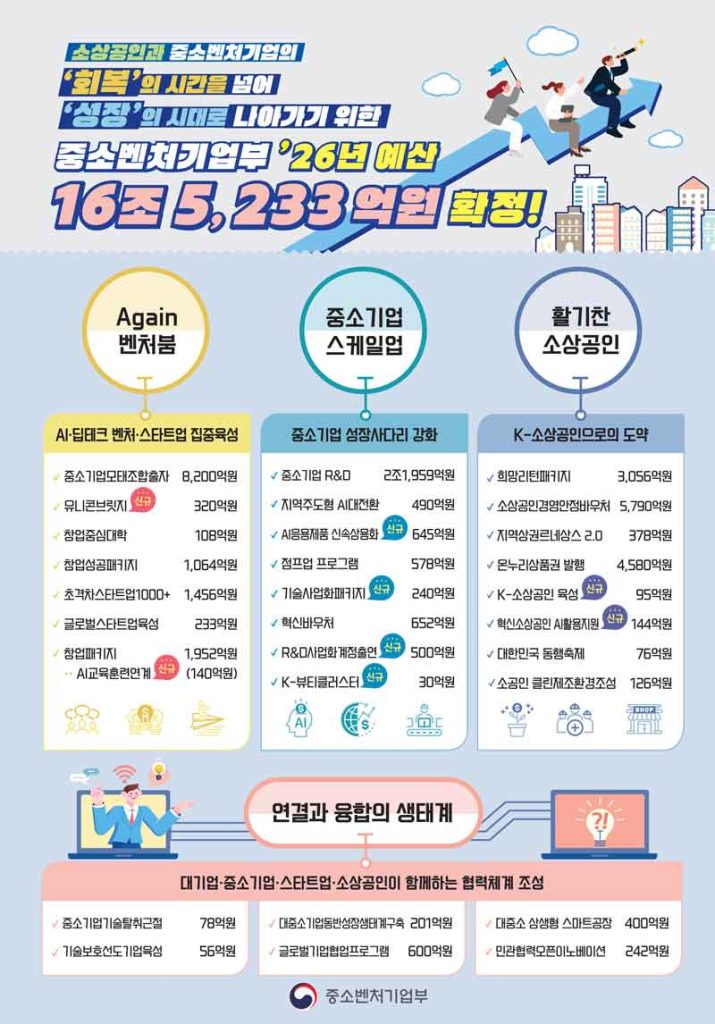
The Ministry of SMEs and Startups (MSS) confirmed its 2026 total expenditure at KRW 16.5233 trillion (USD 12.4 billion), an 8.4% increase from 2025. While the amount is KRW 320 billion (USD 240 million) below the initial government proposal, it still marks a major step up from last year’s baseline.
The Fund of Funds (Mother Fund) was cut from the originally proposed KRW 1.1 trillion to KRW 820 billion, a reduction of roughly 27%, but remains KRW 320 billion higher than 2025. The ministry emphasized that the fund would remain the central tool for fueling the NEXT UNICORN Project, regional and recovery markets, and re-challenge funds designed to accelerate Korea’s “Third Venture Boom.”
The SME R&D budget reached a historic high of KRW 2.1959 trillion (USD 1.65 billion) — a 45% jump from 2025 — marking the strongest government commitment yet to tech-led SME innovation.
Deep-Tech, AI, and Bio Lead Korea’s Next Wave of Venture Growth
The 2026 budget outlines a clear pivot toward deep-tech and AI ecosystems.
The government will prioritize long-term R&D investment in AI, biotechnology, semiconductors, and advanced manufacturing, areas viewed as essential to Korea’s industrial transformation.
The NEXT UNICORN Project will focus on high-growth startups capable of raising more than KRW 10 billion each. The “Unicorn Bridge Program,” newly funded at KRW 32 billion, will support about 50 tech startups through commercialization, technical advancement, and overseas expansion. Meanwhile, the “Super-Gap Startup 1000+” initiative will invest KRW 145.6 billion, expanding support for deep-tech ventures in emerging sectors.
Combined, these programs aim to create a more sustained pipeline for Korean startups moving from domestic scale-up to global competitiveness.
R&D, Smart Factories, and SME Innovation Scale-Up
The R&D increase of nearly KRW 700 billion will support the scaling of SMEs through strategic research funding aligned with market needs — what the ministry called “profitable R&D.”
To foster manufacturing innovation, the smart factory budget was expanded to KRW 402.1 billion (USD 300 million), up KRW 166 billion, supporting AI-integrated and data-driven factories across key industrial clusters. The AI regional transformation initiative received KRW 49 billion (USD 36 million) to help local economies integrate AI into their industrial bases.
The Jump-Up Program, helping SMEs evolve into mid-sized global companies, nearly doubled its funding to KRW 57.8 billion. Complementing this, the Innovation Voucher Program was increased to KRW 65.2 billion to assist SMEs with R&D commercialization and digital transformation.
Small Business and Local Economy: Recovery and Reinvention
The ministry also reinforced its commitment to small business recovery.
The Hope Return Package increased by KRW 60.6 billion to KRW 305.6 billion, expanding support for business closure and restart programs, with store demolition support raised to KRW 6 million per business.
The Onnuri Gift Certificate Program grew to KRW 458 billion, while local market revitalization received KRW 37.8 billion, up more than 700%, to strengthen regional commerce and local employment.
The Entrepreneurial Merchant Program rose to KRW 131.1 billion, encouraging small entrepreneurs to transition toward sustainable business models.
Minister Han Seong-sook on Fund of Funds Budget: “Focused Execution for Innovation and Recovery”
Minister Han Seong-sook emphasized that the 2026 budget represents a strategic balance between innovation acceleration and fiscal discipline, stating:
“We will ensure that policies for rapid recovery and innovation growth among small businesses, startups, and ventures are implemented in a timely and cohesive manner. Every program will be executed swiftly and without disruption.”
Her remarks reflected the administration’s effort to convert fiscal increases into measurable outcomes for Korea’s SME and venture sectors.
Fund of Funds Budget: A Shift from Quantity to Quality in Korea’s Venture Agenda
Korea’s new budget marks a philosophical shift in venture policy. Rather than maximizing the number of startups funded, the government is channeling larger, more strategic investments into deep-tech scalability and commercialization pathways.
The 27% cut in the Fund of Funds signals fiscal prudence amid national budget constraints, but the overall increase still positions Korea among the top global venture investors by public R&D intensity.
What matters next is execution. The success of the NEXT UNICORN and Unicorn Bridge initiatives will hinge on how efficiently capital reaches frontier sectors and whether the private market follows the government’s lead in sustaining the “Third Venture Boom.”
Korea’s Next Test — Converting Capital Into Competitiveness
Finally, the 2026 Fund of Funds budget reaffirms Korea’s ambition to build an innovation economy resilient to global volatility. Yet it also underscores a deeper reality: capital deployment alone does not guarantee competitiveness.
Korea’s next challenge lies in translating this record funding into measurable scale-ups, fostering cross-border collaborations, and attracting global venture confidence through stable policy continuity.
If the execution matches intent, this recalibrated budget could mark the true beginning of Korea’s Third Venture Boom — one driven not by volume, but by value, depth, and global credibility.
– Stay Ahead in Korea’s Startup Scene –
Get real-time insights, funding updates, and policy shifts shaping Korea’s innovation ecosystem.
➡️ Follow KoreaTechDesk on LinkedIn, X (Twitter), Threads, Bluesky, Telegram, Facebook, and WhatsApp Channel.