The cosmetics industry rarely appears in conversations about industrial policy. Yet in South Korea, beauty products have quietly become one of the most effective export vehicles for small and medium-sized enterprises. Record shipments in 2025 suggest that K-Beauty is no longer just a cultural phenomenon tied to trends or influencers. It is evolving into a structured export system built on manufacturing speed, flexible supply chains, and increasingly, data-driven production.
Korean Cosmetics Exports Reach Record Levels as K-Beauty Expands Beyond China
South Korea’s cosmetics exports reached a historic milestone in 2025, highlighting the growing global footprint of K-Beauty companies.
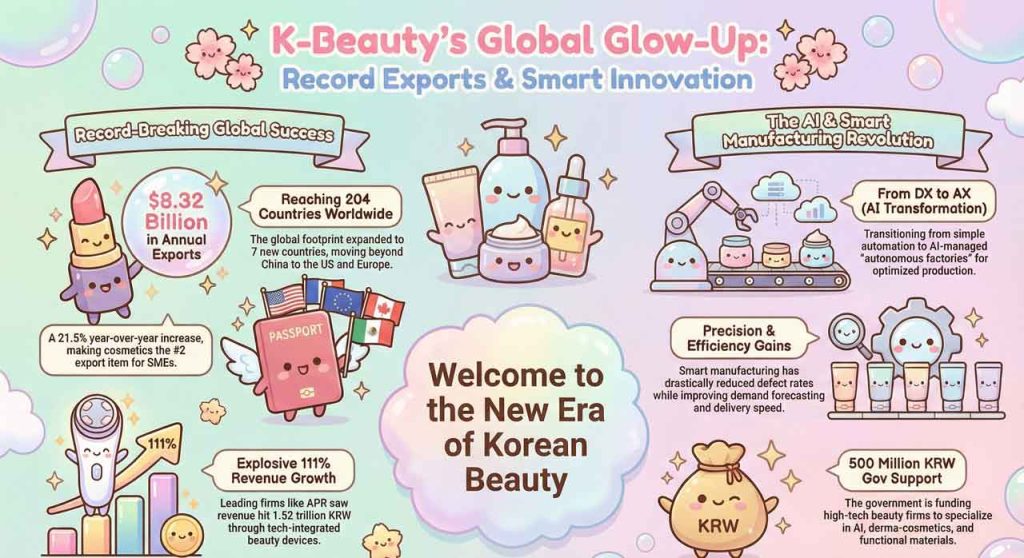
According to the Ministry of SMEs and Startups (MSS), cosmetics exports rose 21.5 percent year-on-year, reaching USD 8.32 billion (approximately KRW 12.02 trillion). The category ranked as the second-largest export item among Korean SME products.
The expansion was not limited to volume. Export destinations also widened. Korean cosmetics were shipped to 204 countries, an increase of seven markets compared with the previous year, reflecting continued geographic diversification.
At the same time, corporate performance has mirrored the export momentum as well.
Beauty and device company APR (에이피알) reported KRW 1.5273 trillion in revenue in 2025, more than doubling from the previous year, while operating profit rose to KRW 365.4 billion. Industry observers attribute the surge to a hybrid product strategy combining cosmetics with beauty devices, which has found strong demand among overseas consumers.
Premium skincare brand d’Alba Global also expanded its international presence, particularly across the United States, Japan, and Europe. Market analysts point to fast product release cycles and social media-driven marketing as key factors supporting its growth.
Together with companies such as Goodai Global and Able C&C, these firms are reinforcing K-Beauty’s position as a major export sector within Korea’s SME economy.
Global Expansion Signals a Structural Shift in Korea’s SME Export Model
What matters more than the headline export figures is the structural shift behind them.
For years, the K-Beauty industry relied heavily on China, both as a consumer market and as a tourism-driven retail channel. That concentration exposed Korean brands to geopolitical tensions, regulatory friction, and sudden demand swings.
Recent export data suggests that the industry is finally breaking away from that dependence.
Growth is increasingly tied to markets such as the United States, Europe, and the Middle East, where Korean brands are building direct distribution channels through online platforms and local partnerships. This shift reduces geographic concentration risk while forcing companies to compete on product differentiation rather than regional popularity.
At the same time, K-Beauty’s operational model is proving unusually well suited to global trend cycles. The sector’s ability to translate viral ingredients, skincare routines, and aesthetic preferences into market-ready products within months has created a feedback loop between consumer demand and manufacturing capacity.
The result is an export engine that behaves more like a responsive technology supply chain than a traditional cosmetics industry.
The Hidden Constraint: Fast Innovation Demands Manufacturing Precision
The speed that defines K-Beauty also creates pressure beneath the surface.
Rapid product launches require manufacturers capable of producing small batches across a wide range of formulations, often with limited lead time. This flexibility has historically been supported by Korea’s ODM (Original Development Manufacturing) ecosystem, where specialized manufacturers handle formulation, development, and production for multiple brands.
The ODM system has allowed Korean startups and indie brands to scale without building their own factories. It has also enabled global brands to experiment with Korean formulations.
Yet the model faces increasing strain.
Demand is shifting toward functional cosmetics, personalized skincare, and clinically validated formulations, all of which require higher precision manufacturing and stricter quality control. As regulatory scrutiny intensifies across Western markets, maintaining product consistency and traceability is becoming just as important as launching quickly.
That tension is beginning to reshape how Korean beauty manufacturers operate.
Smart Factories and AI Manufacturing Offer Scale — But Not Instant Advantage
To address these constraints, the Korean government is pushing the beauty industry toward smart manufacturing and AI-driven production systems.
Under the government’s Smart Manufacturing Innovation Policy, MSS is promoting an AX (AI Transformation) framework that builds on existing smart factory infrastructure. The objective is to move beyond basic automation toward autonomous production environments that collect and analyze manufacturing data in real time.
In practice, smart factory adoption allows cosmetics manufacturers to improve demand forecasting, inventory management, and process automation, while reducing defect rates and production variability.
For global buyers, these improvements translate into something simple but critical: predictable quality and reliable delivery schedules.
Government support programs are expanding alongside the technology push. MSS is helping beauty companies build smart factories and is broadening industry assistance beyond traditional cosmetics to include beauty devices and dermocosmetics. Selected companies can receive up to KRW 500 million over two years to strengthen competitiveness.
Still, technology alone will not guarantee success. Smart manufacturing improves operational capacity, but brand differentiation, ingredient innovation, and global marketing remain decisive in the beauty industry.
Why Global Investors and Brands Are Watching Korea’s Beauty Supply Chain
For international stakeholders, the K-Beauty story is increasingly less about skincare trends and more about industrial capability.
Korea’s beauty ecosystem offers three advantages that are difficult to replicate simultaneously.
First, the ODM manufacturing network allows rapid experimentation at relatively low cost. Second, Korean brands operate within a digital marketing environment that can detect emerging consumer trends almost instantly. Third, the growing adoption of smart factories and AI production systems is pushing the sector toward higher manufacturing reliability.
Together, these elements form a vertically integrated system where trend discovery, product development, and production operate in tight feedback loops.
That model is attracting attention from global retailers, international beauty brands seeking manufacturing partners, and investors looking for scalable consumer product platforms.
Strategic Closing: K-Beauty Is Becoming Manufacturing Infrastructure
K-Beauty’s success is often framed as a triumph of branding or cultural influence. Those factors matter, but they only explain part of the story.
The deeper shift is industrial.
What began as a wave of skincare trends is gradually turning into a specialized manufacturing ecosystem capable of translating consumer signals into export products at unusual speed. As Korean manufacturers layer AI systems onto that foundation, the sector begins to resemble a flexible production network rather than a simple cosmetics industry.
That transformation may ultimately matter more than any single viral product.
Key Takeaway
- South Korea’s cosmetics exports reached USD 8.32 billion in 2025, rising 21.5% year-on-year and becoming a major SME export category.
- K-Beauty companies are expanding beyond China into the United States, Europe, and the Middle East, reducing geographic concentration risk.
- Korea’s ODM manufacturing ecosystem enables rapid product development and flexible small-batch production.
- The government is promoting smart factories and AI transformation (AX) to strengthen manufacturing precision and global competitiveness.
- Export success increasingly depends on the intersection of trend responsiveness, manufacturing capability, and supply chain reliability.
🤝 Looking to connect with verified Korean companies building globally?
Explore curated company profiles and request direct introductions through beSUCCESS Connect.
– Stay Ahead in Korea’s Startup Scene –
Get real-time insights, funding updates, and policy shifts shaping Korea’s innovation ecosystem.
➡️ Follow KoreaTechDesk on LinkedIn, X (Twitter), Threads, Bluesky, Telegram, Facebook, and WhatsApp Channel.