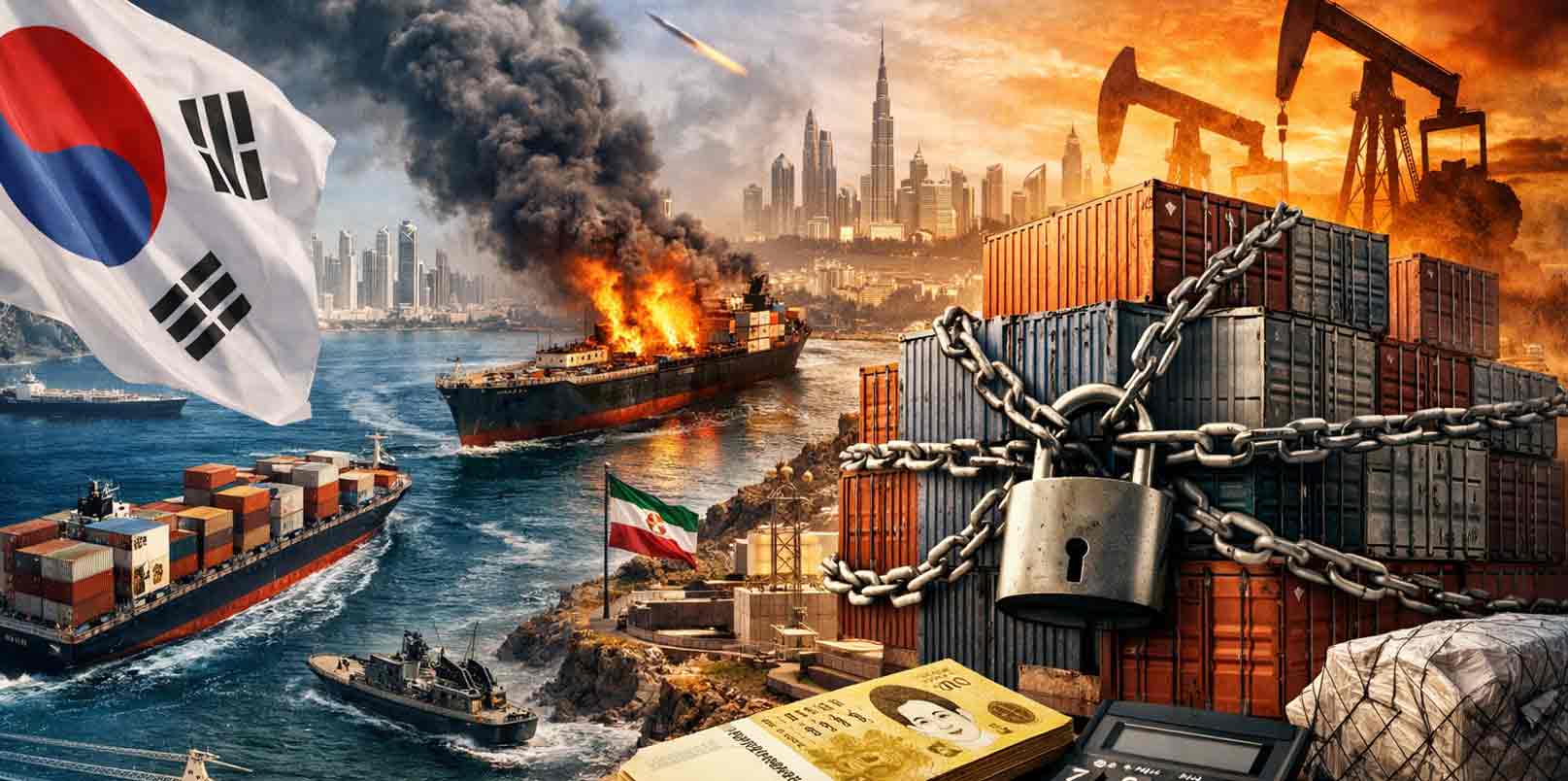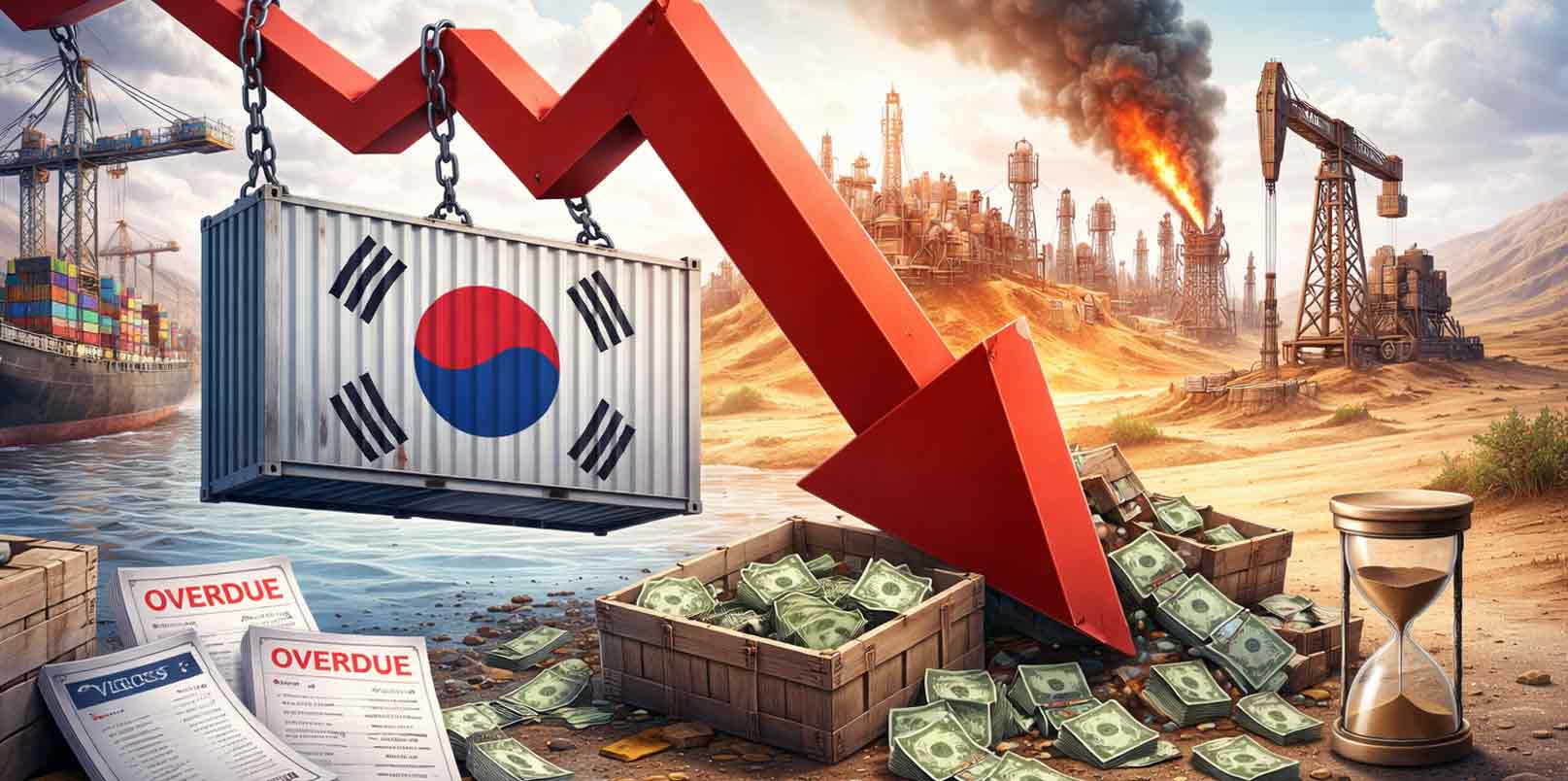
South Korea’s expanding footprint in the Middle East is entering a new phase of risk. Recent government monitoring shows that the pressure facing exporters may extend beyond disrupted shipping routes. Payment delays, contract uncertainty, and rising energy costs are now emerging as operational threats for Korean SMEs and startups operating across the region, prompting the Ministry of SMEs and Startups to activate an emergency coordination response.
Korea Moves to Monitor SME Damage as Middle East Risks Escalate
South Korea’s startup and SME ecosystem is facing a new phase of geopolitical exposure in the Middle East. What initially appeared as a logistics disruption now carries deeper financial implications.
The Ministry of SMEs and Startups (MSS) convened an emergency task force meeting on March 3 to assess damage affecting Korean small and medium-sized enterprises exporting to the region. Officials warned that rising logistics costs are only part of the problem.
Export disruptions, delayed payments, and contract cancellations are emerging as potential cashflow risks for thousands of Korean companies active in Middle Eastern markets.
Emergency Meeting Signals Government Monitoring of SME Trade Exposure
The March 3 meeting, titled “Inspection of Responses to SME Damage and Business Difficulties Related to the Middle East Situation,” gathered major SME support institutions and industry groups.
Participants included:
- Korea SMEs and Startups Agency (KOSME)
- Korea Technology Finance Corporation (KIBO)
- Korea Federation of SMEs (KBIZ)
Officials reviewed risks facing Korean exporters as regional instability intensified following military developments involving Iran. And the concerns raised during the meeting included:
- disruptions to import and export transactions
- logistics delays and rising freight costs
- unpaid export receivables
- suspended or cancelled contracts
- operational challenges facing Korean startups with regional operations
Authorities also examined potential exposure affecting Korean startups and SMEs that have established local offices or market operations in Middle Eastern countries.
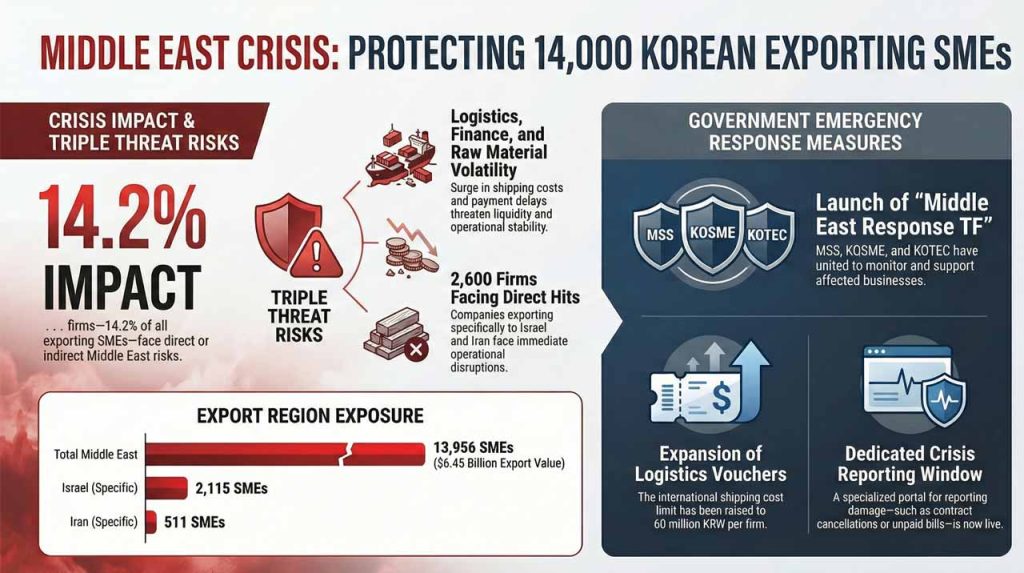
To accelerate damage reporting, MSS opened a “Middle East Situation Damage and Difficulty Reporting” portal through the national Export Support Center system. An emergency contact network linking regional export support centers and SME associations has also been activated.
The ministry indicated that support measures will vary depending on the type of damage reported.
Possible assistance includes responses to rising logistics costs, contract cancellations, and unpaid receivables. Additional support programs may be prepared if instability continues.
Rising Oil Prices and Supply Chain Disruption Amplify SME Pressure
Government monitoring reflects growing concern that the conflict could create cascading economic pressure beyond trade logistics. Industry groups warn that rising oil prices could translate into higher costs for petrochemical feedstocks, shipping, and insurance.
Several sectors already sensitive to oil price movements are closely watching developments. Paint manufacturers, construction materials producers, paper companies, cosmetics firms, and agricultural machinery exporters all rely on global logistics networks or petrochemical inputs.
Executives cited in industry coverage say short-term impact may be cushioned by existing inventories. However, sustained energy price increases could eventually force companies to raise product prices or absorb margin losses.
This uncertainty also affects maritime transport. Exporters are watching shipping routes through the Middle East, including the Strait of Hormuz, a corridor linked to a significant portion of global energy transport. Any disruption could increase shipping times and freight costs for Korean exporters serving Middle Eastern markets.
Government Response Focuses on Liquidity Monitoring and Logistics Support
MSS emphasized the need for rapid identification of SME damage to prevent operational stress among exporters. According to government data, 13,956 Korean SMEs exported to the Middle East last year, representing 14.2 percent of all Korean exporting SMEs.
Middle East exports by Korean SMEs totaled $6.45 billion, accounting for 5.4 percent of total SME exports. Roughly 2,600 SMEs export directly to Israel or Iran, placing them closest to the immediate impact zone.
In response, the government has increased logistics support available through Korea’s export voucher program, raising the cap for international shipping assistance from 30 million KRW to 60 million KRW.
Authorities are also discussing alternative logistics options with freight companies to reduce supply chain disruption. At the same time, officials are monitoring companies facing liquidity stress caused by delayed payments or interrupted contracts.
Government Emphasizes Field Monitoring Through Export Support Centers
First Vice Minister Noh Yong-seok highlighted the need for rapid monitoring and support mechanisms during the March 3 meeting. He stated,
“Uncertainty in the Middle East region is increasing due to the situation between Israel and Iran. It is therefore important to quickly identify the damage and operational difficulties faced by export-oriented SMEs and establish a support system to prepare for potential deterioration in their business conditions.
Through Export Support Centers located in the field, we will continuously monitor the situation of SMEs and swiftly provide support measures to companies experiencing damage or operational difficulties.”
The ministry also instructed participating institutions to maintain close coordination and information sharing to minimize damage across the SME sector.
Why This Matters for Korea’s Startup Ecosystem
The government response reflects a structural reality within Korea’s export-driven startup economy. Many Korean startups and SMEs expanded into the Middle East in recent years as part of broader global expansion strategies. The region offered large infrastructure spending programs and growing demand for technology products, industrial equipment, and consumer goods.
That expansion created meaningful exposure.
Official data shows nearly 14,000 exporting SMEs are now connected to Middle Eastern trade. A disruption affecting payment cycles, logistics, or commodity costs can ripple across the ecosystem.
And so the immediate concern is liquidity.
Export delays often translate into delayed receivables. For smaller firms operating with limited working capital, even short interruptions can create financing stress.
Investors and global partners watching Korea’s startup ecosystem may see the situation as a test of the country’s policy infrastructure. Rapid monitoring systems, export support programs, and financial stabilization tools play a key role in protecting smaller exporters during geopolitical shocks.
The response also highlights how global startup ecosystems increasingly intersect with geopolitical supply chains. Korean startups building hardware, industrial technologies, and manufacturing products remain tightly linked to global trade routes. Instability affecting energy prices or shipping corridors can influence growth trajectories far beyond the immediate conflict zone.
Monitoring Exposure as the Conflict Evolves
For now, Korean authorities are focused on identifying damage quickly rather than announcing large-scale intervention programs. Export Support Centers have become the frontline monitoring system for SMEs experiencing operational stress linked to the Middle East.
If instability persists, additional measures may emerge targeting logistics costs, financing gaps, and export contract disruptions. The scale of exposure suggests that monitoring alone will not be sufficient if supply chain disruption spreads further across the region.
For Korea’s startup ecosystem, the situation illustrates a broader lesson. Global market expansion often creates geopolitical exposure alongside growth opportunities. Managing that risk has now become part of the operational reality for export-driven startups.
Key Takeaways
- MSS launched an emergency task force to monitor SME damage linked to Middle East instability.
- 13,956 Korean SMEs export to the Middle East, representing 14.2 percent of exporting SMEs.
- SME exports to the region reached $6.45 billion, accounting for 5.4 percent of SME exports.
- Key risks include unpaid receivables, cancelled contracts, logistics delays, and rising shipping costs.
- The government raised international shipping support under export vouchers to 60 million KRW.
- An Export Support Center reporting portal has been activated to identify SME damage quickly.
- Roughly 2,600 SMEs exporting directly to Israel or Iran face the most immediate exposure.
- Rising oil prices and shipping disruptions could pressure costs across sectors including manufacturing, cosmetics, construction materials, and machinery.
🤝 Looking to connect with verified Korean companies building globally?
Explore curated company profiles and request direct introductions through beSUCCESS Connect.
– Stay Ahead in Korea’s Startup Scene –
Get real-time insights, funding updates, and policy shifts shaping Korea’s innovation ecosystem.
➡️ Follow KoreaTechDesk on LinkedIn, X (Twitter), Threads, Bluesky, Telegram, Facebook, and WhatsApp Channel.