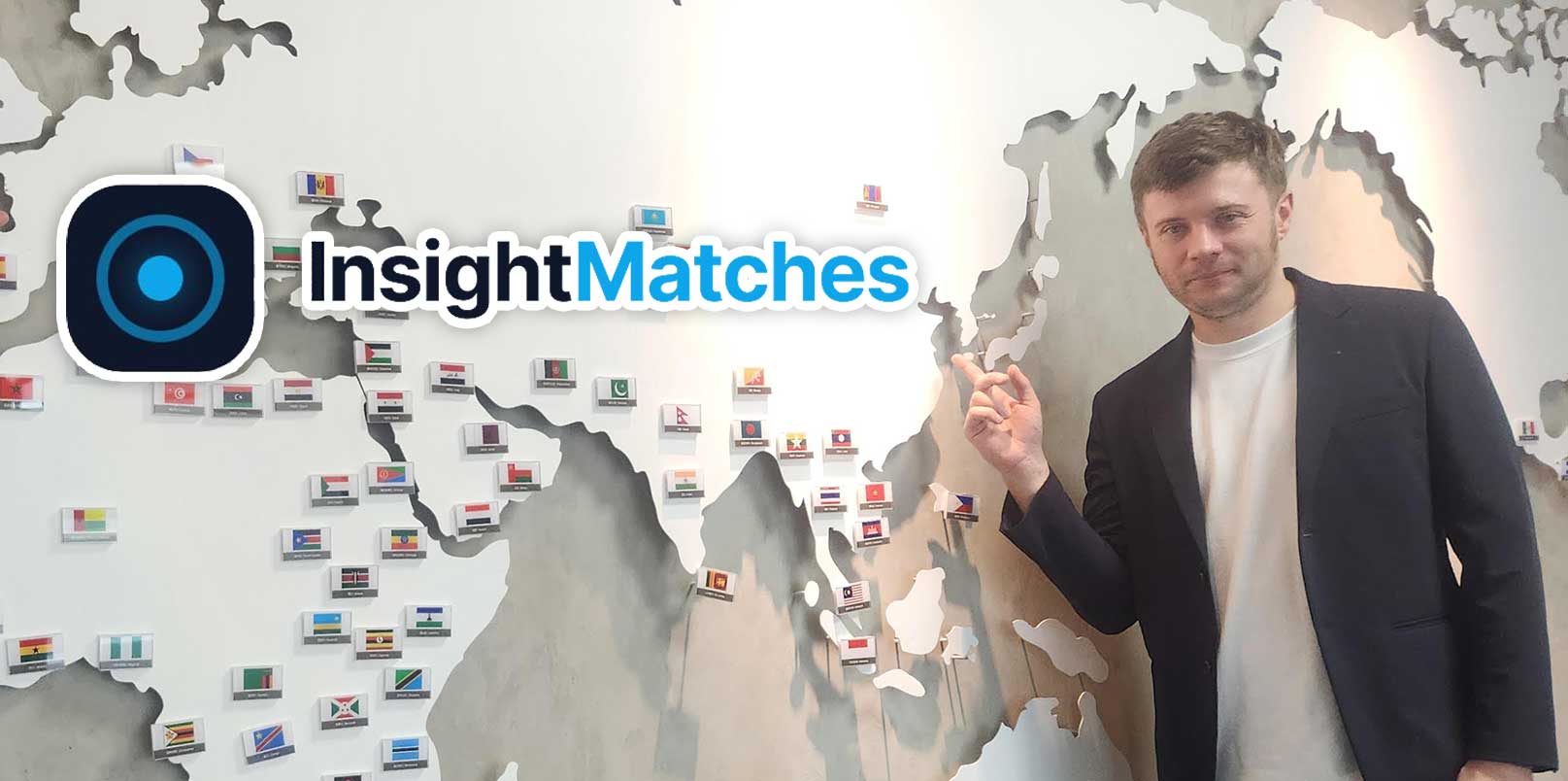
Every year, billions in global research grants remain untouched—not for lack of innovation, but because applying for them is a full-time job. For Paul T. Conversy, a veteran of more than 30 EU education and R&D proposals and now founder of InsightMatches, that problem was too big to ignore.
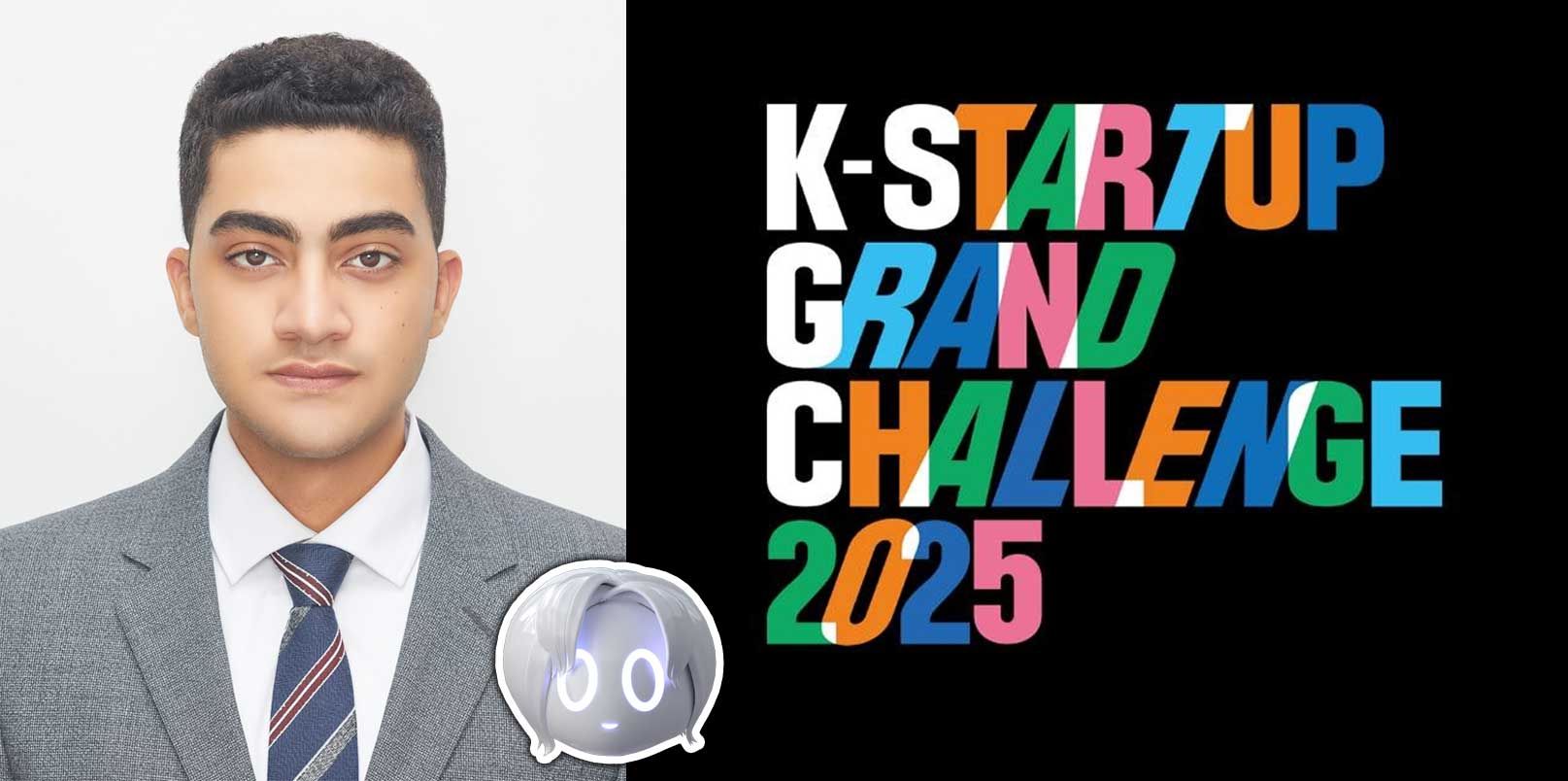
After years spent helping European consortia navigate Horizon Europe, he saw how South Korea’s recent entry into the program created both opportunity and overload. As the company advanced through the K-Startup Grand Challenge (KSGC) 2025 Phase 2, InsightMatches is rewriting how research teams across continents access funding—one algorithm at a time.
Here’s an exclusive interview with InsightMatches founder on the company growth and future outlook post KSGC 2025.
InsightMatches: Turning 480 Hours of Red Tape into One AI Workflow
Q1. What motivated you to start this company, and what core problem were you trying to solve?
InsightMatches began with a single insight: deep-tech teams aren’t limited by ideas, they’re limited by the overwhelming complexity of multinational grant funding. This became even more apparent when South Korea joined Horizon Europe, the EU’s flagship research and innovation program.
Suddenly, a Korean team had to sort through more than 500 funding calls, assemble a dozen international partners, and dedicate nearly 480 hours of manual work to a single proposal. We watched promising breakthroughs—from AI-based cancer diagnostics to advanced materials—stall because the process was too time-consuming to manage.
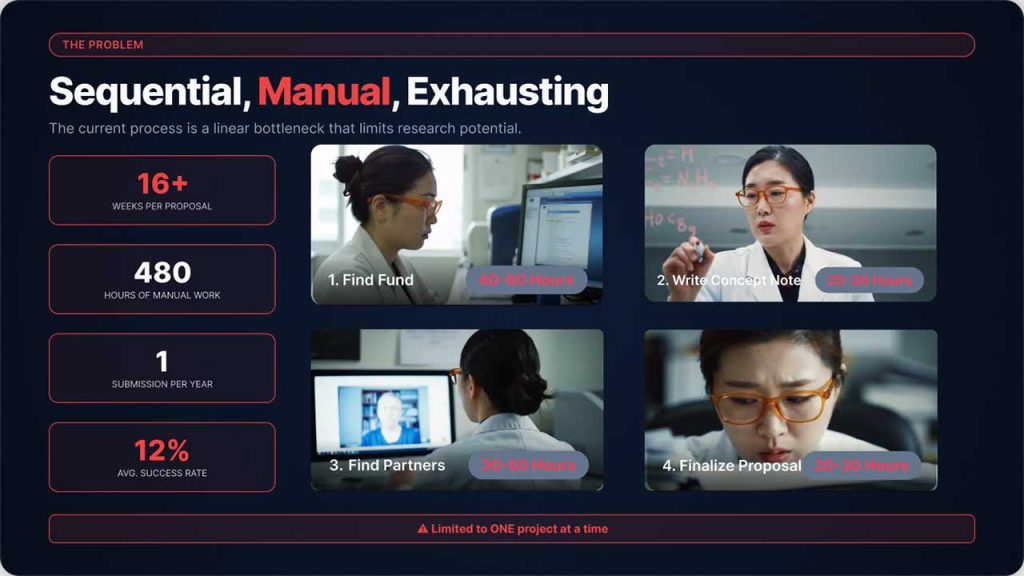
The real issue is that this 480-hour, step-by-step workflow creates a bottleneck that cuts innovators off from billions in available R&D funding. That’s what moved me to build InsightMatches.
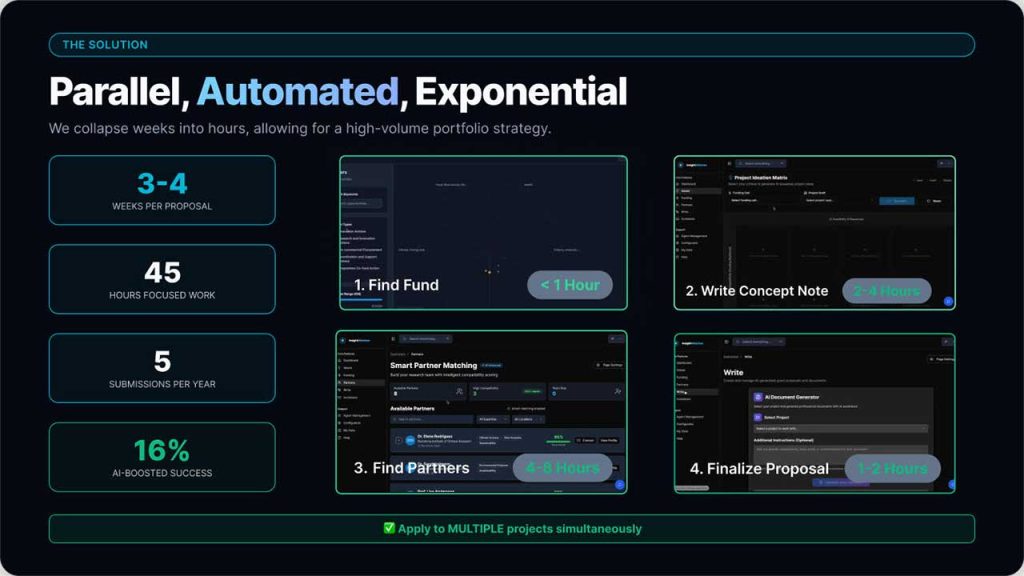
Our goal is to replace this outdated process with an AI-driven engine that handles partner discovery, grant matching, and proposal drafting. By automating the heavy administrative work, research teams can focus on the science, submit more proposals, and build a high-frequency pipeline instead of relying on one or two attempts each year.
Korea’s Entry into Horizon Europe: A Doorway and a Dilemma
Q2. What opportunity or unmet need did you identify in the Korean market, and what early signals convinced you that your solution could gain real traction here?
When South Korea officially joined Horizon Europe, we saw a major gap open almost overnight. Korean researchers suddenly had access to roughly ₩456 billion in annual grants, yet there was no end-to-end support system that combined local knowledge with AI-driven tools for navigating EU funding. Teams had the opportunity, but not the infrastructure to capture it.
And we received a fast response from the market. Within a few weeks, we secured 13 MOUs, including with major networks such as WARESA, giving us reach to more than 5,000 potential users. We also signed four paid pilot contracts that generated about ₩73 million in early revenue and grant support.
Still, what stood out most was that organizations already involved in EU research pre-paid to test our platform. That told us the demand was real and that researchers saw clear value in having automated, friction-free access to EU funding pathways.
From Direct Sales to Building an Ecosystem Moat
Q3. During KSGC, were there any mentors, partners, or specific insights that significantly influenced your product or strategy?
A turning point during KSGC came when a mentor encouraged us to move beyond a direct-sales approach and focus on building an ecosystem moat, a strategy centered on network strength and recurring revenue. This guidance pushed us to reshape our go-to-market plan around strategic partnerships, beginning with WARESA (World African Researchers, Engineers, Entrepreneurs and Scientists Alliance).
Through this collaboration, we piloted our SaaS platform, co-authored EU consortium grant proposals, and carried out joint marketing activities, which allowed us to secure high-value projects while reducing the pressure of individual sales cycles.
And that’s just the beginning. Since then, we have signed additional agreements with other networks and continue to broaden our partner ecosystem.
Building Profitability Around AI-Driven Efficiency
Q4. After joining KSGC, what has been the most meaningful change for your company and what evidence supports this growth?
Since joining KSGC, our most significant progress has been establishing a cash-flow-positive foundation with a clear route to profitability and a solid technological moat. Several milestones reflect this advancement.
We are moving toward early financial stability, with a projected +₩4 million in Net Operating Profit in Year 1 during the validation phase and an 18-month runway supported by our pre-seed round, of which 35 percent (₩70 million) has already been committed. On the technology side, we have filed a domestic Korean patent for our AI-driven grant-discovery and partner-matching engine, following a ₩2.2 million investment.
Our business model has also gained validation, supported by a ₩1.7 billion grant pipeline that includes one funded project (₩22.5 million secured) and three Horizon Europe proposals representing more than ₩1.7 billion in potential revenue.
To anchor our presence locally, we completed Korean incorporation, secured the CEO’s D-8 Startup Visa, and hired our first full-time Korean team member to strengthen on-the-ground execution.
With these foundations in place, we are positioned to lead activity across the Korea–EU Innovation Corridor and expand throughout APAC by 2027, targeting ₩540 million in ARR during Phase 2 through product-led growth.
Expanding the Korea–EU Innovation Corridor Through InsightMatches
Q5. Looking ahead, what is the most important vision or long-term goal your company aims to achieve, and what steps are you taking to move toward it?
Our long-term vision is to establish market leadership within the Korea–EU Innovation Corridor and, by 2027, use this position to expand into the broader APAC region.
Singapore and Japan are already mirroring South Korea’s trajectory as they negotiate participation in Horizon Europe, creating a wider opportunity for regional growth. Our goal is to become the primary SaaS platform for deep-tech research collaboration, targeting ₩540 million in ARR during Phase 2 through product-led growth.
To initiate Phase 2, “Unleash Growth,” we are raising a ₩200 million pre-seed round allocated across three priority areas. Forty-five percent (₩90 million) will accelerate product development, including the completion of our “Auto-Compliance” AI module and the API integrations required to automate complex grant workflows. We also plan to hire a dedicated Business Development Manager to support the onboarding of leading Korean deep-tech startups and drive rapid SaaS adoption. Alongside these efforts, we will establish our European entity and secure full GDPR compliance to enable seamless collaboration across the EU.
By following this capital-efficient plan, we aim to reinforce our first-mover position and scale toward leadership in the multi-trillion-won global R&I software market.
As they joined K-Startup Grand Challenge 2025, InsightMatches shows how AI can democratize innovation funding—turning bureaucracy into bandwidth and unlocking a new era of transnational research collaboration between Korea, Europe, and beyond.
“Thanks to KSGC, we are able to establish a cash-flow-positive foundation with a clear route to profitability and a solid technological moat.”
About This Series
This article is part of the “K-Startup Grand Challenge 2025 Interview Series,” featuring 40 global startups from Phase 2 of Korea’s leading accelerator program. The series highlights how international founders are scaling innovation through Korea’s startup ecosystem.
Read more stories from the K-Startup Grand Challenge 2025 Interview Series on KoreaTechDesk.
– Stay Ahead in Korea’s Startup Scene –
Get real-time insights, funding updates, and policy shifts shaping Korea’s innovation ecosystem.
➡️ Follow KoreaTechDesk on LinkedIn, X (Twitter), Threads, Bluesky, Telegram, Facebook, and WhatsApp Channel.
🤝 Looking to connect with verified Korean companies building globally?
Explore curated company profiles and request direct introductions through beSUCCESS Connect.