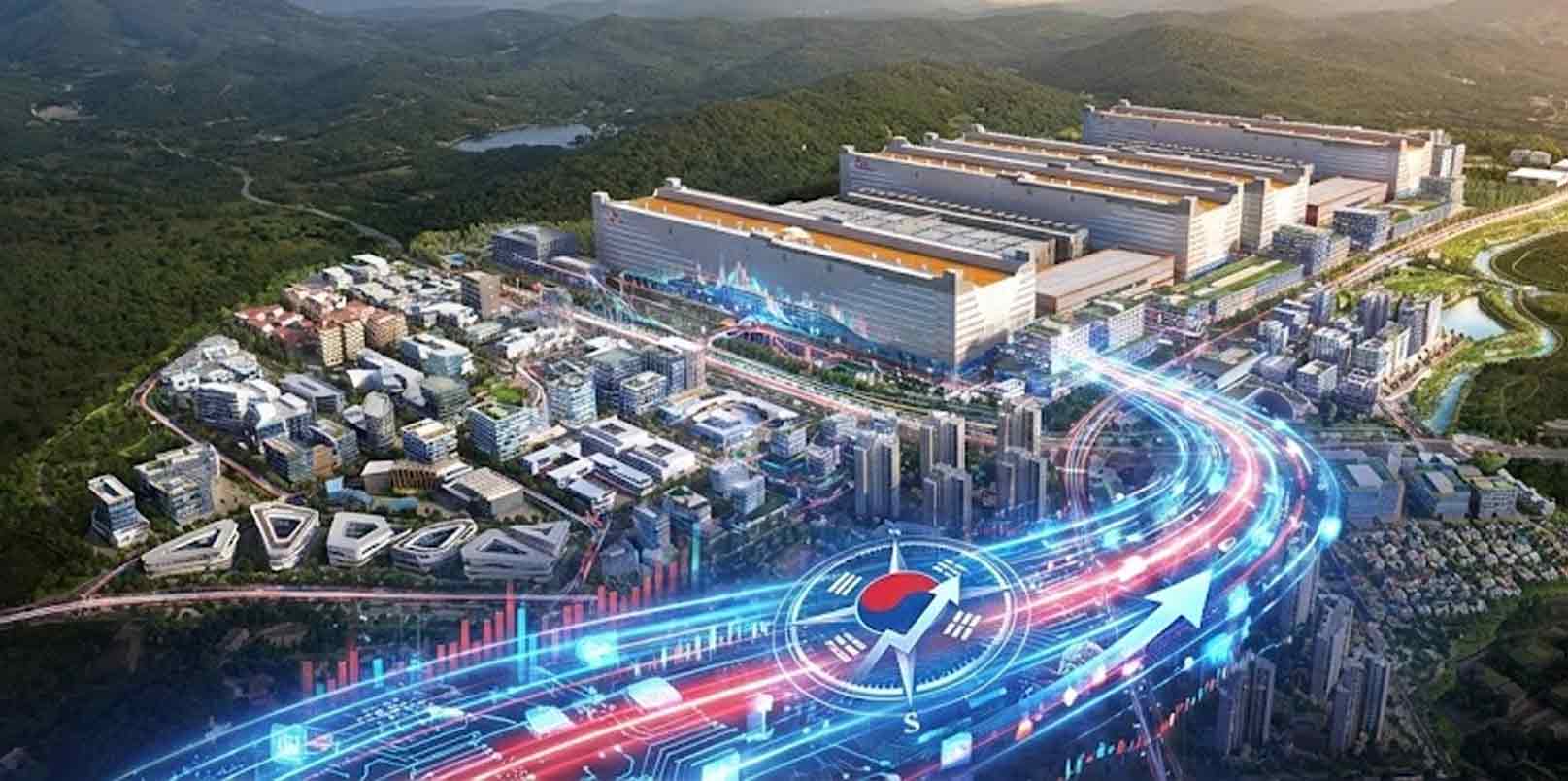
South Korea is reshaping its industrial funding model. After decades of venture-centric policy, Seoul is pivoting toward large-scale deep-tech and infrastructure investment. The government’s KRW 150 trillion (about USD 110 billion) National Growth Fund is now set to make its first move — targeting SK Hynix’s semiconductor cluster in Yongin, one of the largest private-sector industrial projects in Korean history.
Government’s First National Growth Fund Investment: SK Hynix’s Yongin Cluster
The Yongin Semiconductor Cluster, led by SK Hynix, has emerged as the government’s likely first investment destination under the newly launched National Growth Fund. The project aligns directly with Korea’s plan to strengthen its AI semiconductor and deep-tech manufacturing capacity, a cornerstone of its long-term industrial competitiveness.
According to industry sources cited by Seoul Economic Daily, the Financial Services Commission (FSC) and the Korea Development Bank (KDB) have finalized organizational groundwork for the fund, forming a National Growth Fund Strategic Committee and a dedicated secretariat staffed with private-sector investment professionals.
The government will announce four to five first-round projects as early as next week, with the Yongin cluster positioned as the flagship case. Officials have hinted that the fund’s debut will focus on symbolic national infrastructure projects rather than short-term corporate financing.
National Growth Fund: A New Model for Public-Private Industrial Investment
The KRW 150 trillion National Growth Fund represents Korea’s largest coordinated financial initiative since the Industrial Development Act. Designed to complement rather than replace venture investment, it introduces a three-track structure:
- KRW 50 trillion (~ USD 37 billion) for infrastructure financing,
- KRW 15 trillion (~ USD 11 billion) for direct equity investment, and
- KRW 35 trillion (~ USD 26 billion) for indirect VC and PEF participation.
The infrastructure component — where Yongin sits — will finance semiconductor and AI-related industrial facilities, power plants, water systems, and data centers. The fund will deploy capital using a project-financing (PF) model, combining senior policy loans, mid-tier private credit, and equity-linked tranches.
KDB and KB Kookmin Bank are expected to jointly provide KRW 3.3 trillion in senior loans, while mid-tier layers will be filled through private equity vehicles partly capitalized by the fund. The Strategic Industries Sub-Fund, supported by approximately ₩1 trillion in government capital, will assume higher-risk positions such as subordinated debt and equity stakes.
Balancing Stability and Market Leverage
Regulators emphasize that the National Growth Fund aims to balance policy stability with market profitability.
An FSC official stated:
“Multiple investment proposals are under review. The fund’s design combines structured finance and fiscal participation to maintain risk diversification and ensure stable, market-aligned returns.”
Industry associations welcome the decision to begin with infrastructure, viewing it as a credible start following mixed outcomes from earlier government-directed funds. Executives believe participation in SK Hynix’s project could reassure private investors that the fund’s framework will operate transparently and efficiently.
However, some institutional investors note that the target yield of 5–6% for mid-tier instruments may not attract all private credit players. Others counter that state backing reduces downside exposure, making the projects safer than traditional PF models.
Moving Beyond Venture Capital with National Growth Fund
By anchoring its inaugural investment in deep-tech manufacturing infrastructure, Korea signals a fundamental policy shift. The National Growth Fund extends industrial policy beyond startups, recognizing that AI, semiconductors, and energy systems require capital-intensive, long-horizon financing that typical VC structures cannot provide.
The initiative also responds to global competition. As the U.S., Japan, and Taiwan expand semiconductor-sovereignty programs, Korea’s model blends fiscal policy, industrial strategy, and market participation. For the domestic ecosystem, it may trigger a “post-venture era” where high-risk innovation coexists with long-term industrial capital.
Preventing Fund Overlap and Policy Fragmentation
Lawmakers and analysts caution that the National Growth Fund’s scope overlaps with existing ministry-led vehicles, such as:
- The MSS Super-Gap Technology Fund (KRW 10 trillion),
- The MSIT AI Fund (KRW 6 trillion),
- The Ministry of Health’s Bio-Vaccine Fund (KRW 2.7 trillion), and
- The Aerospace and Defense Funds (KRW 1.5 trillion).
A government official confirmed that cross-ministerial coordination will be reinforced through the new National Growth Fund Committee, ensuring clarity in investment mandates and avoiding redundant capital deployment.
Korea’s Fiscal Turn Toward Industrial Maturity
The National Growth Fund marks a pivotal evolution in Korea’s innovation finance. If executed effectively, it will integrate industrial-scale capital with deep-tech entrepreneurship, providing a bridge between startup innovation and national industrial policy.
For global investors, the fund’s first deployment in Yongin will be an indicator of how Korea’s next growth phase unfolds — whether it can sustain market discipline within a state-backed structure, and translate its venture success into a durable foundation for the AI-driven industrial economy.
– Stay Ahead in Korea’s Startup Scene –
Get real-time insights, funding updates, and policy shifts shaping Korea’s innovation ecosystem.
➡️ Follow KoreaTechDesk on LinkedIn, X (Twitter), Threads, Bluesky, Telegram, Facebook, and WhatsApp Channel.