For years, Korea’s e-commerce playbook looked simple: plug into Coupang’s logistics machine and scale. The model worked until trust faltered. After the 2025 Coupang data breach, subtle but measurable shifts in user traffic, delivery strategies, and membership competition began to surface. The episode is now less about one company’s crisis and more about how concentrated platform dependence can quietly amplify systemic risk.
Delivery Wars Intensify as Coupang’s Dominance Faces Strain
Following the 2025 personal data leak at Coupang, competitors moved quickly to reinforce their logistics propositions.
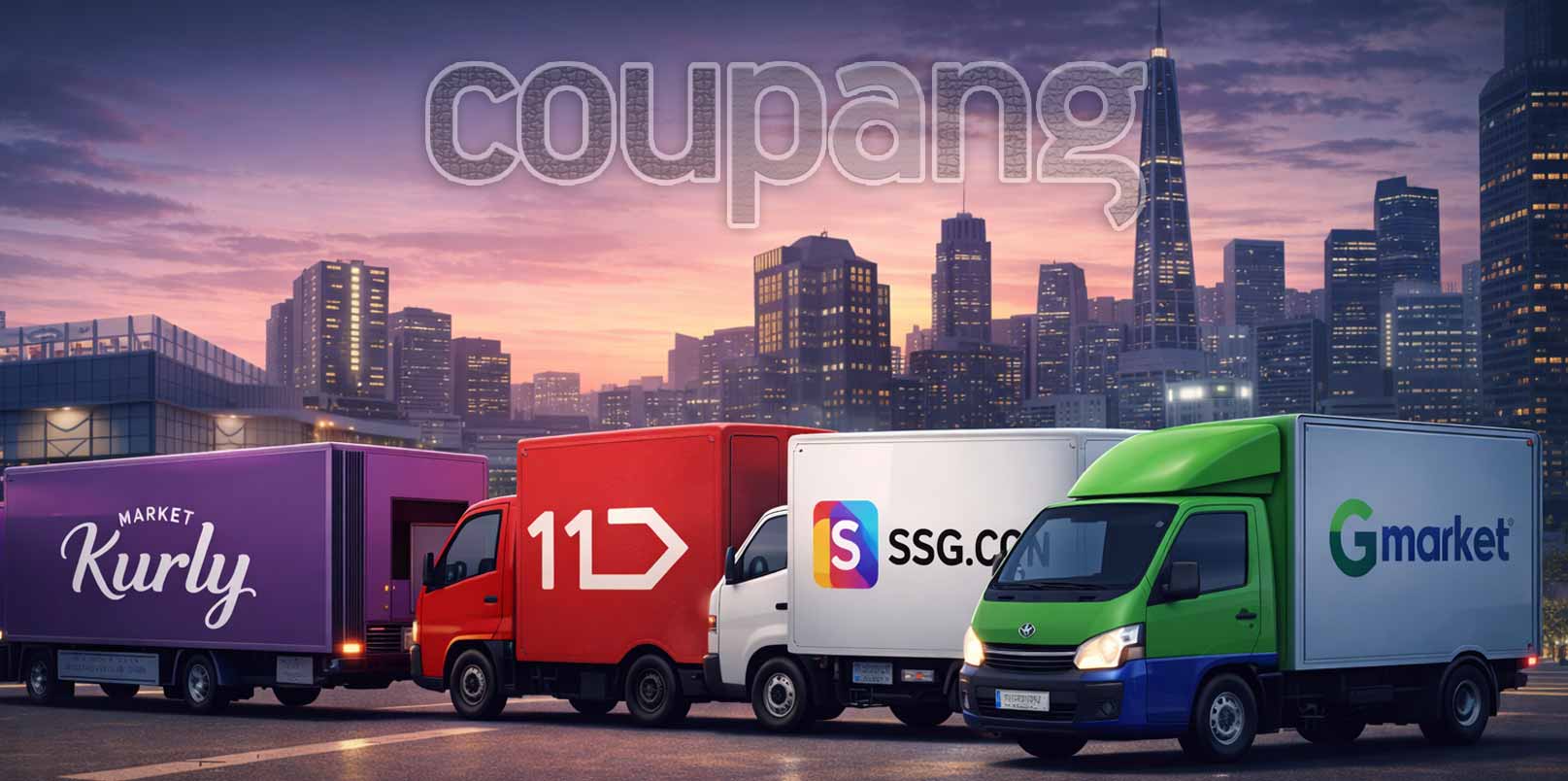
According to industry coverage, retail tech company Kurly launched a new “midnight Star Delivery” service, allowing products to arrive before midnight in addition to its established dawn delivery. The company increased daytime utilization of its logistics centers to support the expansion.
11st introduced free returns and exchanges, along with late-delivery compensation, for its fast-shipping “Shooting Delivery” products. The new benefits were initially applied to members of its free 11st Plus membership program during February, with plans for a broader rollout.
SSG.com expanded its “Baro Quick” one-hour delivery service, extending coverage and increasing logistics hubs from 60 to 70 locations, including Jeju. The company plans to scale to 90 hubs within the first half of the year. Product selection for the service has doubled since launch, now reaching roughly 12,000 SKUs.
Offline retailers are also adjusting. Seven-Eleven expanded its “Kind Delivery” service to previously underserved island regions and reduced average delivery time by leveraging Lotte Global Logistics infrastructure. CU reported that over 95 percent of its low-cost parcel deliveries now arrive next day after transferring operations to Lotte Global Logistics, with usage rising more than 42 percent year-on-year in January.
These moves indicate that logistics reliability and service scope, not only speed, are becoming central competitive variables.
User Shifts Emerge in Korea’s E-Commerce Market
With the rising movement of “Coupang Quit Rush”, data compiled by WiseApp and Retail in January 2026 showed measurable changes in monthly active users (MAU).
Gmarket recorded a 25.4 percent year-on-year increase in MAU, the highest growth rate among major platforms. SSG.com grew 17.9 percent. 11st rose 4.1 percent. Coupang’s MAU growth was limited to 0.8 percent over the same period.
New app installations also diverged. SSG.com saw a 74 percent increase, while Gmarket rose 14.7 percent. AliExpress and Temu posted declines, alongside Lotte On.
Industry observers have not concluded that market leadership has changed. However, the previously stable user structure centered on Coupang now shows signs of diversification.
Meanwhile, quick commerce is expanding through delivery apps. Woowa Brothers, operator of Baemin, reported record monthly performance in December for its “Jang보기·Shopping” category. Orders increased 15.4 percent month-on-month, new customers rose 30 percent, and visits reached approximately 5.63 million, up 30 percent year-on-year. Same-day grocery positioning is evolving into broader daily essentials coverage.
Industry Voices Signal a Structural Shift
One retail industry official stated,
“Delivery is no longer a marketing tool but a prerequisite for doing business. Speed has become the baseline. What will matter next is how consistently companies can deliver across wider coverage areas with operational stability.”
The comment reflects a recalibration underway across the sector.
Rather than competing solely on acceleration, platforms are reinforcing redundancy, regional coverage, and membership economics.
What This Means for Startup Platform Dependency Risk in Korea
The data does not confirm a collapse of Coupang’s market position. It does reveal how quickly platform concentration risk can surface when trust weakens.
Many Korean consumer brands and startup sellers structured distribution around a single dominant marketplace because it provided logistics, traffic, and conversion efficiency in one channel. The breach highlighted a structural vulnerability: operational scale does not equal ecosystem resilience.
For startups, this is not a regulatory lesson but a channel strategy lesson.
Diversifying across marketplaces, quick commerce platforms, and membership-driven ecosystems are becoming less about optional growth and more about risk hedging. The recent user movement toward Gmarket, SSG.com, and delivery app commerce suggests that traffic fluidity can reappear faster than expected when trust shifts.
Globally, this aligns with broader platform risk dynamics seen in the United States and China, where dependence on a single super-platform has repeatedly exposed sellers to policy, algorithmic, or reputational shocks.
Korea’s case adds another variable: logistics vertical integration can magnify both upside and systemic exposure.
Future Outlook: Diversification Becomes a Strategic Discipline
The current user redistribution may stabilize. Coupang remains deeply integrated into Korea’s consumer logistics network.
However, the post-breach environment has altered strategic assumptions.
Founders can no longer treat platform dominance as a permanent condition. Investors evaluating consumer startups may increasingly scrutinize channel concentration ratios. Cross-platform data strategy, independent brand equity, and alternative traffic acquisition models will likely gain weight in funding discussions.
Korea’s e-commerce market shift in 2026 is not yet a regime change. It is a reminder that resilience is built before disruption, not after.
Key Takeaway on Post-Coupang E-Commerce Market Shift Korea 2026
- The 2025 Coupang data breach triggered measurable shifts in user traffic and competitive delivery strategies.
- Gmarket and SSG.com recorded significant monthly active users (MAU) growth in January 2026, while Coupang’s growth slowed.
- Delivery competition now emphasizes coverage expansion and operational stability, not just speed.
- Quick commerce platforms such as Baemin are expanding into broader grocery and daily essentials segments.
- For startups, single-channel sales dependence has become a structural risk factor in Korea’s platform ecosystem.
- Platform diversification is emerging as a strategic requirement, not merely a growth tactic.
– Stay Ahead in Korea’s Startup Scene –
Get real-time insights, funding updates, and policy shifts shaping Korea’s innovation ecosystem.
➡️ Follow KoreaTechDesk on LinkedIn, X (Twitter), Threads, Bluesky, Telegram, Facebook, and WhatsApp Channel.
🤝 Looking to connect with verified Korean companies building globally?
Explore curated company profiles and request direct introductions through beSUCCESS Connect.