
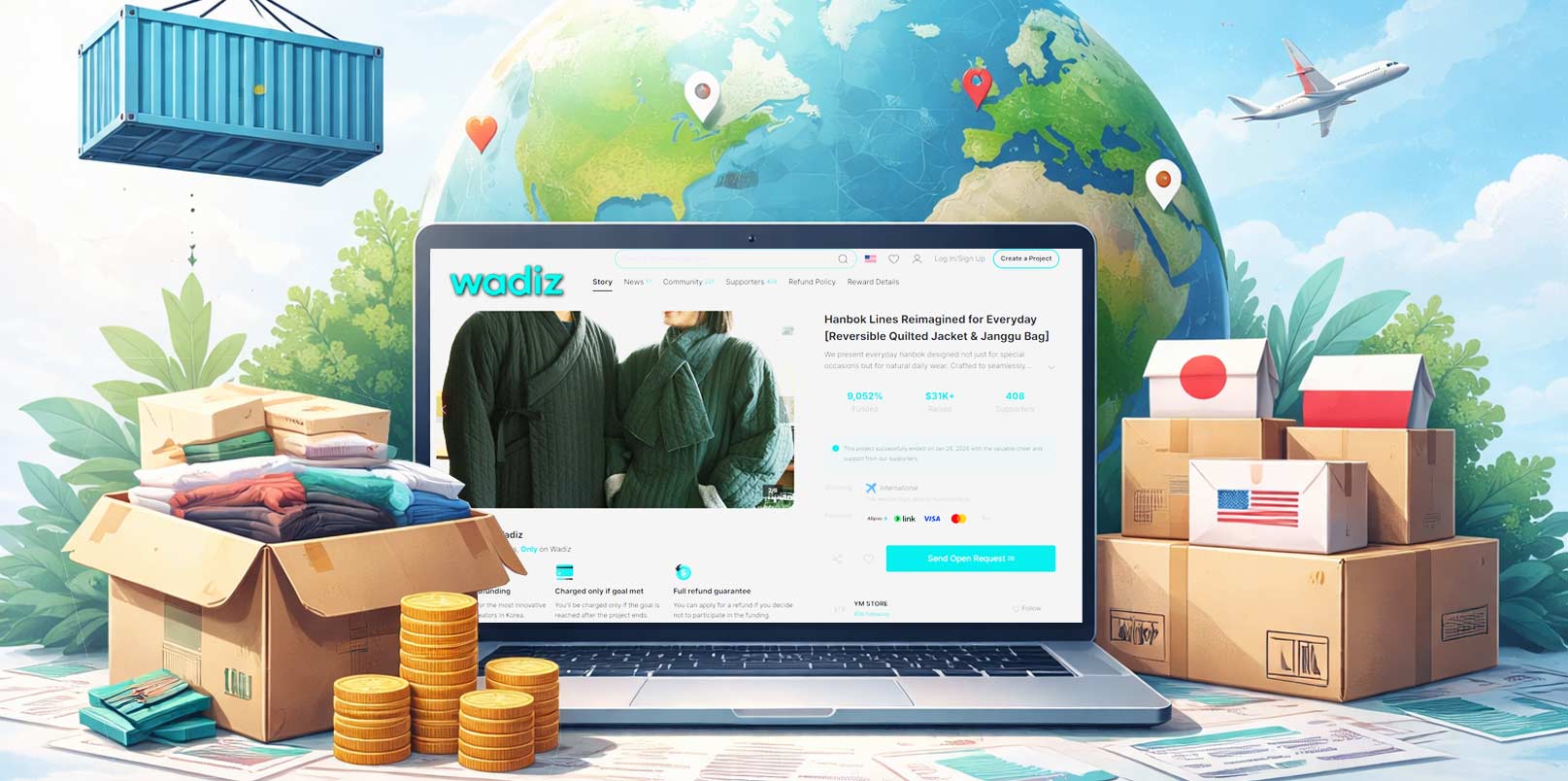
Korean consumer exports are rising again, but the more revealing shift is happening before products ever reach customs. Instead of shipping bulk inventory overseas and hoping for traction, some Korean fashion startups are now testing global appetite through crowdfunding first. It is a quieter move than trade deals or export subsidies, yet it may say more about how early-stage brands are recalibrating risk in 2026.
Consumer Goods Exports Double as Wadiz Expands Global Crowdfunding
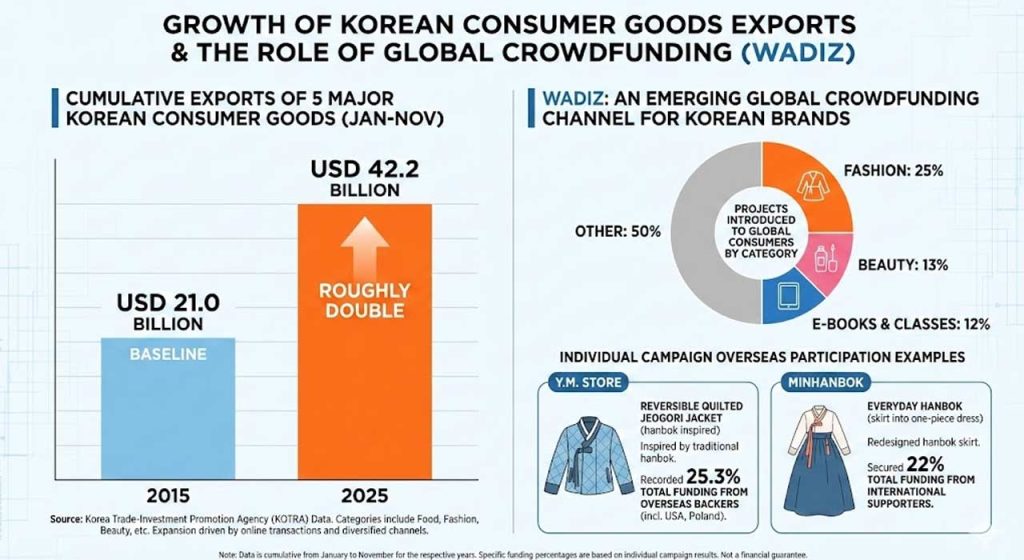
According to data released by the Korea Trade-Investment Promotion Agency (KOTRA), cumulative exports of five major consumer goods categories — including food, fashion, and beauty — reached USD 42.2 billion from January to November 2025. That figure is roughly double the USD 21.0 billion recorded in 2015.
As online transactions have expanded, export channels have also diversified. Within this environment, the Wadiz global crowdfunding platform has emerged as an alternative route for Korean brands entering international markets.
On Wadiz, fashion accounted for 25 percent of projects introduced to global consumers, the largest share among categories. Beauty followed at 13 percent, while e-books and classes accounted for 12 percent.
Individual campaigns reflect measurable overseas participation. Y.M. Store’s “Reversible Quilted Jeogori Jacket,” inspired by traditional hanbok design, recorded 25.3 percent of total funding from overseas backers, including those in the United States and Poland. Minhanbok’s “Everyday Hanbok,” which redesigns a hanbok skirt into a one-piece dress, secured 22 percent of its funding from international supporters.
Since officially launching its global service in May 2025, Wadiz reports steady growth. As of January 2026, monthly active users more than doubled compared to the same period a year earlier. Approximately 40 percent of visitors now come from more than 180 countries, including the United States, Japan, and China.
Crowdfunding: Emerging Capital-Light Export Strategy for Korean Fashion Startups
The significance lies less in fashion aesthetics and more in execution mechanics.
Traditional overseas expansion in consumer goods often requires upfront production, distributor agreements, and inventory allocation before real demand is proven. For early-stage Korean fashion startups, that model ties up capital and exposes founders to unsold stock risk.
Crowdfunding for overseas market testing changes that sequence. Campaigns allow brands to validate interest, collect pre-orders, and gather feedback before scaling production. Inventory risk reduction for startups becomes not just a financial benefit but a strategic filter.
If overseas backers respond, founders gain signal. If not, losses remain limited.
In an environment where capital discipline has become more important than growth-at-any-cost narratives, this shift matters. It suggests that K-fashion global expansion is no longer dependent solely on distributor networks or department store entry, but on demand validation first.
Global Visibility Does Not Equal Global Distribution
Yet traction on a crowdfunding page should not be confused with durable export infrastructure.
Overseas participation in a campaign reflects interest, often driven by cultural appeal or fandom. It does not automatically resolve logistics, returns management, regulatory compliance, or sustained retail presence.
The forty percent of platform traffic coming from 180 countries signals only the reach. It does not guarantee repeat purchasing behavior. A successful campaign can validate product appeal, but scaling into stable international revenue requires operational capacity that crowdfunding alone does not provide.
For Korean fashion startups, this is the tension. Crowdfunding lowers the cost of testing global demand. It does not remove the complexity of serving that demands long term.
What Crowdfunding Enables — and What It Still Leaves to Founders
What this model clearly enables is disciplined experimentation.
Brands can launch high-end outerwear or functional product lines to international backers without committing to full production runs. They can observe where interest concentrates geographically. They can adjust sizing, materials, or positioning before wider export.
What it does not replace is the need for structured export strategy. Cross-border shipping, local marketing partnerships, customer service infrastructure, and regulatory adaptation remain outside the platform’s core function.
Wadiz’s growth suggests appetite for Korean brands entering international markets through alternative channels. It does not substitute for export execution.
Strategic Implications for Global Founders, Investors, and Cross-Border Partners
Hence, for global founders observing Korea, the takeaway is not that crowdfunding is new. It is that Korean consumer brands are using it systematically as an early export filter.
Meanwhile for international investors, campaign data may increasingly function as a demand signal. Overseas funding percentages of 20 percent or more indicate cross-border resonance before formal market entry. That data, while imperfect, reduces uncertainty at the pre-Series A stage.
As for cross-border partners, including distributors and logistics providers, the rise of capital-light export strategy suggests a pipeline of brands that have already tested global appetite. Engagement may shift from speculative scouting to data-informed partnership.
Korea consumer goods exports in 2025 show scale at the macro level. Crowdfunding shows how some companies and startups are potentially trying to reach that scale without absorbing early-stage fragility.
Korea’s Export Model Is Quietly Becoming More Iterative
For years, Korea’s consumer export success has been tied to large manufacturers, distribution alliances, and cultural wave effects. Today, the emerging layer is smaller, more iterative, and more cautious.
If Korean fashion startups continue to treat crowdfunding as structured overseas validation rather than as publicity, the model could evolve into a predictable pre-export stage. If treated as a shortcut to global presence, it risks misreading attention as stability.
The distinction will shape whether this becomes a sustainable pathway or a passing tactic.
Key Takeaway on K-Fashion Crowdfunding
- Korea consumer goods exports reached USD 42.2 billion in Jan–Nov 2025, doubling over a decade, according to KOTRA.
- Fashion represents 25 percent of globally introduced projects on the Wadiz global crowdfunding platform.
- Individual campaigns show 22–25 percent overseas funding participation.
- Crowdfunding is being used as a capital-light export strategy to test global demand and reduce inventory risk.
- Campaign success validates interest but does not replace long-term international distribution and operational infrastructure.
– Stay Ahead in Korea’s Startup Scene –
Get real-time insights, funding updates, and policy shifts shaping Korea’s innovation ecosystem.
➡️ Follow KoreaTechDesk on LinkedIn, X (Twitter), Threads, Bluesky, Telegram, Facebook, and WhatsApp Channel.
🤝 Looking to connect with verified Korean companies building globally?
Explore curated company profiles and request direct introductions through beSUCCESS Connect.